


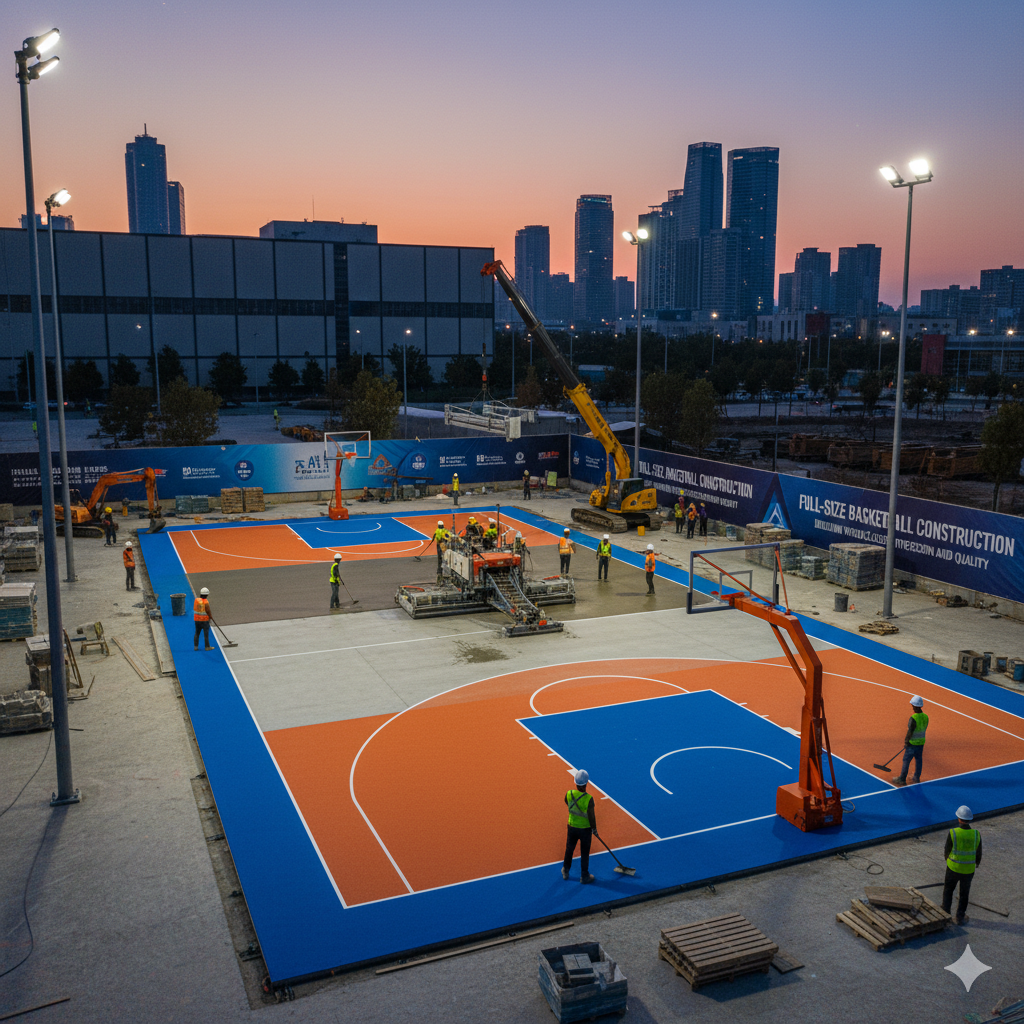
A full-size basketball court represents the highest standard of sports infrastructure, designed to meet professional and international play requirements. Whether for schools, clubs, universities, stadiums, or sports complexes, constructing a full-size basketball court demands accuracy, quality materials, and expert craftsmanship. Every element—from the flooring and substructure to the lighting and finishing—must align with global standards to ensure player safety, consistent performance, and lasting durability.
This guide provides a detailed look into full-size basketball court construction, highlighting the design principles, material choices, and best practices that define a professional-grade playing environment.
Understanding Full-Size Basketball Court Standards
A full-size basketball court is built according to the official dimensions prescribed by the International Basketball Federation (FIBA) or the National Basketball Association (NBA), depending on the project’s purpose.
-
FIBA Standard Court: 28 meters (length) × 15 meters (width)
-
NBA Standard Court: 28.65 meters (length) × 15.24 meters (width)
The court layout includes precise markings for:
-
Center circle and free throw lanes
-
Three-point arc and restricted area
-
Sidelines, baselines, and team benches
Maintaining these dimensions and markings is essential to ensure a professional gameplay experience and compliance with tournament-level requirements.
Key Phases in Full-Size Basketball Court Construction
1. Site Assessment and Planning
Every successful project begins with detailed site evaluation and planning. Engineers and designers assess the location to determine:
-
Soil strength and leveling requirements
-
Drainage and water runoff systems (especially for outdoor courts)
-
Space allocation for spectator seating, fencing, and access routes
-
Environmental conditions such as sunlight exposure and wind direction
Proper planning ensures the foundation is solid, the court orientation minimizes glare, and the layout accommodates safe movement around the playing area.
2. Design and Layout Planning
The design phase involves creating an accurate layout that meets performance, safety, and aesthetic goals. This includes:
-
Defining the court boundaries, markings, and buffer zones
-
Incorporating subfloor systems or base layers for shock absorption
-
Planning for lighting, ventilation (for indoor courts), and player facilities
At this stage, designers may also include branding or customization—such as color schemes, team logos, or specific line markings—to give the court a professional identity.
3. Base and Subfloor Construction
The subfloor or base structure plays a crucial role in durability and performance. Depending on whether the court is indoor or outdoor, the substructure varies:
-
For Indoor Courts:
-
A moisture barrier and shock-absorbing underlayment are installed to reduce impact on players’ joints.
-
High-quality plywood or engineered wood panels form the base for the top hardwood layer.
-
The structure must be perfectly leveled for consistent ball bounce.
-
-
For Outdoor Courts:
-
A solid foundation of compacted soil, aggregate, and reinforced concrete is prepared.
-
Drainage channels and slope grading (usually 1%) are added to prevent water accumulation.
-
A weather-resistant coating or synthetic layer ensures durability in variable climates.
-
The foundation determines the court’s longevity and overall performance, making this stage one of the most important in construction.
4. Surface Installation and Finishing
The surface material defines how the court performs, feels, and looks.
Common Flooring Options for Full-Size Courts:
-
Hardwood Flooring (Maple Wood): The preferred choice for professional indoor arenas. Offers excellent traction, smooth ball bounce, and a premium finish.
-
Synthetic Surfaces (PU or PVC): Ideal for multi-use indoor spaces. These surfaces are cost-effective, shock-absorbent, and low-maintenance.
-
Concrete or Asphalt with Acrylic Coating: Popular for outdoor courts. The acrylic top layer enhances grip, color vibrancy, and weather protection.
After installation, the surface is sanded, polished, and sealed with a protective finish. Line markings are applied using high-quality, non-fading paint to ensure clarity and durability.
5. Lighting, Ventilation, and Surroundings
A full-size basketball court must have proper illumination and air circulation to support optimal play conditions.
-
Lighting:
-
For indoor courts, LED lighting systems providing 500–1500 lux are installed for uniform brightness and minimal glare.
-
Outdoor courts are equipped with floodlights positioned to avoid shadows on the playing area.
-
-
Ventilation:
-
Indoor arenas require proper HVAC systems or natural ventilation to maintain air quality and control humidity.
-
Adequate airflow prevents surface expansion, slipperiness, and structural damage.
-
Additional features like spectator seating, fencing, and entry zones are integrated to enhance safety and comfort.
6. Basketball Equipment Installation
A full-size court includes professional-grade accessories that meet performance and safety standards:
-
Adjustable or Fixed Basketball Systems: Made with steel frames, tempered glass backboards, and breakaway rims.
-
Court Padding: Installed along baselines and poles to prevent injury during collisions.
-
Benches and Scoreboards: For players, officials, and spectators.
-
Storage and Utility Zones: For keeping balls, nets, and maintenance equipment organized.
Each component is installed with precision to ensure professional quality and ease of use.
7. Court Markings and Customization
Professional markings are essential for gameplay accuracy. Standard lines include:
-
Center circle (radius 1.8 m)
-
Free throw lane (4.9 m from baseline)
-
Three-point arc (6.75 m radius for FIBA)
Customization allows for brand integration, sponsor logos, and color-coded zones to make the court visually distinctive. High-quality polyurethane or epoxy paints ensure lasting color and clarity.
8. Maintenance and Durability
A full-size basketball court, when built with superior materials and workmanship, can last decades with proper care.
Maintenance Practices Include:
-
Regular cleaning to prevent dust and surface damage
-
Resealing hardwood or recoating acrylic surfaces every few years
-
Checking for cracks, loose panels, or faded lines
-
Maintaining lighting, nets, and accessories
Scheduled maintenance preserves both the functionality and the visual appeal of the court.
Benefits of Building a Full-Size Basketball Court
-
Professional Play Experience: Meets official standards for training and tournaments.
-
Enhanced Safety: With shock-absorbing systems, cushioned floors, and proper lighting.
-
Long-Term Value: Quality construction ensures durability and reduces long-term repair costs.
-
Aesthetic Appeal: A well-designed court becomes a signature sports attraction.
-
Community Engagement: Encourages sports development and healthy recreation.
A full-size basketball court is a long-term investment that supports both athletic growth and facility prestige.
Choosing the Right Construction Partner
Building a full-size basketball court requires technical expertise, sports engineering knowledge, and quality assurance. Partnering with an experienced construction company ensures:
-
Compliance with FIBA or NBA specifications
-
Use of premium materials and coatings
-
On-time project completion with precision workmanship
-
Post-installation maintenance support and warranty options
From initial design to final polish, expert builders deliver a facility that performs flawlessly, looks impressive, and lasts for years.
Conclusion
Full-size basketball court construction is a blend of engineering precision, sports science, and aesthetic design. Every element—from foundation to finishing—must align with professional standards to create a world-class playing environment.
Whether you’re developing a training academy, sports complex, school facility, or private court, investing in quality construction, premium materials, and expert design guarantees a superior playing experience, durability, and long-term value