

Introduction
Basketball is rapidly gaining popularity across India, creating an increasing demand for professionally designed basketball courts in schools, colleges, sports academies, residential communities, clubs, and commercial sports facilities. As more institutions and organizations invest in sports infrastructure, the need for reliable basketball court builders who understand construction standards, flooring systems, and long-term performance has become increasingly important.
Building a basketball court involves much more than installing basketball hoops and painting court lines. Every successful project requires careful planning, proper site preparation, a stable foundation, suitable sports flooring, effective drainage, accurate dimensions, and professionally installed equipment. Each component contributes to the court’s durability, safety, appearance, and overall playing experience.
Ridham Sports, a professional basketball court builder in India, offers customized sports court construction solutions designed around project requirements, available space, intended usage, flooring preferences, and budget considerations. From initial site assessment and civil construction to sports flooring installation and final finishing, a systematic approach helps create basketball facilities suited to recreational play, regular training, and competitive use.
Whether you are planning a basketball court for an educational institution, a residential development, a sports academy, or a commercial facility, choosing the right construction partner is an important step toward developing a durable and functional sports environment.
Why Choose a Professional Basketball Court Builder in India?
A basketball court must support continuous running, jumping, landing, rapid direction changes, and lateral movement. Its construction quality directly affects how players interact with the surface and how well the facility performs over time.
Working with a professional basketball court builder helps coordinate the technical and practical requirements of the project from the beginning.
1. Proper Site Assessment and Planning
Before construction starts, the site must be evaluated for available space, ground conditions, surface levels, accessibility, and drainage requirements. Proper assessment helps identify potential construction challenges before they lead to delays or additional expenses.
2. Suitable Basketball Court Flooring
Different facilities require different flooring systems. Outdoor courts may benefit from appropriately specified acrylic sports surfaces, while indoor facilities can use wooden, polyurethane (PU), PVC, or other specialized sports flooring systems.
A knowledgeable construction team can help select a surface according to the intended application, performance requirements, environmental conditions, and maintenance expectations.
3. Improved Player Safety
Basketball involves frequent acceleration, jumping, sudden stops, and repeated landings. A properly designed playing surface should provide appropriate traction, consistent support, and suitable impact-management characteristics for its intended use.
Correct equipment installation, adequate surrounding clearance, proper lighting, and a well-maintained surface also contribute to a safer playing environment.
4. Long-Term Durability
A basketball court is a long-term investment. Proper foundation preparation, suitable construction materials, effective drainage, and correct flooring installation can help reduce premature deterioration and avoidable repairs.
5. Professional Finishing
Accurate court markings, uniform surface colours, correctly aligned hoops, and clean finishing improve the functionality and appearance of the facility.
About Ridham Sports
Ridham Sports provides sports infrastructure solutions for projects involving basketball courts and other sporting facilities across India.
The company’s project requirements may include basketball court construction, sports flooring, volleyball courts, tennis courts, and multipurpose sports facilities for schools, colleges, academies, residential developments, clubs, and commercial properties.
Each project requires a construction approach suited to its intended use, site conditions, available space, and technical specifications. By coordinating planning, base preparation, flooring selection, installation, and finishing, a structured construction process can help clients develop functional sports facilities that meet their operational requirements.
For a new basketball court or an existing facility requiring renovation, the appropriate construction solution should be determined after reviewing the site and project specifications.
Types of Basketball Courts Built in India
Basketball courts can be constructed in several configurations depending on the available location, intended level of play, environmental exposure, and budget.
Indoor Basketball Court Construction
Indoor basketball courts are commonly developed in schools, colleges, sports academies, professional training centres, clubs, and indoor stadiums.
Because these courts are protected from direct rainfall and intense sunlight, they offer greater control over playing conditions. However, indoor construction requires careful attention to building design, ventilation, lighting, ceiling clearance, and moisture management.
Important considerations include:
- Appropriate indoor sports flooring
- Adequate and uniform lighting
- Suitable ceiling height and ball clearance
- Effective ventilation
- Moisture control
- Player safety zones
- Wall protection and equipment padding
- Spectator seating, where required
Wooden sports flooring is often considered for premium indoor basketball facilities. PU, PVC, and other specialized synthetic systems may also be appropriate, depending on the performance requirements and intended use of the court.
Outdoor Basketball Court Construction
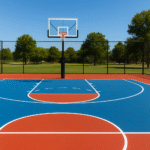
Outdoor basketball courts are suitable for school playgrounds, residential communities, public recreational areas, sports clubs, and open-air training facilities.
Unlike indoor courts, outdoor installations must withstand rain, sunlight, dust, humidity, and temperature variations. The construction system must therefore account for environmental exposure from the foundation stage through final surface finishing.
Important requirements include:
- A stable and properly prepared base
- Effective surface drainage
- Weather-appropriate flooring materials
- UV-resistant surface systems where required
- Suitable traction and surface texture
- Durable and clearly visible court markings
- Secure basketball equipment
- Appropriate perimeter fencing and safety clearance
Acrylic sports flooring is a common option for outdoor basketball courts when installed over a suitable concrete or asphalt base. The specific system should be selected according to the site’s conditions and the manufacturer’s installation requirements.
Basketball Court Flooring Options
Selecting the right flooring is one of the most important decisions when working with a basketball court builder in India. The ideal surface depends on whether the court is indoors or outdoors, how frequently it will be used, and the desired playing characteristics.
Acrylic Basketball Court Flooring
Acrylic sports flooring is widely considered for outdoor basketball courts.
It generally consists of a prepared base and a compatible sports coating system designed to provide colour, surface texture, and durability. Depending on the specification, multiple coating layers may be required.
Suitable applications: Schools, residential communities, recreational courts, outdoor academies, and multipurpose sports facilities.
Key considerations include base quality, crack treatment, drainage, weather exposure, and correct application conditions.
Wooden Basketball Court Flooring
Wooden flooring is associated with premium indoor basketball courts and competition-oriented facilities.
A professional wood flooring system may include a structural subfloor, resilient or sprung components, hardwood boards, sanding, sealing, finishing, and court markings.
Suitable applications: Indoor sports complexes, high-performance training centres, colleges, clubs, and selected competition venues.
The flooring specification should account for the required sports performance, subfloor design, moisture conditions, and maintenance arrangements.
PU Basketball Court Flooring
Polyurethane flooring can be used in selected indoor sports applications, depending on the system’s design and performance characteristics.
PU systems may provide a seamless surface and can be engineered with different levels of elasticity or cushioning.
Suitable applications: Indoor sports facilities and multipurpose courts where the selected system meets the intended basketball requirements.
The performance characteristics of PU flooring vary by product, so the complete system specification should be reviewed before selection.
PVC Basketball Court Flooring
PVC sports flooring is available in specialized systems designed for indoor sporting applications.
Depending on the product, it may offer a resilient playing surface, controlled traction, and practical cleaning requirements.
Suitable applications: Indoor training facilities, educational institutions, sports halls, and selected multipurpose venues.
Subfloor preparation, joint quality, moisture conditions, and compatibility with the intended sporting activity are important installation considerations.
Concrete Basketball Court Base
Concrete is commonly used as a structural base for outdoor basketball courts and may also form part of an indoor construction system.
However, a concrete base and a finished sports surface are not necessarily the same thing. A raw concrete playing surface may not provide the characteristics required for a particular basketball application.
Depending on the design, a suitable sports coating or specialized flooring system can be installed over the prepared base.
Standard Basketball Court Dimensions and Layout
Accurate dimensions are essential when planning a basketball court. The layout should be confirmed before foundation construction, equipment installation, and line marking.
For a standard FIBA-style full basketball court, the playing area measures 28 metres in length and 15 metres in width.
The complete construction area should be larger than the marked playing area to accommodate suitable clearance around the sidelines and end lines, equipment supports, circulation, and any required safety zones.
When planning a basketball court, consider the following:
- Playing area: Confirm the dimensions required for the intended format of play.
- Court markings: Establish the correct positions of the centre circle, boundary lines, free-throw areas, three-point lines, and other markings.
- Basketball hoops: Select suitable backboards, rims, support structures, and installation arrangements.
- Safety clearance: Allow adequate space beyond the playing boundaries.
- Accessibility: Plan access for players, coaches, maintenance personnel, and spectators.
- Additional facilities: Account for fencing, seating, storage, lighting, and other requirements.
For half-court installations, recreational courts, and multipurpose spaces, the dimensions should be customized according to the available site and the intended playing format.
Facilities intended for official competition should be designed against the applicable governing-body requirements.
Basketball Court Construction Process
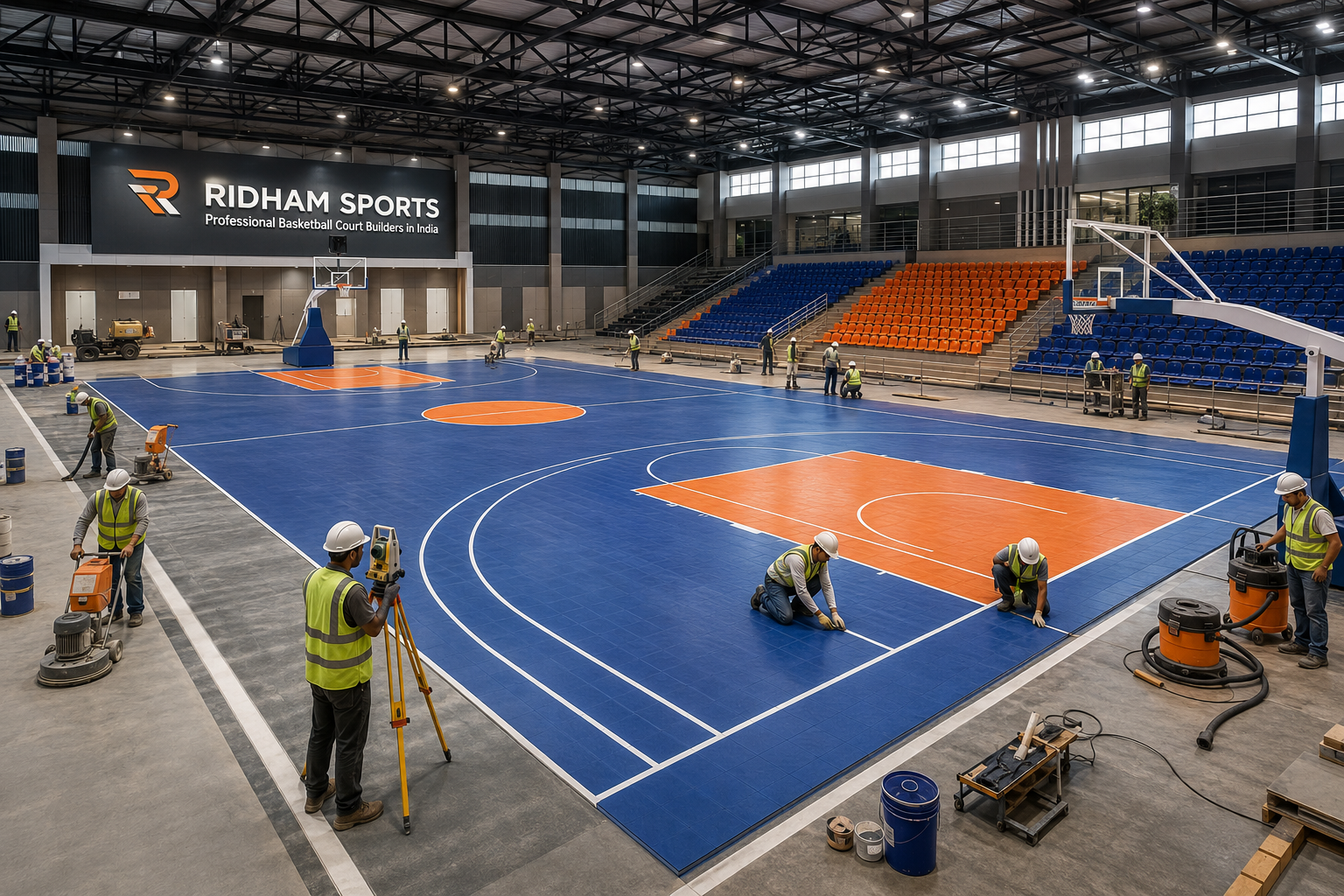
A reliable basketball court construction project follows a planned sequence of site assessment, civil work, flooring installation, equipment fitting, and quality inspection.
Site Inspection and Measurement
The first stage involves assessing the proposed location and determining whether it is suitable for basketball court construction.
The assessment may include available land, existing levels, soil conditions, access, drainage, nearby structures, and environmental exposure.
For renovation projects, the condition of the existing base and surface should also be examined.
Site Preparation and Earthwork
The construction area is cleared and prepared according to the project design.
Depending on the site, this may involve excavation, grading, removal of unsuitable material, filling, and compaction. Proper preparation helps establish a stable platform for subsequent construction work.
Foundation and Base Construction
The foundation is critical to the long-term performance of the court.
The appropriate base may involve engineered concrete, asphalt, or another specified structural system. The selection depends on the flooring system, ground conditions, loading requirements, drainage strategy, and intended application.
Proper compaction, level control, curing where applicable, and surface preparation must be completed according to the construction specification.
Drainage and Moisture Management
Outdoor courts require particular attention to water movement.
The design should direct rainwater away from the playing surface and prevent persistent water accumulation. The base profile, surrounding ground levels, drainage channels, and discharge arrangements should work together as part of the overall design.
For indoor courts, moisture in the building and subfloor should be assessed before installing sensitive flooring materials.
Basketball Flooring Installation
Once the base meets the flooring manufacturer’s requirements, the selected sports surface can be installed.
The procedure varies by flooring type. Acrylic systems may involve primers, resurfacing compounds, textured layers, and colour coats. Wooden systems require appropriate subfloor preparation and installation. PU and PVC systems have their own material-specific requirements.
Installation conditions, surface moisture, curing periods, and product compatibility should be checked before work begins.
Court Marking and Finishing
Basketball court markings are applied after the surface has reached the appropriate stage of completion.
The markings must follow the approved layout, with suitable line widths, clear visibility, and accurate positioning. Finishing work may also include edge detailing and other surface treatments required by the specification.
Basketball Equipment Installation
The court is fitted with the equipment required for its intended use.
This can include backboards, rims, nets, support structures, protective padding, and scoreboards. Equipment should be selected and installed according to the appropriate performance and safety requirements.
Final Inspection and Handover
Before the facility is opened for use, the completed work should be inspected.
The review may cover court dimensions, surface finish, drainage, line markings, equipment stability, lighting, and general safety. Any identified defects should be addressed according to the project requirements.
Maintenance instructions should also be provided so the owner understands how to clean, inspect, and care for the facility.
Factors Affecting Basketball Court Construction Cost in India
The cost of building a basketball court in India varies according to the project’s size, location, technical specification, and site conditions. A reliable estimate should be based on a defined scope of work rather than a generic price alone.
1. Court Size
A full-size court generally requires more construction materials and labour than a smaller recreational or half-court installation.
The total area may also increase when additional safety clearances, seating, and supporting facilities are included.
2. Flooring Selection
Different flooring systems have different material, installation, and maintenance requirements. Acrylic, wooden, PU, PVC, and other specialized sports flooring options should be compared on the basis of their complete specifications.
3. Civil Construction
Excavation, soil preparation, filling, compaction, concrete or asphalt work, and other foundation requirements can have a significant influence on the overall project budget.
4. Drainage and Site Conditions
Uneven land, weak ground conditions, waterlogging, and difficult access may require additional work before flooring installation can begin.
5. Basketball Equipment
The type and quality of hoops, backboards, support structures, protective padding, and scoreboards influence the final cost.
6. Lighting and Additional Infrastructure
Indoor lighting, outdoor floodlights, fencing, spectator seating, ventilation, and supporting amenities may be included depending on the facility’s purpose.
7. Location and Transportation
Material transportation, labour availability, local site access, and project logistics can affect construction costs in different parts of India.
8. Maintenance Requirements
The long-term budget should account for cleaning, inspections, repairs, and any future resurfacing or flooring replacement that may be required.
Before approving a quotation, confirm whether it includes site preparation, the structural base, sports flooring, court markings, equipment, installation, transportation, taxes, and any additional infrastructure. Comparing contractors against the same scope makes it easier to assess the true value of each proposal.
Basketball Court Construction for Different Facilities
A professional basketball court builder should understand that each facility has distinct operational and performance requirements.
Schools and Colleges
Educational institutions generally need robust courts that can accommodate regular student activities, physical education classes, and recreational games. Ease of maintenance, appropriate safety provisions, and durability are important considerations.
Sports Academies
Training academies may require courts that support frequent practice sessions and structured player development. Flooring performance, equipment quality, lighting, and the intended training level should guide the specification.
Residential Communities
Residential basketball courts can provide a valuable recreational amenity for apartment complexes, gated communities, and housing developments.
The design should make efficient use of available land while considering access, noise, lighting, drainage, and the safety of residents.
Sports Clubs and Commercial Facilities
Commercial sports facilities need to balance playing experience, durability, appearance, maintenance, and operating costs.
The project may also require spectator seating, booking-related infrastructure, scoreboards, storage, and other amenities based on the business model.
Government and Community Sports Projects
Public sports infrastructure requires particular attention to usability, durability, maintenance planning, accessibility, and compliance with the applicable project specifications.
A carefully planned court can support community recreation, school sports, and local player development.
Indoor vs Outdoor Basketball Court Construction
Choosing between indoor and outdoor construction depends on the available space, local climate, intended use, and investment plan.
An indoor court offers greater protection from weather and can support more consistent playing conditions, but it requires a suitable building, adequate lighting, ventilation, and a potentially higher overall infrastructure investment.
An outdoor court can be a practical solution for schools, communities, and recreational facilities with available open space. However, it needs a suitable weather-resistant surface, effective drainage, and a base designed for outdoor exposure.
The right choice should be made after comparing the project’s initial construction requirements, expected usage, environmental conditions, and long-term operating costs.
Basketball Court Maintenance and Renovation
Regular maintenance helps preserve the court’s appearance, playing characteristics, and service life.
Recommended practices include:
- Remove dust, leaves, and debris from the playing surface.
- Use cleaning methods appropriate for the installed flooring system.
- Inspect cracks, surface separation, and other signs of deterioration.
- Check basketball rims, backboards, support structures, and protective padding.
- Keep outdoor drainage channels and water outlets clear.
- Inspect line markings for fading or damage.
- Address minor defects before they develop into larger problems.
- Follow the manufacturer’s recommendations for cleaning, repairs, and resurfacing.
The maintenance schedule should reflect the flooring type, usage frequency, weather exposure, and observed condition of the court.
For an existing court, renovation may involve localized repairs, crack treatment, resurfacing, new line markings, equipment replacement, or more extensive base reconstruction. The appropriate solution depends on the underlying cause of the damage rather than its visible appearance alone.
Basketball Court Safety and Quality Considerations
Safety should be incorporated into every stage of basketball court planning and construction.
Important considerations include suitable surface traction, appropriate impact management, secure basketball equipment, accurate court markings, sufficient surrounding clearance, effective lighting, and adequate drainage.
The base should be stable and the playing surface should be suitable for the intended application. Outdoor courts should be inspected for standing water and weather-related deterioration, while indoor facilities require attention to moisture, ventilation, ceiling clearance, and surrounding obstacles.
Where a court is intended for regulated competition, the applicable basketball governing-body specifications should be confirmed before construction. Equipment, markings, and dimensions should be verified against the requirements relevant to the planned level of play.
A final quality inspection and an appropriate maintenance plan help the owner manage the facility responsibly after handover.
Why Choose Ridham Sports as Your Basketball Court Builder in India?
Selecting the right construction company is an important decision when investing in a basketball facility. The contractor should understand both the civil construction requirements and the performance expectations of the selected sports flooring system.
Ridham Sports can be considered for basketball court projects that require a coordinated approach to planning, construction, flooring, and finishing.
Project-Specific Planning
Every site has different dimensions, ground conditions, usage requirements, and budget limitations. The construction approach should be tailored to the project rather than based on a single standard design.
Flooring Selection Support
Choosing an appropriate flooring system involves evaluating the intended application, environmental exposure, playing characteristics, and maintenance requirements. The final choice should be supported by clear product specifications.
Coordinated Construction
Site preparation, foundation work, flooring installation, court marking, and equipment fitting need to be completed in the correct sequence. Coordinated project execution can help reduce avoidable rework and installation problems.
Quality-Focused Installation
Proper surface preparation, accurate dimensions, suitable materials, and adherence to installation requirements are essential for achieving a functional and durable court.
Support for Different Facility Types
Basketball court requirements vary between schools, sports academies, residential developments, commercial venues, and community facilities. A project-specific approach helps address these different needs.
For the most suitable recommendation, discuss the proposed location, court size, indoor or outdoor requirements, preferred flooring, and available budget with the construction team. Company-specific credentials, service coverage, warranties, and project references should be verified directly before finalizing a contract.
Frequently Asked Questions About Basketball Court Builders in India
1. How do I choose the right basketball court builder in India?
Review the contractor’s relevant project experience, construction methodology, flooring specifications, equipment details, quality-control process, and maintenance guidance. Ask for comparable project references and a written quotation that clearly defines the scope of work.
2. What is the standard size of a basketball court?
A standard FIBA-style full court measures 28 metres by 15 metres. Additional space is needed around the playing area for safety clearance, equipment, and circulation.
3. Which flooring is best for a basketball court in India?
The best option depends on the court’s location and intended use. Acrylic systems are commonly considered for outdoor courts, while wooden, PU, PVC, and other specialized systems may be suitable for indoor applications.
4. How much does basketball court construction cost in India?
The cost depends on court dimensions, site preparation, foundation design, flooring, equipment, drainage, lighting, fencing, transportation, and labour. A detailed quotation based on the actual site and project specification provides the most useful estimate.
5. Can a basketball court be built in a school or residential complex?
Yes. Courts can be designed for schools, colleges, residential communities, and other facilities according to the available space, intended playing format, safety requirements, and local conditions.
6. How long does basketball court construction take?
The timeline depends on site conditions, civil work, flooring type, weather, material availability, and the scope of supporting infrastructure. The contractor should provide a project schedule after reviewing the site and specifications.
7. Can an existing basketball court be renovated?
Yes. Depending on its condition, renovation may include surface repairs, resurfacing, repainting, new markings, equipment replacement, or reconstruction of damaged foundation sections. A site inspection helps identify the appropriate treatment.
8. Is outdoor basketball court construction suitable for Indian weather?
Outdoor courts can be built in different Indian climatic conditions, provided the construction system is selected for the local environment. Base stability, drainage, UV exposure, temperature changes, and suitable surface materials must be considered during planning.
Conclusion
Building a basketball court requires careful coordination of site preparation, foundation construction, sports flooring, drainage, court dimensions, equipment, lighting, safety, and maintenance. Each component influences the performance, durability, and usability of the finished facility.
Whether you are planning a court for a school, college, sports academy, residential community, club, government project, or commercial sports centre, choosing a suitable basketball court builder in India can help you make informed decisions from the initial planning stage through final installation.
Ridham Sports offers a sports infrastructure solution for projects requiring basketball courts and related sporting facilities. By assessing the site, defining the project requirements, selecting an appropriate flooring system, and following a structured construction process, facility owners can work toward developing a reliable sports environment.
Planning a basketball court in India? Visit Ridham Sports to discuss your project requirements and explore a construction solution suited to your space, intended use, and budget.