

Introduction
The demand for basketball court construction in India has grown significantly in recent years, supported by increasing interest in sports, fitness, and the development of modern recreational facilities. Schools, colleges, sports academies, residential communities, and private institutions are investing in basketball infrastructure to encourage physical activity and provide better training opportunities.
Basketball is a versatile sport that requires comparatively less space and infrastructure than many other outdoor games. A properly constructed basketball court can accommodate recreational activities, professional coaching, practice sessions, and competitive tournaments. It also provides a valuable space for community engagement and promotes an active lifestyle among people of different age groups.
However, constructing a basketball court in India requires careful consideration of climatic conditions, surface materials, drainage, foundation strength, and safety standards. Factors such as high temperatures, seasonal rainfall, and regular usage can affect the performance and lifespan of the playing surface.
Whether you are developing a basketball facility for a school, residential complex, sports academy, or commercial sports centre, understanding the construction requirements is essential. This guide covers the important aspects of basketball court construction, including standard dimensions, flooring options, construction methods, estimated costs, and maintenance considerations.
Standard Basketball Court Dimensions and Layout
Before beginning construction, it is important to establish the correct court dimensions and playing layout. Following internationally recognized specifications helps maintain consistency, player safety, and suitability for organized competitions.
Standard Court Size
According to international basketball standards, a full-size basketball court has the following dimensions:
- Playing area: 28 metres long × 15 metres wide
- Safety clearance: Ideally 2 metres or more around the playing area
- Recommended overall space: Approximately 32 metres × 19 metres
The additional space around the court provides sufficient room for players to move safely beyond the boundary lines during gameplay.
Important Court Markings
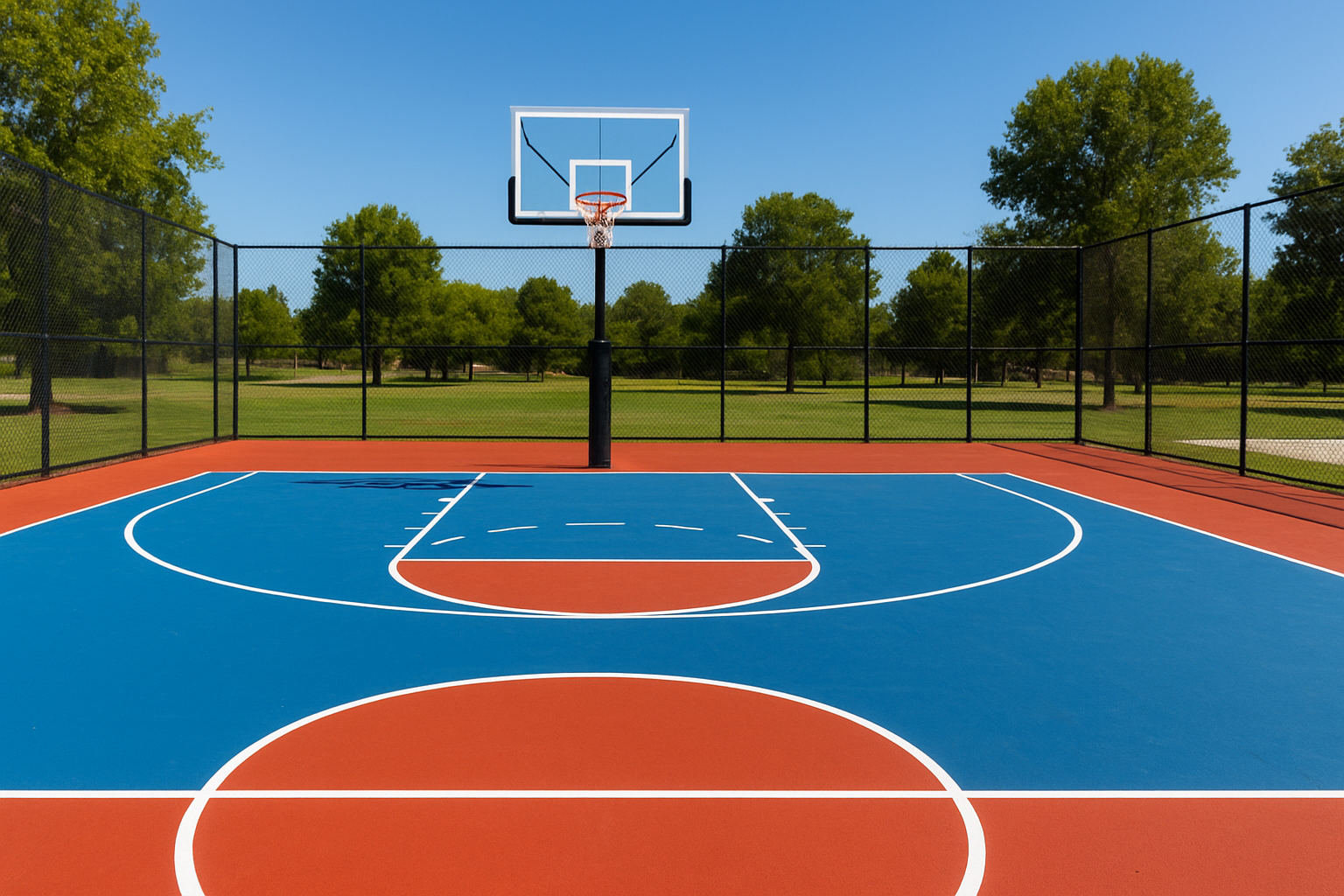
The main playing markings and equipment specifications include:
- Centre circle radius: 1.8 metres
- Three-point line: 6.75 metres from the basket’s centre
- Free-throw line: 4.6 metres from the backboard plane
- Line width: 5 cm
- Basket height: 3.05 metres above the playing surface
Accurate marking is essential to ensure proper gameplay and compliance with competition requirements.
Court Orientation
For outdoor basketball facilities, a north-south orientation is generally preferred. This arrangement can help reduce direct sunlight interference during certain playing hours, improving visibility and player comfort.
Indoor Ceiling Height
Indoor basketball courts require sufficient vertical clearance to support unrestricted gameplay.
- Minimum recommended clearance: Approximately 7 metres
- Preferred clearance for advanced play: 10–14 metres
A higher ceiling provides better playing conditions, particularly for competitive matches and professional training facilities.
Types of Basketball Court Flooring in India
Selecting the appropriate flooring system is one of the most important decisions in basketball court construction. The surface directly influences player comfort, ball response, grip, durability, and maintenance requirements.
Several flooring options are available in India, with each system offering different benefits depending on the location, budget, and intended level of usage.
1. Acrylic Basketball Court Flooring
Acrylic flooring is one of the most commonly selected options for outdoor basketball courts in India. It is generally installed over a properly prepared concrete or asphalt base.
Key Features:
- Textured surface designed to provide adequate grip
- UV-resistant coating options
- Suitable for outdoor weather conditions
- Available in different colours and finishes
Advantages:
- Economical compared with premium sports flooring systems
- Relatively quick installation
- Easy to clean and maintain
- Suitable for schools, parks, and residential facilities
Limitations:
- Requires periodic resurfacing or recoating
- Offers less shock absorption than cushioned flooring systems
- Surface performance depends heavily on the quality of the underlying base
2. Polyurethane (PU) Basketball Flooring
Polyurethane flooring is a synthetic sports surface designed to provide a comfortable and consistent playing experience. It is suitable for facilities where player comfort, surface elasticity, and long-term performance are important.
Key Features:
- Seamless synthetic construction
- Elastic surface with shock-absorbing properties
- Consistent playing characteristics
- Available in different thicknesses and system specifications
Advantages:
- Improved player comfort
- Good durability when properly installed
- Suitable for training and competitive sports facilities
- Smooth and uniform playing surface
Limitations:
- Higher installation cost than basic acrylic systems
- Requires trained installation professionals
- Proper substrate preparation is essential
3. Wooden Basketball Court Flooring
Wooden flooring is widely preferred for premium indoor basketball facilities, professional academies, and tournament venues. Maple wood and engineered sports flooring systems are commonly used for specialized indoor applications.
Key Features:
- Natural or engineered wooden surface
- Installed over a suitable subfloor system
- Designed to provide controlled elasticity and ball response
- Professional appearance and playing characteristics
Advantages:
- Excellent playing experience
- Effective shock absorption with an appropriate sprung subfloor
- Suitable for high-performance indoor facilities
- Preferred for many professional basketball environments
Limitations:
- Relatively high installation investment
- Requires controlled indoor conditions
- Periodic polishing, cleaning, and refinishing are necessary
- Sensitive to moisture and unsuitable environmental conditions
4. Interlocking Sports Flooring Tiles
Interlocking polypropylene tiles are another popular option for outdoor and multipurpose basketball courts. These modular tiles feature a connecting mechanism that allows individual sections to be assembled over a prepared base.
Key Features:
- Modular snap-fit installation
- Multiple colour combinations
- Drainage-friendly design options
- Different surface textures and cushioning configurations
Advantages:
- Fast installation
- Easy replacement of damaged sections
- Relatively low maintenance
- Suitable for multipurpose sports facilities
Limitations:
- Product quality differs between manufacturers
- Thermal expansion and contraction must be considered
- Requires a properly prepared and level base
- Playing characteristics depend on tile design and quality
Basketball Court Construction Process in India
Building a durable basketball court involves several stages, starting with site assessment and ending with equipment installation and final inspection. Each stage must be completed carefully to ensure structural stability, player safety, and reliable surface performance.
1. Site Selection and Ground Preparation
The first step is identifying a suitable location for the basketball facility.
Important activities include:
- Selecting a relatively flat and stable site
- Conducting soil testing to evaluate ground conditions
- Removing vegetation, loose soil, and construction debris
- Establishing accurate court boundaries
- Checking the availability of drainage arrangements
Proper site preparation helps minimize settlement problems and prevents future damage to the court surface.
2. Sub-base Preparation
Once the ground has been cleared and levelled, the next step is preparing a stable sub-base.
The process generally includes:
- Spreading crushed stone or suitable granular material
- Compacting the material in appropriate layers
- Maintaining uniform levels across the construction area
- Checking the required slope and drainage arrangement
A properly compacted sub-base provides structural support and helps prevent uneven settlement, cracks, and surface deformation.
3. Concrete or Asphalt Base Construction
The base is one of the most important structural components of an outdoor basketball court. It provides the foundation for the selected sports flooring system.
Typical construction considerations include:
- Concrete thickness: Around 100 mm as a preliminary reference
- Heavy-use facilities: Approximately 125–150 mm, depending on engineering requirements
- Reinforcement: Steel mesh or reinforcement bars where specified
- Control joints: Provided to manage shrinkage and cracking
- Curing: Appropriate curing and drying time before surface installation
The actual base thickness and reinforcement requirements should be determined through site conditions, soil characteristics, engineering calculations, and the selected flooring manufacturer’s specifications.
4. Sports Flooring Installation
After the base has achieved the required strength and moisture conditions, the selected sports flooring system can be installed.
Different flooring systems require different application methods:
- Acrylic flooring: Applied through multiple coating layers over the prepared base.
- PU flooring: Installed using specified polyurethane layers and application techniques.
- Wooden flooring: Fixed over a suitable sprung subfloor structure.
- Interlocking tiles: Assembled over a clean, stable, and level surface.
Following the manufacturer’s installation guidelines is important for achieving the expected performance and durability.
5. Basketball Court Line Marking
Accurate line marking is necessary for proper gameplay and compliance with standard court layouts.
The work generally includes:
- Marking the centre line and centre circle
- Establishing the free-throw areas
- Measuring and marking the three-point lines
- Painting the boundary lines
- Maintaining the specified line width
Sports-grade marking materials should be selected to ensure clear visibility and good adhesion to the flooring system.
6. Basketball Equipment Installation
The next stage involves installing the basketball equipment and supporting accessories.
Common installations include:
- Basketball poles and support structures
- Backboards
- Standard-height basketball rims
- Basketball nets
- Protective padding around suitable equipment components
The basket height should be maintained at 3.05 metres. Pole foundations and support systems must be designed to withstand the expected loads and usage conditions.
7. Drainage System Development
Effective drainage is particularly important for outdoor basketball courts in India, where seasonal rainfall can lead to water accumulation and surface damage.
Important drainage requirements include:
- Providing an appropriate surface slope
- Maintaining suitable water runoff arrangements
- Installing drainage channels where necessary
- Preventing water from collecting around the court
- Ensuring that adjoining ground levels do not direct water onto the playing surface
An approximate slope of 1% is commonly considered for outdoor drainage planning, although the final gradient should be selected according to the site layout and flooring system.
8. Lighting and Additional Facilities
Proper lighting improves visibility and allows basketball activities to continue during evening hours.
Typical lighting considerations include:
- Recreational facilities: Approximately 200–300 lux
- Competitive facilities: Approximately 500–750 lux, depending on the level of competition and applicable standards
LED floodlights are a popular option because of their energy efficiency and long operating life.
Other facilities that can improve the overall usability of the court include:
- Player seating and spectator areas
- Boundary fencing
- Scoreboards
- Drinking water facilities
- Storage areas
- Safety signage
Indoor vs Outdoor Basketball Courts in India
The choice between an indoor and outdoor basketball court depends on the available space, construction budget, climatic conditions, and intended usage.
Indoor Basketball Courts
Indoor courts are generally preferred for professional training, educational institutions, sports academies, and tournament facilities.
Advantages:
- Protection from rain, heat, and other weather conditions
- More consistent playing environment
- Better control over lighting and playing conditions
- Potentially longer flooring lifespan with proper maintenance
Challenges:
- Higher initial construction investment
- Requires a suitable building structure
- Additional expenses for ventilation, lighting, and facility maintenance
Outdoor Basketball Courts
Outdoor courts are commonly developed in schools, parks, residential societies, and community sports facilities.
Advantages:
- Lower construction investment in many cases
- Easier site development
- Suitable for recreational and community activities
- Can accommodate multiple sports with appropriate planning
Challenges:
- Exposure to sunlight, rain, and temperature changes
- Requires effective drainage
- Periodic surface maintenance is necessary
- Playing conditions can be affected by weather
Cost of Basketball Court Construction in India
The overall cost of basketball court construction depends on several factors, including court dimensions, site conditions, foundation requirements, flooring materials, equipment specifications, and additional facilities.
The following are indicative flooring-related cost ranges:
Approximate Flooring Costs
- Outdoor acrylic flooring: ₹120–₹350 per sq. ft.
- PU sports flooring: ₹300–₹800 per sq. ft.
- Indoor wooden flooring: ₹800–₹1,500 or more per sq. ft.
These figures should be treated as preliminary estimates rather than fixed project quotations. Actual prices vary depending on material quality, system specifications, project location, and installation requirements.
Major Cost Components
A complete basketball court project may include the following expenses:
- Site preparation: Excavation, levelling, soil preparation, and compaction.
- Foundation and base work: Sub-base materials, concrete or asphalt, and reinforcement.
- Sports flooring: Acrylic, PU, wooden flooring, or interlocking tiles.
- Court equipment: Basketball poles, backboards, rims, and nets.
- Line marking: Sports-grade paints and application work.
- Lighting: LED floodlights, electrical connections, and supporting structures.
- Fencing and accessories: Boundary protection, seating, and other supporting facilities.
For an accurate estimate, it is advisable to obtain a detailed quotation after evaluating the site and finalizing the required specifications.
Common Mistakes to Avoid During Basketball Court Construction
Even a well-planned basketball court can develop problems if important construction requirements are overlooked.
Some common mistakes include:
- Skipping soil testing: Inadequate ground assessment can lead to settlement and structural issues.
- Poor drainage planning: Water accumulation can damage flooring and make the court unsafe.
- Choosing unsuitable flooring: Flooring should match the intended usage, environmental conditions, and budget.
- Incorrect dimensions: Improper measurements can affect gameplay and competition suitability.
- Using inferior materials: Low-quality construction materials can increase maintenance expenses.
- Ignoring foundation quality: An uneven or weak base can reduce flooring performance.
- Neglecting maintenance: Regular inspection and timely repairs are necessary to extend the court’s service life.
Working with experienced sports infrastructure professionals can help minimize these issues and improve the overall quality of the project.
Conclusion
Basketball court construction in India requires a combination of proper planning, quality materials, technical expertise, and careful execution. From selecting the construction site and preparing the foundation to choosing suitable sports flooring and installing basketball equipment, every stage contributes to the overall performance and durability of the facility.
The right flooring system should be selected according to the court’s intended purpose, whether it is designed for recreational activities, school sports, professional training, or competitive tournaments. Equally important are accurate dimensions, proper drainage, sufficient safety clearance, and suitable lighting arrangements.
A well-designed basketball court can become a valuable long-term investment for educational institutions, residential communities, sports academies, and commercial sports facilities. With the continued development of sports infrastructure across India, quality basketball facilities can contribute significantly to athletic development, community engagement, and healthier lifestyles.
For professional guidance and information about sports infrastructure solutions, explore basketball court construction services.
Frequently Asked Questions (FAQs)
1. What is the standard size of a basketball court in India?
The standard full-size basketball playing area measures 28 metres × 15 metres. Additional safety clearance is recommended around the playing area, making an overall space of approximately 32 metres × 19 metres suitable for planning.
2. Which flooring is best for an outdoor basketball court?
Acrylic flooring is a popular choice for outdoor basketball courts because of its affordability, weather resistance, and relatively simple maintenance. PU flooring and interlocking sports tiles are alternative options depending on the required playing characteristics and budget.
3. How much time is required to construct a basketball court?
The construction timeline depends on the project size, site conditions, flooring system, and weather.
- Outdoor basketball court: Approximately 4–6 weeks.
- Indoor basketball court: Approximately 2–6 months, depending on building and flooring requirements.
4. What is the recommended slope for an outdoor basketball court?
An approximate slope of 1% is commonly considered for outdoor basketball courts to facilitate rainwater drainage. The final slope should be determined according to the site conditions and selected flooring system.
5. Which basketball court flooring requires less maintenance?
Interlocking sports tiles and properly installed PU flooring systems can offer relatively low maintenance requirements. However, maintenance needs depend on product quality, usage frequency, environmental exposure, and manufacturer recommendations.
6. Is a concrete base necessary for basketball court construction?
A stable and properly prepared foundation is essential for durable basketball court construction. Concrete or asphalt bases are commonly used for outdoor courts, while indoor facilities may require specialized subfloor systems depending on the selected flooring.
7. What is the standard basketball hoop height?
The standard basketball rim height is 3.05 metres (10 feet) above the playing surface. This measurement is generally followed for adult basketball courts and competitive play.