
Introduction
Basketball is rapidly gaining popularity across India, and Hisar is becoming an emerging destination for sports infrastructure development. With increasing interest in sports among students, athletes, and fitness enthusiasts, the demand for professionally designed basketball courts is growing across schools, colleges, residential societies, sports academies, and government institutions.
However, building a high-quality basketball court involves much more than preparing a flat playing surface. It requires proper site planning, ground preparation, suitable flooring materials, accurate court dimensions, and professional installation. Every stage plays an important role in ensuring player safety, durability, and optimal playing performance.
Whether you are planning a school basketball court, a community sports facility, or a professional training ground, this guide covers everything you need to know about basketball court construction in Hisar, including construction methods, flooring options, dimensions, estimated costs, and maintenance requirements.
Why Is Basketball Court Construction in Hisar Becoming Popular?
The growing awareness of sports, fitness, and physical education has increased the need for modern basketball facilities in Hisar. Schools, colleges, private sports academies, and residential communities are investing in dedicated courts to encourage participation and develop sporting talent.
Some of the major benefits of constructing a basketball court include:
- Increasing Demand for Sports Infrastructure: Growing participation in basketball and local sporting competitions is encouraging institutions to develop dedicated playing facilities.
- All-Weather Playing Conditions: High-quality acrylic and synthetic flooring systems can provide reliable playing surfaces throughout the year when installed over a properly designed base.
- Health and Fitness Benefits: Basketball promotes cardiovascular fitness, coordination, agility, teamwork, and overall physical development.
- Professional Sports Training: Properly constructed courts provide athletes with suitable facilities for regular practice, coaching, and competitive tournaments.
- Long-Term Investment: A professionally installed basketball court can serve schools, communities, and sports organizations for many years with appropriate maintenance.
Types of Basketball Courts Suitable for Hisar
Selecting the right basketball court surface is one of the most important decisions during construction. The choice should depend on the available budget, location, expected usage, and maintenance requirements.
1. Concrete Basketball Courts
Concrete courts are commonly used for outdoor basketball facilities because of their relatively low initial construction cost.
Key features:
- Strong and durable playing base.
- Suitable for outdoor installations.
- Comparatively economical construction.
- Can be finished with an appropriate sports coating.
However, untreated concrete can become slippery, develop cracks, and provide limited shock absorption. A suitable sports flooring system can improve its playing characteristics.
2. Wooden Basketball Courts
Wooden basketball courts are widely preferred for indoor sports complexes, professional training centres, and competitive basketball facilities.
Key features:
- Excellent ball response and playing consistency.
- Professional appearance.
- Better playing comfort with suitable sports subfloor systems.
- Ideal for indoor stadiums and multipurpose sports halls.
Wooden flooring requires controlled indoor conditions, regular maintenance, and periodic refinishing to maintain its performance.
3. Synthetic and Acrylic Basketball Courts
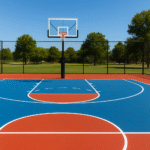
Synthetic and acrylic flooring systems are popular choices for outdoor basketball courts because of their weather resistance, attractive finish, and relatively low maintenance requirements.
Key features:
- Available in multiple colours and surface finishes.
- UV-resistant options for outdoor applications.
- Anti-slip sports surface when correctly specified and installed.
- Suitable for schools, colleges, academies, and residential societies.
- Easy to clean and maintain.
Depending on the project requirements, acrylic, polyurethane, and rubber-based flooring systems can be considered.
Standard Basketball Court Dimensions
Correct court dimensions are essential for ensuring a professional playing experience. Basketball courts are generally designed according to the guidelines of the International Basketball Federation (FIBA).
The standard dimensions include:
| Court Specification | Standard Measurement |
|---|---|
| Full basketball court | 28 m × 15 m |
| Half-court area | 14 m × 15 m |
| Free-throw line | 4.6 m from the backboard plane |
| Three-point line | 6.75 m from the basket centre |
| Court playing area | 420 sq. m |
Additional space should be considered around the playing area for player movement, safety zones, fencing, and spectator access.
Accurate line marking using high-quality sports marking paint is equally important for maintaining consistency during practice sessions and competitive matches.
Step-by-Step Process of Basketball Court Construction in Hisar
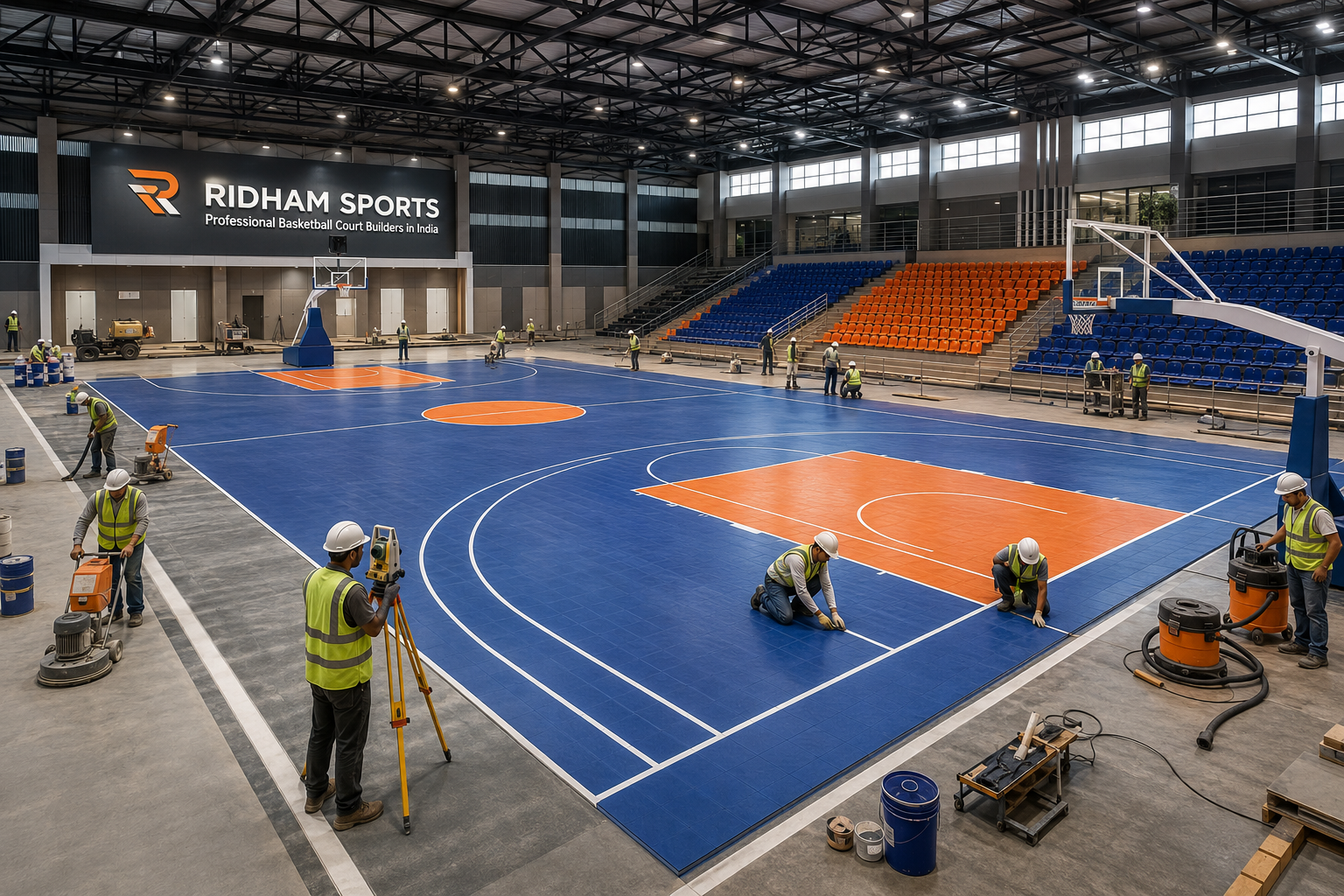
A successful basketball court construction project requires a systematic approach. Each stage must be completed carefully to achieve a durable, safe, and high-performance playing surface.
1. Site Selection and Ground Preparation
The first step is selecting an appropriate location for the basketball court.
The selected site should have:
- Sufficient space for the required court dimensions.
- Stable and level ground conditions.
- Proper drainage arrangements.
- Convenient access for players and maintenance equipment.
- Adequate provision for lighting and fencing.
The ground is then cleared, levelled, and compacted before the base construction begins.
2. Base Construction
A strong foundation is essential for the long-term performance of a basketball court.
Depending on the soil conditions and project requirements, contractors may use an RCC or asphalt base.
Important considerations include:
- Proper soil compaction.
- Suitable base thickness and reinforcement.
- Adequate surface slope for rainwater drainage.
- Smooth and uniform finishing.
- Proper curing before flooring installation.
In Hisar, where outdoor courts experience high summer temperatures and seasonal rainfall, proper base preparation and drainage are particularly important.
3. Sports Flooring Installation
Once the base is ready, the selected sports flooring system is installed.
For outdoor basketball courts, acrylic or other suitable synthetic flooring systems are commonly considered.
The installation process may include:
- Surface cleaning and preparation.
- Application of suitable primers.
- Crack filling and levelling.
- Application of required cushioning and coating layers.
- Final colour coating and surface finishing.
The flooring system should be selected according to the intended playing level, climatic conditions, and project budget.
4. Court Marking and Finishing
After flooring installation, the court markings are completed according to the selected basketball standards.
This stage includes:
- Centre circle marking.
- Three-point line marking.
- Free-throw lane and line marking.
- Boundary line marking.
- Colour coding and finishing.
High-quality marking materials help maintain visibility and durability, particularly for outdoor courts exposed to sunlight and rain.
5. Installation of Basketball Equipment
The final construction stage involves installing the necessary basketball equipment and additional facilities.
These may include:
- Basketball poles and support structures.
- Backboards and basketball rings.
- Basketball nets.
- Protective padding.
- Boundary fencing.
- LED floodlights.
- Player seating and spectator arrangements.
All equipment should be securely installed and suitable for the intended level of use.
Cost of Basketball Court Construction in Hisar
The overall cost of basketball court construction depends on several factors, including court dimensions, ground conditions, flooring materials, base preparation, equipment, and installation requirements.
The following are indicative flooring price ranges:
| Flooring Type | Estimated Cost |
|---|---|
| Acrylic synthetic flooring | ₹70–₹90 per sq. ft. |
| Rubber/PVC flooring | ₹90–₹120 per sq. ft. |
| Wooden indoor sports flooring | ₹250–₹350 per sq. ft. |
For a full-size outdoor synthetic basketball court, the estimated project budget may range between ₹8 lakh and ₹15 lakh, depending on the specifications and scope of work.
The final quotation may vary depending on:
- Site preparation and excavation.
- RCC or asphalt base construction.
- Selected flooring system.
- Basketball equipment and accessories.
- Fencing and lighting requirements.
- Labour, transportation, and installation charges.
It is advisable to obtain a detailed project quotation before starting construction to avoid unexpected expenses.
Maintenance Tips for Long-Lasting Basketball Courts
Regular maintenance helps preserve the appearance, safety, and playing quality of a basketball court.
Here are some important maintenance practices:
- Regular Cleaning: Remove dust, leaves, mud, and other debris to maintain a clean playing surface.
- Periodic Inspections: Check for cracks, loose flooring, surface damage, and drainage issues.
- Timely Repairs: Address minor defects before they develop into major structural or flooring problems.
- Surface Resurfacing: Acrylic and synthetic courts may require periodic recoating or resurfacing depending on usage and environmental exposure.
- Equipment Inspection: Regularly inspect basketball poles, backboards, rings, and protective padding.
- Drainage Maintenance: Keep drainage channels clear to prevent water accumulation during the rainy season.
With proper maintenance, a professionally constructed basketball court can provide years of reliable performance.
Common Challenges in Basketball Court Construction in Hisar
Although basketball court construction offers several benefits, certain local conditions must be considered before starting a project.
Extreme Weather Conditions
Hisar experiences hot summers and seasonal rainfall. Therefore, outdoor basketball courts should use suitable UV-resistant coatings, durable materials, and effective drainage systems.
Poor Construction Quality
Inadequate base preparation, incorrect surface application, and improper line marking can affect the durability and playing performance of a basketball court.
Choosing an experienced sports infrastructure contractor helps minimize these risks.
Budget Planning
Many projects focus only on initial construction expenses and overlook long-term maintenance, equipment replacement, and resurfacing costs.
A comprehensive budget should account for both installation and future maintenance requirements.
Site and Drainage Issues
Improper ground levelling and inadequate drainage can lead to water accumulation, surface deterioration, and premature damage.
A proper site assessment before construction can help prevent these problems.
Conclusion
The demand for basketball court construction in Hisar is increasing as schools, colleges, sports academies, residential societies, and government institutions recognize the importance of quality sports infrastructure.
Whether you are planning a compact community basketball court, a school sports facility, or a professional indoor basketball arena, selecting the right flooring material, preparing a strong foundation, following standard court dimensions, and hiring experienced installation professionals are essential for achieving long-lasting results.
If you are planning to build a basketball court in Hisar, consider working with an experienced sports infrastructure company such as Sports-Facility.in. The company specializes in synthetic and wooden sports flooring solutions and offers support for sports facility construction projects.
Investing in a professionally designed basketball court is not just about creating a playing space; it is about encouraging fitness, developing sporting talent, and building better sports infrastructure for the future.