

A regulation basketball court layout forms the foundation for professional, school, and community-level games. Every measurement, marking, and zone on the court is carefully designed to ensure fair play, player safety, and game consistency worldwide. Whether the court is built for NBA, FIBA, or High School standards, understanding the official layout is essential for quality construction and gameplay accuracy.
This guide provides a complete overview of regulation basketball court dimensions, markings, and design principles, helping you plan or construct a court that meets international standards for performance and safety.
Understanding the Regulation Basketball Court Layout

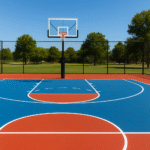
A regulation basketball court is a rectangular playing area with clearly defined lines, zones, and markings. It consists of two main sections:
-
The frontcourt, where a team attempts to score, and
-
The backcourt, which includes their defensive half and inbound area.
The layout is divided symmetrically, with a central line and circle, two baskets on opposite ends, and marked zones for free throws, three-pointers, and restricted play.
The goal of the layout is to ensure every player—offensive or defensive—has equal opportunities within a standardized, rule-compliant playing environment.
Official Basketball Court Dimensions
The dimensions vary slightly based on the governing body or level of competition:
| Court Standard | Length | Width | Three-Point Line | Free-Throw Line | Rim Height |
|---|---|---|---|---|---|
| NBA (Professional) | 94 ft (28.65 m) | 50 ft (15.24 m) | 23.75 ft (7.24 m) | 15 ft (4.57 m) | 10 ft (3.05 m) |
| FIBA (International) | 91.86 ft (28 m) | 49.21 ft (15 m) | 22.15 ft (6.75 m) | 15.09 ft (4.6 m) | 10 ft (3.05 m) |
| High School (USA) | 84 ft (25.6 m) | 50 ft (15.24 m) | 19.75 ft (6.02 m) | 15 ft (4.57 m) | 10 ft (3.05 m) |
Note: The differences in measurements primarily affect the length, width, and three-point arc radius, but the internal structure and layout principles remain the same across all standards.
Key Zones and Markings in a Regulation Basketball Court
A regulation basketball court layout features several key zones that define the game’s movement, scoring, and positioning.
1. Center Circle and Half-Court Line
-
Located exactly at the middle of the court.
-
Center circle diameter: 12 ft (3.66 m).
-
Used for the game’s opening tip-off and jump balls.
-
The half-court line divides the playing area into two equal halves: the team’s offensive and defensive zones.
2. Free-Throw Lane (The Key or Paint)
-
Rectangular area beneath each basket.
-
NBA width: 16 ft (4.88 m); FIBA: 16.08 ft (4.9 m); High School: 12 ft (3.66 m).
-
The free-throw line is 15 ft (4.57 m) from the backboard.
-
Also includes block markers for player positioning during free throws.
This area is often shaded or painted to help players identify the restricted region—commonly called “the paint.”
3. Three-Point Line (Arc)
-
Defines the scoring boundary for 3-point shots.
-
NBA distance: 23.75 ft (7.24 m) at the top of the arc, and 22 ft (6.7 m) at the corners.
-
FIBA distance: 22.15 ft (6.75 m).
-
High School distance: 19.75 ft (6.02 m).
Any basket made beyond this arc earns three points, adding a strategic layer to shooting and defense.
4. Restricted Area (No-Charge Zone)
-
A 4 ft (1.22 m) radius semicircle underneath the basket.
-
Defenders cannot draw charging fouls while standing within this area.
-
Ensures safe play during aggressive drives to the basket.
5. Backboard and Hoop Placement
-
Rim height: 10 ft (3.05 m) from the playing surface.
-
Backboard dimensions: 6 ft wide x 3.5 ft high (1.83 m x 1.07 m).
-
The front face of the backboard extends 4 ft (1.22 m) from the baseline into the court.
The rim has a diameter of 18 inches (45.7 cm) and must be positioned directly above the center of the key’s width.
6. Baseline and Sidelines
-
Baselines: The shorter boundary lines located behind each hoop.
-
Sidelines: The longer boundary lines running the full court length.
-
Lines are 2 inches (5 cm) thick and painted in contrasting colors for visibility.
A minimum safety buffer of 3–5 feet beyond the sidelines and baselines is recommended for outdoor or indoor courts to ensure player safety.
7. Team Benches and Scoring Table Area
-
Located outside the playing boundary on one side of the court.
-
Includes space for team benches, coaches, scoring officials, and timekeepers.
-
The scorer’s table typically sits at the center line, between both benches.
Court Surface and Material Standards
The performance and safety of a regulation basketball court depend on the surface material and finish quality. Common materials include:
1. Maple Wood Flooring (Indoor Professional Courts)
-
Preferred for NBA and top-tier indoor arenas.
-
Provides perfect ball bounce, consistent traction, and shock absorption.
-
Requires regular maintenance and sealing for longevity.
2. Acrylic Coated Concrete (Outdoor Courts)
-
Durable, anti-slip, and weather-resistant.
-
Available in multiple color options.
-
Ideal for schools, clubs, and public outdoor areas.
3. Polyurethane (PU) or Synthetic Flooring
-
Seamless, cushioned surface with anti-slip texture.
-
Reduces joint stress and improves comfort.
-
Easy to clean and maintain—suitable for indoor practice courts.
4. Modular Interlocking Tiles
-
Made from polypropylene with drainage systems.
-
Great for outdoor or temporary installations.
-
Quick installation and replacement options.
Lighting and Safety Features
For optimal play and visibility, a regulation basketball court should include:
-
LED Sports Lighting: 300–500 lux for training courts, up to 1500 lux for professional matches.
-
Anti-glare light fixtures positioned at least 20–25 ft above the surface.
-
Fencing or protective netting (10–12 ft high) for outdoor courts.
-
Shock-absorbing base layers to reduce player impact injuries.
These elements enhance visibility, safety, and all-weather usability—especially for multi-purpose sports facilities.
Customizing a Regulation Layout
While regulation courts follow international standards, customization may be necessary depending on space and purpose. For example:
-
Schools may opt for high school or FIBA measurements.
-
Residential or training courts may use half-court layouts with full markings.
-
Multi-sport complexes often combine basketball lines with badminton or volleyball boundaries using color-coded markings.
Maintaining the proportion and marking accuracy ensures the court feels natural for players, regardless of size.
Maintenance of Regulation Basketball Courts
Regular upkeep preserves court performance and safety standards:
-
Clean dust and debris frequently to maintain grip.
-
Repaint lines every 2–3 years for clarity.
-
Resurface coatings or polish wood floors periodically.
-
Inspect hoop systems and backboards for wear or misalignment.
-
Ensure proper drainage for outdoor setups.
Well-maintained courts not only look professional but also enhance player experience and longevity.
Conclusion
A regulation basketball court layout is the heart of any quality basketball facility. From precise measurements to accurate markings, every detail impacts the integrity of the game. By adhering to NBA, FIBA, or High School standards, choosing the right surface materials, and ensuring professional construction, you can create a court that offers unmatched performance, safety, and aesthetic appeal.
Whether you’re building a professional arena, a school court, or an outdoor community space, following regulation standards guarantees a court where players can truly experience the thrill of the game — with precision, fairness, and excellence.
Frequently Asked Questions (FAQs) – Regulation Basketball Court Layout
1. What are the official dimensions of a regulation basketball court?
A regulation basketball court typically measures 94 feet long and 50 feet wide (28.65 m × 15.24 m) according to standards used by organizations such as National Basketball Association. International competitions governed by International Basketball Federation use slightly different dimensions of 28 meters by 15 meters. These measurements ensure consistent gameplay and professional standards.
2. What are the main zones in a regulation basketball court layout?
A standard basketball court includes several key zones that define gameplay, including:
-
Center Circle – Used for the opening tip-off
-
Three-Point Arc – Determines three-point scoring shots
-
Free Throw Lane (The Key/Paint) – Area for free throws and restricted play
-
Restricted Area – Prevents defensive charges near the basket
-
Sidelines and Baselines – Define the boundaries of the court
-
Free Throw Line – Location where foul shots are taken
Each zone plays an important role in regulating movement, scoring, and player positioning.
3. What is the size of the three-point line on a regulation basketball court?
The distance of the three-point line depends on the level of competition:
-
NBA: 23.75 feet (7.24 m) from the basket
-
FIBA: 6.75 meters (22.15 feet)
-
High School: 19.75 feet (6.02 m)
-
NCAA: 22.15 feet (6.75 m)
This arc determines whether a successful shot is counted as two points or three points.
4. What are the dimensions of the key (free-throw lane)?
The free-throw lane, often called “the paint”, has different widths depending on league rules:
-
NBA: 16 feet wide
-
FIBA: 4.9 meters (16.08 feet)
-
NCAA/High School: 12 feet wide
The key includes the free throw line, free throw circle, and restricted area, which are essential for offensive and defensive positioning.
5. How high is a regulation basketball hoop?
A regulation basketball hoop is installed at a height of 10 feet (3.05 meters) from the playing surface. This standard height is used worldwide in competitions regulated by the National Basketball Association and International Basketball Federation.
6. What is the restricted area in a basketball court?
The restricted area is a semicircular zone located under the basket. Defenders inside this zone cannot draw an offensive foul (charge) when an offensive player drives toward the basket. This rule helps protect players and encourages dynamic offensive play.
7. What line markings are required for a professional basketball court?
A professional basketball court requires several precise markings, including:
-
Center line and center circle
-
Three-point arc
-
Free throw line and circle
-
Key (paint area) boundaries
-
Restricted arc
-
Sidelines and baselines
-
Substitution and coaching boxes
Accurate line markings ensure compliance with international game standards.