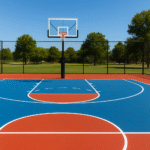



A half-court basketball setup is an ideal choice for limited spaces, residential properties, schools, clubs, and recreational facilities. While it occupies only a portion of a full-size basketball court, it still delivers the same excitement, performance, and practice benefits. Understanding the half-court basketball dimensions and construction requirements is crucial to ensure the court meets standard playing guidelines and provides a safe, enjoyable experience for players.
This guide explains everything about half-court dimensions, design layouts, flooring choices, and marking details, helping you plan or construct the perfect basketball half-court—whether for training, personal use, or community recreation.
What Is a Half-Court Basketball Layout?
A half-court basketball is essentially one half of a standard full-size court. It includes one basketball hoop, one free-throw lane, and the corresponding three-point arc, allowing players to practice shooting, dribbling, and defense in a smaller area.
Half-courts are ideal for 1-on-1, 2-on-2, or 3-on-3 games, training drills, or recreational play. They maintain the official proportion and layout of a full court but occupy less space—making them popular for homes, apartments, schools, and sports clubs.
Standard Half-Court Basketball Dimensions
The exact size of a half-court can vary depending on whether it follows NBA, FIBA, or High School standards. Below is a breakdown of each:
| Court Type | Full Court Dimensions | Half-Court Dimensions (Approx.) | Three-Point Line (From Hoop) |
|---|---|---|---|
| NBA (Professional) | 94 ft x 50 ft (28.65m x 15.24m) | 47 ft x 50 ft (14.32m x 15.24m) | 23.75 ft (7.24m) at top of arc |
| FIBA (International) | 91.86 ft x 49.21 ft (28m x 15m) | 45.93 ft x 49.21 ft (14m x 15m) | 22.15 ft (6.75m) |
| High School (USA) | 84 ft x 50 ft (25.6m x 15.24m) | 42 ft x 50 ft (12.8m x 15.24m) | 19.75 ft (6.02m) |
Note: Half-courts do not include the center circle or mid-court line, as play occurs entirely within one side of the court.
Key Markings and Zones in a Half-Court
Even though it’s smaller, a half-court includes all the essential basketball markings that support regulation-style play.
1. Free-Throw Line
-
Distance from the backboard: 15 feet (4.57 meters)
-
The line is 12 feet wide, marking the area for foul shots.
2. Three-Point Arc
-
The distance varies by level (NBA: 23.75 ft, FIBA: 22.15 ft, High School: 19.75 ft).
-
The arc starts from the basket’s center point and extends to both sides.
3. Free-Throw Lane (Key or Paint Area)
-
Width: 16 feet (NBA) or 12 feet (High School)
-
The rectangular “key” area extends from the baseline to the free-throw line.
4. Restricted Area Arc
-
Radius: 4 feet (NBA) or No-Contact Zone under the rim for player safety.
5. Baseline and Sidelines
-
The baseline marks the back boundary under the hoop.
-
Sidelines define the outer limits of play.
All lines are 2 inches (5 cm) wide and painted in white or contrasting colors for visibility.
Popular Half-Court Sizes for Different Spaces
Depending on the available area and use case, half-courts can be customized in various sizes:
| Court Type | Dimensions (Feet) | Usage |
|---|---|---|
| Professional Half-Court | 47 ft x 50 ft | Competitive and practice matches |
| Compact Half-Court | 42 ft x 50 ft | Schools, clubs, small gyms |
| Residential Half-Court | 30 ft x 50 ft or 28 ft x 46 ft | Backyard or private homes |
| Mini Practice Court | 25 ft x 45 ft | Limited space or junior players |
For residential projects, the minimum recommended space including safety buffer zones is around 30 ft x 50 ft, allowing enough clearance for comfortable play.
Surface Options for Half-Court Construction
The performance, comfort, and durability of your half-court largely depend on the flooring material you choose. Common options include:
1. Acrylic Flooring
-
Ideal for outdoor courts
-
UV-resistant and weatherproof
-
Available in anti-slip textured finishes
-
Low maintenance and cost-effective
2. Maple Wood Flooring
-
Preferred for indoor professional courts
-
Offers natural bounce and premium aesthetics
-
Provides excellent grip and shock absorption
3. Polyurethane (PU) Flooring
-
Seamless, cushioned indoor surface
-
Anti-slip, durable, and easy to clean
-
Great for training and multi-sport use
4. Modular PP Tiles
-
Quick-install interlocking system
-
Suitable for outdoor or indoor use
-
Water-drainage design prevents puddles
-
Available in multiple colors and patterns
Each surface type can be customized with anti-slip coatings, cushioned layers, and color zones for a professional finish.
Lighting and Accessories
For all-weather usability and extended play hours, proper lighting and accessories enhance the court’s functionality.
-
LED Floodlights: Provide uniform illumination for night play.
-
Adjustable Basketball Systems: Allow height variation for junior or professional play.
-
Protective Fencing: Ensures safety and prevents ball loss.
-
Scoreboards and Benches: Optional additions for advanced setups.
These elements make your half-court more engaging, professional, and player-friendly.
Benefits of a Half-Court Basketball Setup
-
Space Efficiency – Perfect for limited spaces such as backyards, schools, and indoor gyms.
-
Lower Construction Cost – Uses fewer materials and requires less land compared to full courts.
-
Easy Maintenance – Smaller area means simpler cleaning, resurfacing, and repairs.
-
Ideal for Training – Focused practice on shooting, dribbling, and footwork.
-
Customizable Design – Can include team logos, customized paint zones, or branding.
-
Versatility – Can double as a multi-sport play area for volleyball, badminton, or futsal when designed appropriately.
Half-Court Construction Guidelines
To build a professional-quality half-court, follow these essential construction steps:
-
Site Preparation – Level and compact the ground to ensure stability.
-
Base Formation – Use reinforced concrete (minimum 100 mm thick) for a solid, crack-resistant base.
-
Surface Coating – Apply anti-slip acrylic or PU coatings for grip and durability.
-
Line Marking – Use standard paint colors for clear visibility.
-
Equipment Installation – Fix the basketball pole, rim, and backboard securely at the correct height (10 ft).
-
Final Inspection – Ensure slope for water drainage (approx. 1%) and test bounce consistency.
With expert design and precision, your half-court can replicate professional quality even in a smaller format.
Maintenance Tips for Longevity
-
Regularly clean dust, leaves, or debris from the surface.
-
Repaint lines every 2–3 years for visibility.
-
Reseal or resurface periodically based on wear.
-
Check pole alignment and rim stability regularly.
-
Avoid using sharp or heavy objects that may damage the surface.
Routine upkeep ensures your half-court remains safe, visually appealing, and ready for daily play.
Conclusion
A half-court basketball setup is an excellent investment for any property — combining fun, fitness, and skill development in a compact space. By following the proper half-court basketball dimensions, choosing high-quality materials, and ensuring professional construction, you can enjoy a court that delivers authentic performance and long-lasting durability.