

Introduction
Basketball is gaining popularity across India as schools, colleges, sports academies, residential communities, and fitness centres increasingly recognize the importance of structured sports infrastructure. In Allahabad, officially known as Prayagraj, the development of modern basketball courts offers educational institutions, sports organizations, and private facility owners an opportunity to encourage athletic participation and provide better training environments.
However, building a high-quality basketball court involves much more than installing a basketball hoop and painting lines on a concrete surface. Successful basketball court construction in Allahabad requires careful site evaluation, soil preparation, foundation design, drainage planning, sports flooring selection, accurate court markings, and the installation of appropriate basketball equipment.
The local climate is another important consideration. Outdoor basketball courts must withstand intense summer sunlight, high temperatures, dust, and seasonal rainfall. Selecting a suitable flooring system and preparing a durable foundation can help minimize maintenance requirements and improve the long-term performance of the facility.
Whether you are planning a basketball court for a school, college, sports academy, housing society, government sports complex, or commercial sports centre, understanding the construction process can help you make informed decisions about design, materials, budget, and maintenance.
This comprehensive guide explains the essential aspects of basketball court construction in Allahabad (Prayagraj), including court dimensions, flooring options, construction stages, estimated costs, maintenance practices, and contractor selection.
Why Is Basketball Court Construction Important in Allahabad?
Investment in sports infrastructure can support physical fitness, athletic development, and community engagement. A professionally designed basketball court provides a dedicated space for organized training, recreational games, school competitions, and local tournaments.
1. Sports Infrastructure for Schools and Colleges
Educational institutions can use basketball courts to encourage students to participate in physical activities, develop coordination, and learn teamwork. A properly planned facility can accommodate physical education classes, regular practice sessions, inter-school competitions, and recreational games.
2. Training Facilities for Sports Academies
Basketball academies require consistent playing surfaces and correctly marked courts to support coaching programmes. Suitable flooring, reliable basketball equipment, and appropriate lighting can help create an environment for skill development and competitive preparation.
3. Recreational Facilities for Residential Communities
Housing societies, residential townships, and community centres can benefit from dedicated basketball courts that provide residents with opportunities for exercise and social interaction.
4. Commercial Sports and Fitness Facilities
Entrepreneurs developing sports complexes or multipurpose recreational centres can incorporate basketball courts to expand their facilities and attract players, coaches, schools, and sports groups.
5. Long-Term Value of Sports Infrastructure
A well-engineered court can deliver years of regular use when its foundation, flooring, drainage, and equipment are selected according to the intended application. Investing in construction quality from the beginning can help reduce avoidable repairs and premature resurfacing.
Types of Basketball Courts and Flooring Systems
The most suitable basketball court design depends on whether the facility will be installed indoors or outdoors, how frequently it will be used, the available budget, and the required playing characteristics.
1. Acrylic Basketball Court Flooring
Acrylic sports flooring is a popular option for outdoor basketball courts because it provides a finished playing surface with customizable colours and clearly defined court markings.
The system is generally applied over a properly prepared asphalt or concrete base using compatible primers, resurfacing materials, and sports coatings according to the manufacturer’s specifications.
Key advantages include:
- Suitable for many outdoor basketball facilities.
- Good surface traction when correctly specified and maintained.
- UV-resistant options for exposure to sunlight.
- Customizable colours and court designs.
- Straightforward routine cleaning.
- Repair and resurfacing options when the coating wears out.
For outdoor projects in Prayagraj, the complete flooring system should be selected for the local climate and expected usage. Acrylic coatings are not a substitute for a properly designed foundation, and they do not independently correct structural cracks or drainage problems.
2. Synthetic and Polyurethane Sports Flooring
Synthetic sports flooring includes several systems designed for recreational and competitive sports applications. Depending on the product, these may include polyurethane-based coatings, cushioned systems, and other specialized surfaces.
Some systems provide additional cushioning compared with conventional hard courts. However, impact absorption, traction, ball response, weather resistance, and maintenance requirements vary by product.
Before selecting a system, evaluate its suitability for basketball, installation requirements, outdoor exposure, and compatibility with the underlying base.
3. Rubberized Basketball Court Flooring
Rubberized flooring can be considered for selected recreational and multipurpose sports applications. Depending on the system, it may offer a more cushioned feel than a conventional hard surface.
However, not every rubber flooring product is suitable for basketball. The surface must provide appropriate traction, ball bounce, dimensional stability, and durability for the intended level of play.
4. Wooden Basketball Court Flooring
Wooden basketball flooring is primarily used for indoor sports halls, professional training facilities, and competition venues.
A professionally installed sports wood floor can provide consistent ball response and suitable playing characteristics when designed as a complete sports flooring system.
These systems require a suitable indoor environment, controlled moisture conditions, regular cleaning, and periodic professional maintenance. They are generally not the first choice for uncovered outdoor courts exposed to rainfall and direct sunlight.
5. Concrete and Asphalt Court Bases
Concrete and asphalt are primarily considered structural or base construction options rather than interchangeable finished sports flooring systems.
A properly designed concrete base can provide a stable foundation for suitable sports coatings. Asphalt can also serve as a base for compatible outdoor sports surfacing systems.
The selection depends on soil conditions, drainage, engineering requirements, local construction practices, and the proposed flooring material.
Standard Basketball Court Dimensions
Correct dimensions are essential for basketball courts intended for organized training and competitive play.
Under standard FIBA rules, a full-size basketball playing court measures:
- Length: 28 metres.
- Width: 15 metres.
- Playing area: 420 square metres, or approximately 4,521 square feet.
The total site requirement will be larger than the playing area because additional space may be necessary around the sidelines and endlines for player movement, safety, fencing, access, and equipment.
Important court markings include the centre line, centre circle, sidelines, endlines, free-throw lines, restricted areas, and three-point arcs.
Basketball hoops, backboards, and other equipment should be positioned according to the applicable specifications.
For schools and recreational facilities with limited space, a half-court layout may be a practical alternative. However, the dimensions and available clearance should be planned around the intended activities and user requirements.
If the court will host official competitions, the design should be checked against the current rules and facility requirements applicable to the intended level of play.
Step-by-Step Process for Basketball Court Construction in Allahabad
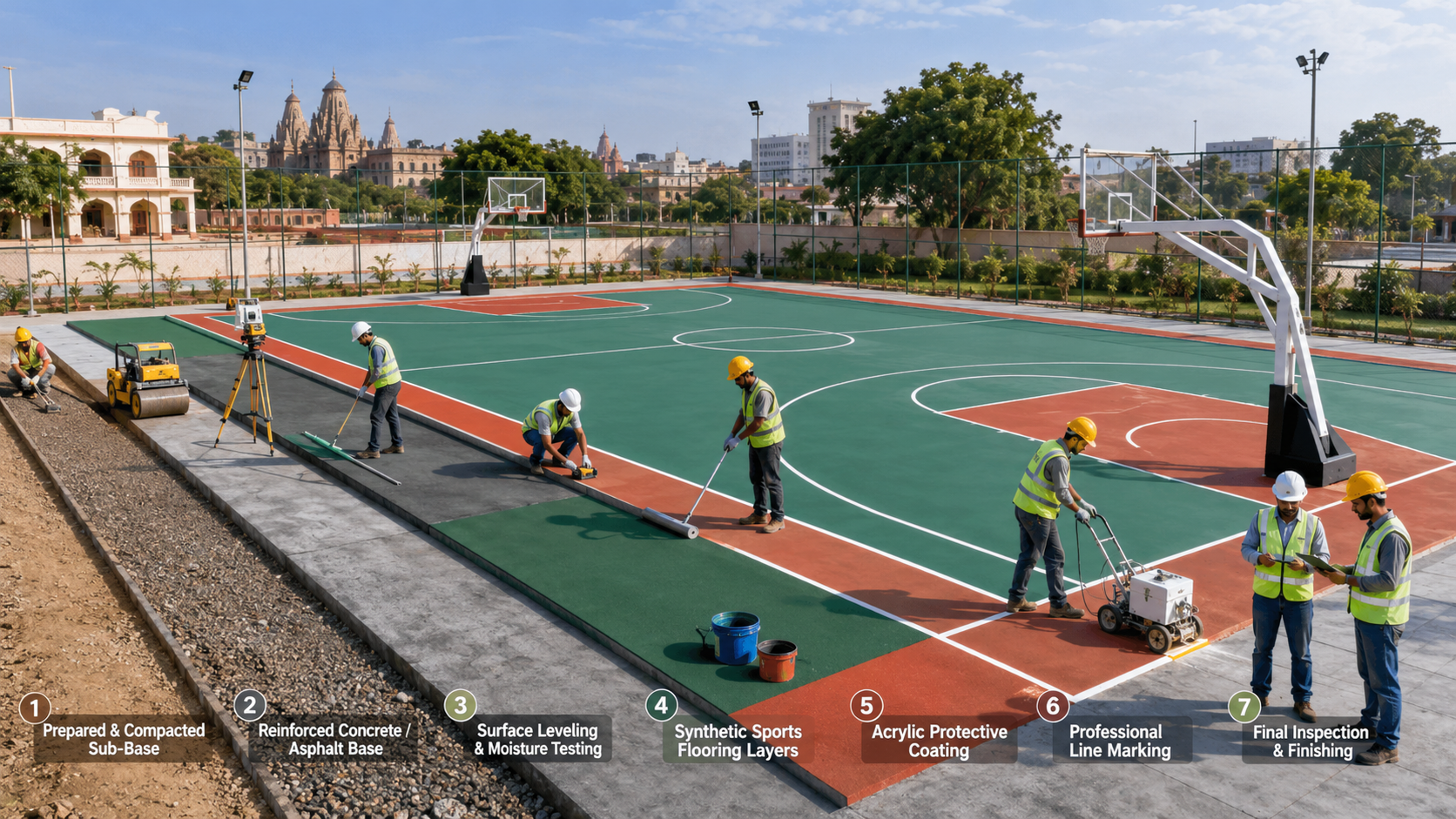
Professional basketball court construction involves several interconnected stages. Each stage affects the durability, safety, and playing quality of the finished facility.
Site Inspection and Feasibility Assessment
The project begins with an inspection of the proposed construction site.
The contractor or engineering team should evaluate soil conditions, ground levels, existing drainage, available space, access routes, surrounding buildings, and utility requirements.
For outdoor courts, the assessment should also consider exposure to direct sunlight, nearby trees, rainwater flow, and the possibility of water collecting around the playing area.
This information helps determine the appropriate base design, drainage arrangement, flooring system, and construction budget.
Site Clearing and Ground Preparation
The construction area is cleared of vegetation, debris, loose material, and unsuitable soil.
The ground is then graded and compacted according to the approved design. Where necessary, weak soil may need to be removed, replaced, or treated.
Proper compaction is essential because settlement beneath the court can cause unevenness, cracking, and premature damage to the finished flooring.
Foundation and Base Construction
The foundation provides the structural support for the basketball court.
Depending on site conditions and the selected surface, the base may consist of engineered granular layers, asphalt, reinforced concrete, or a combination of suitable materials.
Important considerations include:
- Soil-bearing capacity and compaction.
- Base thickness and structural design.
- Surface levels and dimensional accuracy.
- Appropriate joints and crack-control measures.
- Drainage slope and water discharge.
- Compatibility with the proposed sports flooring.
The design should be prepared according to actual site conditions rather than relying on a single construction specification for every project.
For outdoor facilities in Allahabad, effective drainage is particularly important because seasonal rainfall can affect both the playing surface and the underlying base.
Step 4: Drainage Planning and Surface Protection
Drainage should be integrated into the project from the beginning.
The court and surrounding areas must be designed so rainwater can move away from the playing surface without collecting near the foundation or entering adjoining buildings.
Depending on the site, drainage solutions may include suitable surface gradients, perimeter drains, channels, and properly positioned outlets.
Drainage requirements must be coordinated with the base and flooring design. Simply applying a waterproof or synthetic coating will not solve an underlying water-management problem.
Step 5: Sports Flooring Installation
After the base has achieved the required condition, the selected flooring system can be installed.
For acrylic basketball courts, the process may involve surface cleaning, crack treatment where appropriate, compatible priming, resurfacing layers, and the application of specified sports coatings.
Each material must be applied according to the manufacturer’s instructions, including requirements for surface moisture, temperature, curing, and recoat intervals.
For indoor wooden courts, installation involves a different process that may include a prepared subfloor, a sports flooring support system, wooden flooring, finishing, and protective coatings.
The correct installation procedure depends on the selected product and its technical specifications.
Step 6: Basketball Court Line Marking
Accurate line marking is essential for consistent gameplay and organized competitions.
The court layout is measured carefully, and the relevant markings are applied using compatible sports marking materials.
These markings typically include the centre circle, free-throw lines, restricted areas, three-point arcs, sidelines, and endlines.
Colour combinations, logos, and customized designs may be incorporated when they do not interfere with the visibility of the playing lines.
Step 7: Basketball Hoop and Equipment Installation
The final construction stage includes installing the basketball system and other required facilities.
Equipment may include backboards, hoops, nets, support poles, anchoring systems, and protective padding.
The basketball system should be securely installed, with appropriate clearances and safety provisions around the playing area.
Depending on the project, additional facilities may include fencing, floodlights, player benches, seating, scoreboards, and access pathways.
Before opening the court, the completed facility should be inspected for surface defects, equipment stability, drainage performance, and marking accuracy.
Basketball Court Construction Cost in Allahabad
The cost of basketball court construction in Allahabad varies according to the site, court dimensions, flooring specifications, foundation requirements, equipment, and additional facilities.
As a preliminary budgeting reference, the following illustrative flooring rates may be considered. These figures are not verified current market quotations and should be confirmed with suppliers and contractors.
| Flooring system | Indicative flooring cost |
|---|---|
| Acrylic sports flooring | ₹70–₹90 per sq. ft. |
| Rubber or PVC sports flooring | ₹90–₹120 per sq. ft. |
| Wooden indoor sports flooring | ₹250–₹350 per sq. ft. |
Actual prices can differ significantly depending on product quality, system thickness, cushioning, surface preparation, installation requirements, and project location.
A complete outdoor basketball court project may cost approximately ₹8 lakh to ₹15 lakh or more, depending on the scope of work. This range should be treated as a preliminary estimate rather than a guaranteed price or fixed quotation.
The final cost may be higher where extensive earthwork, retaining structures, advanced drainage, premium sports flooring, lighting, fencing, or specialized basketball equipment is required.
Factors That Influence the Total Project Budget
Site preparation: Clearing, excavation, grading, soil replacement, and compaction can influence initial costs.
Foundation construction: The base material, thickness, reinforcement, and structural requirements affect the overall budget.
Flooring selection: Acrylic, polyurethane, rubberized, and wooden systems have different material and installation costs.
Drainage arrangements: Surface grading, drainage channels, and outlets add to project costs but are important for long-term performance.
Basketball equipment: The cost depends on the backboard type, hoop quality, support structure, anchoring arrangement, and protective padding.
Lighting and fencing: Floodlights, electrical work, perimeter fencing, and safety barriers may be necessary depending on the location and intended use.
Transportation and installation: Material delivery, labour, equipment handling, and site accessibility also affect the final quotation.
Maintenance planning: Cleaning, inspections, repairs, resurfacing, and equipment replacement should be considered when evaluating the long-term cost of ownership.
For a more reliable estimate, request a detailed quotation that separates civil work, sports flooring, equipment, electrical work, and other project components.
Important Factors to Consider Before Construction
Before starting a basketball court project, evaluate the following requirements carefully.
Indoor or Outdoor Location
An outdoor court generally requires weather-resistant materials and effective drainage. An indoor court requires attention to ventilation, moisture control, lighting, ceiling clearance, and the appropriate sports flooring system.
Intended Level of Play
A recreational court may have different requirements from a facility intended for academy training or official competition. The design should reflect the expected usage and applicable rules.
Available Space
The project should account for the playing area as well as surrounding clearance, equipment, player access, fencing, and maintenance access.
Flooring Performance
Traction, ball response, durability, impact absorption, and ease of maintenance should be evaluated together. A surface should not be selected on appearance or price alone.
Climate and Environmental Exposure
Outdoor courts in Prayagraj must be designed for hot weather, dust, direct sunlight, and seasonal rain. Product specifications and installation procedures should reflect these conditions.
Future Maintenance
Choose materials and construction methods that can be inspected, repaired, and maintained appropriately throughout the facility’s expected service life.
Basketball Court Maintenance and Longevity
Regular maintenance protects the investment in sports infrastructure and helps preserve the court’s playing characteristics.
Routine Cleaning
Remove dust, leaves, mud, and other debris from the playing surface. Use cleaning methods and products compatible with the installed flooring system.
Surface Inspection
Check periodically for cracks, peeling, unevenness, loose components, faded markings, and other visible defects. Address problems early to help prevent further deterioration.
Drainage Management
Keep drainage channels and outlets clear, particularly before and during the rainy season. Investigate recurring water accumulation instead of treating it as a routine cleaning issue.
Flooring Repairs and Resurfacing
Acrylic and other synthetic systems may require repairs or resurfacing as they age. The timing depends on the product, usage, environmental exposure, installation quality, and maintenance history.
Equipment Safety Checks
Inspect hoops, backboards, support structures, anchors, nets, and protective padding regularly. Any loose or damaged equipment should be repaired before the court returns to use.
Indoor Wooden Floor Care
Wooden basketball floors need appropriate cleaning, moisture management, periodic finishing, and professional inspection. Excessive moisture and unsuitable cleaning chemicals should be avoided.
Common Mistakes to Avoid During Basketball Court Construction
Several construction mistakes can affect court quality and increase long-term expenses.
- Ignoring soil conditions: Inadequate ground preparation can lead to settlement and surface cracking.
- Underestimating drainage: Poor water management can damage the base and flooring system.
- Choosing flooring only by price: Low initial costs may not provide the performance or durability required for the intended application.
- Using unsuitable coatings: Products should be specifically appropriate for the selected sports application and exposure conditions.
- Neglecting court dimensions: Incorrect markings or inadequate clearance can reduce the usefulness of the facility.
- Installing equipment without proper safety provisions: Basketball systems need secure anchoring and suitable protection.
- Skipping final inspection: The finished court should be checked before players begin using it.
Careful planning and quality control throughout the construction process can help avoid these problems.
How to Choose the Right Basketball Court Construction Company in Allahabad
Selecting an experienced sports infrastructure contractor is an important step in achieving a durable and professionally finished court.
Before finalizing a company, review its experience in basketball court construction, previous project examples, sports flooring expertise, and understanding of outdoor and indoor construction requirements.
Ask the contractor to explain the proposed foundation design, drainage system, flooring materials, installation sequence, equipment specifications, and quality-control procedures.
It is also advisable to request a written quotation that identifies the scope of work, material specifications, exclusions, project timeline, warranty conditions, and recommended maintenance practices.
Where possible, inspect completed projects to assess the quality of the surface, line markings, finishing, and equipment installation.
A reliable contractor should offer a solution suited to the project’s actual requirements rather than recommending the same flooring system for every site.
Why Consider Sports-Facility.in for Basketball Court Construction?
Organizations planning a new basketball court can explore sports infrastructure and flooring solutions from Sports-Facility.in.
When evaluating a potential service provider, discuss your site requirements, intended court usage, available budget, flooring preferences, and installation expectations.
A project-specific assessment can help establish the appropriate construction scope, including base preparation, drainage, sports flooring, line marking, basketball equipment, and associated facilities.
Request detailed technical specifications and a project quotation before finalizing the design and materials.
Conclusion
Basketball court construction in Allahabad (Prayagraj) requires a combination of sound engineering, suitable sports flooring, accurate court dimensions, effective drainage, and professional installation. Each component contributes to the court’s safety, playing quality, durability, and long-term maintenance requirements.
For outdoor facilities, acrylic and other suitable synthetic sports flooring systems can provide practical options when installed over a properly designed base. Indoor facilities may benefit from specialized wooden or synthetic sports flooring selected according to the level of play and building conditions.
Schools, colleges, sports academies, residential communities, government organizations, and commercial sports operators should assess their available space, expected usage, environmental exposure, and total project budget before construction begins.
By prioritizing foundation quality, drainage, appropriate materials, accurate markings, and equipment safety, project owners can create a basketball facility that supports recreational activities, structured training, and long-term sports development.
If you are planning basketball court construction in Allahabad (Prayagraj), visit Sports-Facility.in to explore sports infrastructure solutions and discuss the requirements of your proposed project.
Frequently Asked Questions
1. What is the standard size of a basketball court?
A standard FIBA basketball playing court measures 28 metres long and 15 metres wide, providing a playing area of 420 square metres. Additional space is required around the court for safety and access.
2. Which flooring is suitable for an outdoor basketball court in Allahabad?
Acrylic sports flooring is a common option for outdoor basketball courts. Other synthetic systems may also be suitable, depending on their performance specifications, weather resistance, budget, and compatibility with the underlying base.
3. How much does basketball court construction cost in Allahabad?
The total cost depends on court dimensions, soil conditions, base construction, flooring, drainage, basketball equipment, lighting, and fencing. A preliminary project budget may be around ₹8 lakh to ₹15 lakh or more, but a site-specific quotation is necessary to establish the actual cost.
4. How long does it take to construct a basketball court?
The construction period depends on site preparation, foundation work, curing requirements, flooring installation, weather conditions, and equipment availability. The contractor should provide a realistic project schedule after assessing the site and specifications.
5. Can a basketball court be constructed in a school or residential society?
Yes. Basketball courts can be developed in schools, colleges, housing societies, academies, clubs, and recreational facilities. The design should account for available space, intended usage, safe clearances, drainage, and the appropriate flooring system.
6. How can I maintain an outdoor basketball court?
Regular cleaning, drainage maintenance, surface inspections, timely repairs, equipment checks, and periodic resurfacing when required can help preserve the court’s condition and playing performance.
7. What should I check before hiring a basketball court contractor?
Review previous projects, flooring expertise, foundation and drainage specifications, equipment quality, installation procedures, warranty terms, maintenance guidance, and the detailed project quotation before making a decision.