

An outdoor basketball court is more than just a playing area—it’s a space for recreation, skill development, and community engagement. Whether built for a school, sports complex, housing society, or backyard, understanding the correct basketball court measurements is essential to achieve professional standards of play, safety, and performance.
This comprehensive guide explores standard outdoor basketball court dimensions, layout details, design considerations, and key construction insights to help you plan and build a world-class court for your space.
Why Measurements Matter in Outdoor Basketball Court Design
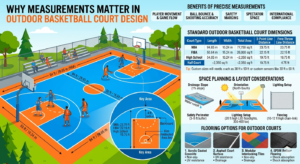
Every successful basketball court starts with precise measurements and layout planning. The dimensions directly influence:
-
Player movement and game flow
-
Ball bounce and shooting accuracy
-
Safety margins around boundaries
-
Spectator space and accessibility
-
Compliance with international standards
Accurate sizing ensures the court feels natural to players—whether it’s for professional matches, school training, or friendly outdoor games.
Standard Outdoor Basketball Court Dimensions
Outdoor basketball courts can be built to different standards depending on the level of play—NBA, FIBA, or High School. Below is a quick reference chart:
| Court Type | Length | Width | Total Area | 3-Point Line Distance | Free-Throw Line Distance |
|---|---|---|---|---|---|
| NBA (Professional) | 94 ft (28.65 m) | 50 ft (15.24 m) | 4,700 sq. ft | 23.75 ft (7.24 m) | 15 ft (4.57 m) |
| FIBA (International) | 91.86 ft (28 m) | 49.21 ft (15 m) | 4,520 sq. ft | 22.15 ft (6.75 m) | 15.09 ft (4.6 m) |
| High School | 84 ft (25.6 m) | 50 ft (15.24 m) | 4,200 sq. ft | 19.75 ft (6.02 m) | 15 ft (4.57 m) |
| Half Court (Outdoor) | 47 ft (14.32 m) | 50 ft (15.24 m) | ~2,350 sq. ft | Same as full court | 15 ft (4.57 m) |
Tip: For residential or recreational outdoor courts, custom sizes like 30 ft x 50 ft or 40 ft x 60 ft are also common, offering flexibility based on available space.
Key Zones and Markings in an Outdoor Basketball Court
Even though the play area is outdoors, the markings must match the regulation pattern to maintain gameplay consistency. Here are the critical areas:
1. Playing Boundary (Sidelines and Baselines)
-
Sidelines: The longer boundary lines (court length).
-
Baselines: The shorter boundary lines behind each hoop.
-
Recommended safety buffer: at least 3–5 feet beyond boundary lines to allow player movement.
2. Free-Throw Lane (Key Area)
-
Width: 16 ft (NBA) or 12 ft (High School).
-
Length from baseline to free-throw line: 19 ft (NBA).
-
The free-throw line is 15 ft from the backboard.
3. Three-Point Arc
-
Measured from the center of the basket to the arc’s top:
-
23.75 ft (NBA)
-
22.15 ft (FIBA)
-
19.75 ft (High School)
-
-
The sides of the arc are shorter (approx. 22 ft) due to court width limits.
4. Center Circle
-
Diameter: 12 ft (3.66 m).
-
Used for tip-off in full-court games.
5. Restricted Area Arc
-
Radius: 4 ft from the center of the basket.
-
Prevents defensive players from taking charges too close to the hoop.
6. Backboard and Rim Placement
-
Backboard size: 6 ft wide x 3.5 ft high (1.83m x 1.07m).
-
Rim height: 10 ft (3.05 m) above the playing surface.
-
The backboard extends 4 ft from the baseline into the court.
All markings are 2 inches (5 cm) wide and painted in bright, non-slip, weather-resistant colors (usually white or yellow).
Space Planning and Layout Considerations
When designing an outdoor basketball court, it’s important to plan beyond the basic dimensions. Key space factors include:
-
Safety Perimeter:
-
Add 3–5 ft around the court to prevent collisions with walls or fences.
-
Total site area including buffer: approx. 100 ft x 56 ft (30.5m x 17m) for a full court.
-
-
Drainage Slope:
-
Maintain a 1% slope (about 1 inch every 10 feet) for effective rainwater runoff.
-
-
Orientation:
-
Position the court north-south to minimize glare and shadow during play.
-
-
Lighting Setup:
-
Install LED floodlights (minimum 300–400 lux for recreational use).
-
Mount lights on poles at least 20 ft high, ensuring even illumination without glare.
-
-
Fencing:
-
Install chain-link fencing (10–12 ft high) for safety and ball containment.
-
Flooring Options for Outdoor Basketball Courts
Outdoor basketball courts face varying weather conditions, so the flooring material must ensure durability, traction, and low maintenance. Common surface choices include:
1. Acrylic Coated Concrete
-
Popular for outdoor use due to excellent grip and UV resistance.
-
Non-slip finish suitable for all weather conditions.
-
Available in multiple vibrant colors.
2. Asphalt Court Surface
-
Traditional choice for public and community courts.
-
Cost-effective and easy to install.
-
Requires periodic resurfacing to maintain texture.
3. Modular Interlocking Tiles
-
Made from high-quality polypropylene (PP).
-
Anti-slip texture and built-in water drainage.
-
Quick installation, portable, and available in custom designs.
4. EPDM Rubber Flooring
-
Provides excellent shock absorption and anti-slip grip.
-
Ideal for multi-sport outdoor zones.
-
Resistant to extreme temperatures and UV rays.
Recommended Accessories and Features
Enhance your outdoor basketball court experience with the right add-ons and accessories:
-
Adjustable basketball poles and hoops for varying age groups.
-
Court lighting systems for night play.
-
Bleachers or benches for spectators.
-
Scoreboard systems for clubs or tournaments.
-
Protective fencing and netting to maintain safety.
-
Drainage channels to avoid waterlogging during monsoon seasons.
These additions not only improve functionality but also create a professional playing environment.
Maintenance Tips for Outdoor Courts
Outdoor basketball courts require regular upkeep to ensure long-term performance and player safety.
-
Clean debris and leaves weekly to maintain traction.
-
Recoat acrylic or paint lines every 3–5 years.
-
Check drainage before monsoon seasons.
-
Inspect rim, net, and pole for rust or wear.
-
Avoid standing water to prevent surface damage.
With proper care, an outdoor basketball court can last 10–15 years with minimal maintenance.
Customizing Outdoor Court Dimensions
While professional courts follow strict measurements, recreational courts can be customized to fit available space.
Common custom sizes include:
-
30 ft x 50 ft: Compact residential courts
-
40 ft x 60 ft: Ideal for apartment or community complexes
-
47 ft x 50 ft: Regulation half-court for training and 3-on-3 games
Custom designs can include multi-sport markings (for volleyball or badminton) or branding with school or club logos.
Conclusion
An outdoor basketball court is a fantastic addition to any space, providing opportunities for recreation, fitness, and professional training. By following standard basketball court measurements, using high-quality materials, and ensuring proper construction techniques, you can create a durable, safe, and high-performance court suitable for all ages.
Whether you’re building a full-size professional court or a compact half-court, precision in measurement and attention to detail are key. A perfectly sized court not only meets international standards but also guarantees years of enjoyable and competitive play under the open sky.
FAQs – Outdoor Basketball Court Measurements
1. What are the standard outdoor basketball court dimensions?
The standard outdoor basketball court size used by professional organizations like the National Basketball Association is 94 feet long and 50 feet wide (28.65 m × 15.24 m). However, many outdoor courts in schools, parks, and residential areas may use slightly smaller dimensions depending on available space.
2. What are the half-court measurements for outdoor basketball?
A half basketball court typically measures 50 feet wide and 47 feet long. Half courts are commonly used in residential complexes, community parks, training facilities, and recreational areas where full court space is limited.
3. What is the standard height of a basketball hoop?
The official basketball hoop height is 10 feet (3.05 meters) from the playing surface to the rim. This height is consistent across professional leagues, including the National Basketball Association and the International Basketball Federation.
4. What is the distance of the three-point line on an outdoor basketball court?
Three-point line distance varies by competition level:
-
NBA: 23.75 feet (7.24 m) from the basket
-
FIBA: 22.15 feet (6.75 m)
-
Recreational courts: Often adjusted between 19–22 feet depending on court size.
5. What are the key area (paint) measurements on a basketball court?
The key area, also called the paint or free-throw lane, typically measures:
-
Width: 16 feet (NBA standard)
-
Free-throw line distance: 15 feet from the backboard
-
Free-throw circle diameter: 12 feet
These measurements help regulate player positioning during free throws.
6. How far is the free-throw line from the basket?
The free-throw line is 15 feet (4.57 meters) away from the backboard. This distance is standardized by organizations such as the International Basketball Federation and the National Basketball Association.
7. What is the recommended space around an outdoor basketball court?
For safety and proper movement, it is recommended to have at least 3–10 feet of clearance around the court boundary lines. Professional courts usually include additional run-off space to prevent player injuries.
8. Can outdoor basketball courts have custom measurements?
Yes. Many outdoor courts in schools, residential societies, sports academies, and public parks use custom court dimensions to fit the available land area. However, maintaining proportional measurements for the key lines, free-throw area, and hoop height is recommended for proper gameplay.