

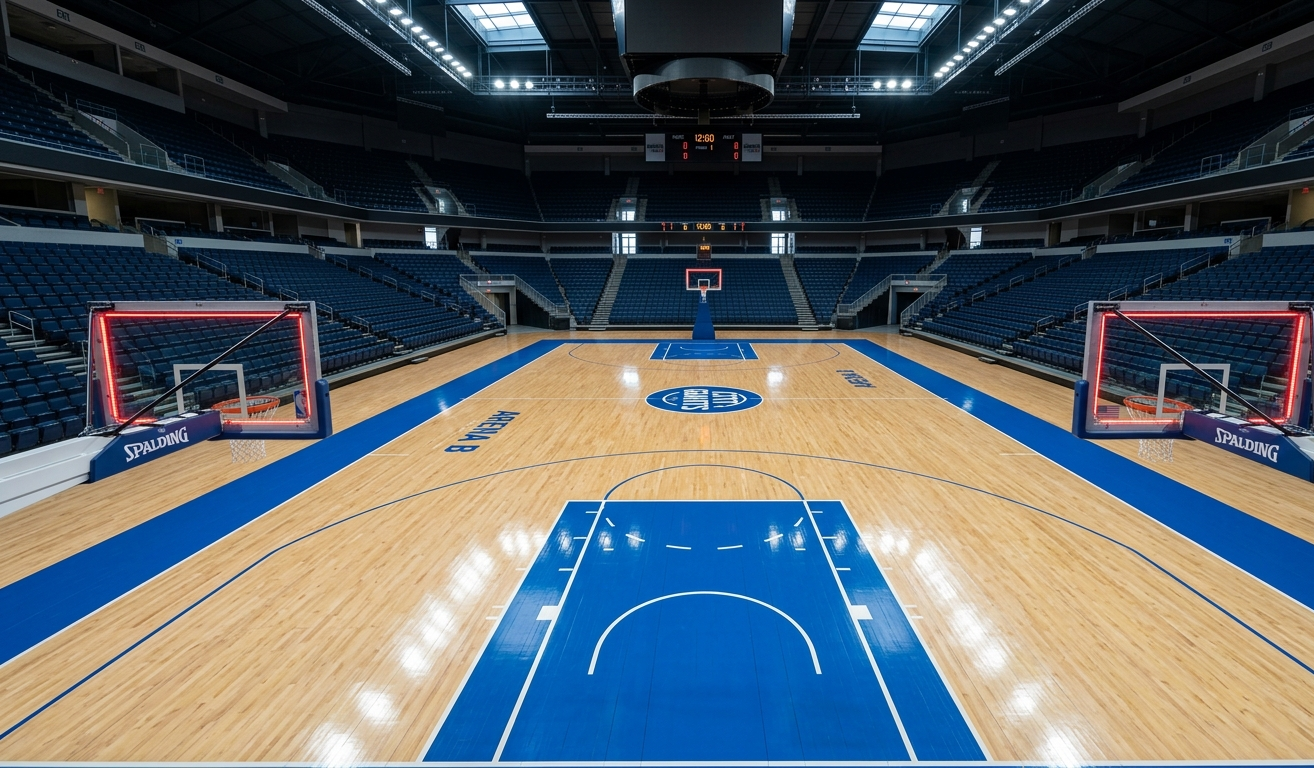
A basketball court is much more than a flat surface with lines — it’s a carefully measured design that defines the structure, flow, and fairness of the game. Every marking on a professional basketball court serves a specific purpose, ensuring that players, referees, and coaches operate within clear boundaries and rules.
Understanding professional basketball court markings is essential for anyone involved in court construction, design, or sports facility management. Proper markings enhance gameplay accuracy, safety, and consistency, aligning with international standards set by organizations such as FIBA (International Basketball Federation) and the NBA (National Basketball Association).
The Importance of Accurate Basketball Court Markings
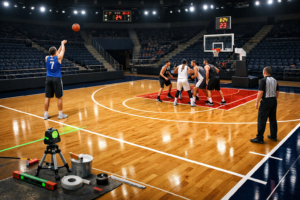
Markings on a basketball court are not just aesthetic—they represent the game’s geometry. Accurate markings ensure:
-
Fair and consistent gameplay according to global standards.
-
Player orientation, allowing athletes to position themselves correctly for shots, defense, and rebounds.
-
Referee accuracy, helping officials enforce rules with precision.
-
Training efficiency, as players can practice professional-level movements and spacing.
Whether constructing an indoor or outdoor basketball court, precision in measurement and alignment is crucial to meet official regulations and create a world-class playing environment.
Official Standards for Professional Basketball Court Markings
There are two main governing standards for professional basketball courts: FIBA (used globally) and NBA (used in the United States). While similar in layout, their dimensions differ slightly. Below are the essential markings and their specifications.
1. Court Boundary Lines
The outermost markings define the play area.
-
Sidelines: The two longer boundary lines running along the court’s length.
-
NBA: 94 feet (28.65 meters)
-
FIBA: 28 meters (91.86 feet)
-
-
Baselines/End Lines: The shorter lines behind each basket.
-
NBA: 50 feet (15.24 meters)
-
FIBA: 15 meters (49.21 feet)
-
These boundary lines define the live playing area — when the ball crosses these lines, it is out of bounds.
2. Center Circle
-
Radius: 6 feet (1.8 meters).
-
Diameter: 12 feet (3.6 meters).
It ensures equal opportunity for both teams to contest the initial possession.
3. Mid-Court Line (Half-Court Line)
This line divides the court into two equal halves. It is essential for determining backcourt violations — once the offensive team crosses this line with the ball, they cannot return it to the backcourt.
The mid-court line also includes the center circle and a small restraining circle around it for referee positioning during jump balls.
4. Three-Point Line
Perhaps the most recognized marking in basketball, the three-point line defines the arc beyond which shots are awarded three points.
-
NBA Distance: 23.75 feet (7.24 meters) from the basket at the top of the key, 22 feet (6.7 meters) from the corners.
-
FIBA Distance: 6.75 meters (22.15 feet) from the basket all around.
The three-point line is measured from the center of the basket and is a smooth arc that extends around both sides of the key.
5. Free-Throw Line and Circle
The free-throw line is located directly in front of each basket and is used for penalty shots following fouls.
-
Distance from Backboard: 15 feet (4.57 meters).
-
Free-Throw Circle Radius: 6 feet (1.8 meters).
Players must remain behind the line during a free throw attempt and cannot step on or over it until the ball hits the rim. The free-throw circle helps ensure shooters stay properly positioned.
6. Key (Paint Area or Free-Throw Lane)
The key is the rectangular area extending from the baseline to the free-throw line, also known as the paint because it’s often filled with color.
-
NBA Dimensions: 16 feet wide x 19 feet deep (4.9m x 5.8m).
-
FIBA Dimensions: 16 feet wide x 19.7 feet deep (4.9m x 6m).
Inside the key, you’ll find the lane lines, which mark player positions during free throws. This zone is crucial for rebounds, post plays, and defending the basket.
7. Restricted Area (No-Charge Semi-Circle)
This is a semi-circular arc located directly beneath the basket. It’s used to determine charging fouls.
-
Radius: 4 feet (1.22 meters) from the center of the basket.
If a defender is standing inside this area while taking contact, it’s not considered an offensive foul. This rule encourages safer, more dynamic play under the rim.
8. Team Bench Area and Scorer’s Table Zone
Located along one sideline, the team benches and scorer’s table area are designated with specific markings.
These zones ensure order, proper substitution management, and clear space for officials.
9. The No-Play Zones (Referee and Technical Areas)
Professional court layouts include off-court markings for referees, scorekeepers, and coaches. These ensure that only authorized personnel enter specific areas during the game.
Line Colors and Width
All basketball court markings must be clearly visible and of contrasting color to the surface.
-
Standard Line Width: 2 inches (5 cm).
-
Recommended Colors: White, yellow, or black (depending on surface tone).
-
Paint Finish: Non-slip, high-contrast, UV-resistant acrylic paint for longevity and safety.
For multi-purpose courts, distinct color schemes can differentiate basketball lines from other sports such as volleyball or badminton.
Professional Marking Techniques
Professional basketball court markings require precision, specialized equipment, and durable materials. The marking process typically includes:
-
Surface Preparation: Cleaning and leveling the surface to remove dust and moisture.
-
Measuring and Layout: Using laser-guided tools or chalk lining to ensure accurate geometry.
-
Line Application: Applying premium-grade sports paint resistant to abrasion and fading.
-
Finishing and Coating: Adding protective sealant for enhanced durability and color retention.
The markings should comply with FIBA, NBA, or client-specific standards based on court type — indoor or outdoor.
Indoor vs. Outdoor Marking Considerations
Indoor Courts
-
Usually made of hard maple wood or synthetic PU flooring
-
Require precision for tournament certification.
Outdoor Courts
-
Constructed from acrylic-coated concrete, asphalt, or modular tiles.
-
Use weatherproof, UV-resistant paint.
-
Often include anti-slip textures and water drainage markings for safe play in varied conditions.
Why Professional Markings Matter
Accurate basketball court markings bring multiple advantages:
-
Compliance: Meets FIBA or NBA specifications for official play.
-
Safety: Prevents player confusion and ensures correct positioning.
-
Performance: Improves shot accuracy and game strategy understanding.
-
Professional Appearance: Enhances the visual appeal of sports facilities.
-
Longevity: Durable markings reduce the need for frequent repainting or resurfacing.
For schools, clubs, or commercial complexes, professional marking boosts the facility’s credibility and readiness for tournaments or training camps.
Conclusion
A professionally marked basketball court represents the perfect balance between art and precision.
Whether building a professional indoor arena or a durable outdoor court, accurate markings following FIBA or NBA standards ensure your facility meets global expectations for safety, fairness, and performance.
With expert planning, high-quality materials, and attention to detail, you can create a basketball court that not only meets international specifications but also inspires athletes to play their best game.
FAQs – Professional Basketball Court Markings
1. What are professional basketball court markings?
Professional basketball court markings are the standard lines and boundary areas drawn on a basketball court to define gameplay zones such as the center circle, free-throw line, three-point arc, key area, and sidelines. These markings follow official rules set by organizations like the National Basketball Association and the International Basketball Federation.
2. What lines are included in professional basketball court markings?
A professional basketball court includes several essential markings:
-
Boundary lines (sidelines and baselines)
-
Center line and center circle
-
Free-throw line and free-throw circle
-
Three-point arc
-
Key area or paint
-
Restricted area arc
-
Half-court line
These markings ensure the game is played according to official basketball regulations.
3. What is the standard width of basketball court lines?
Professional basketball court lines are typically 2 inches (5 cm) wide. This standard width ensures the markings are clearly visible for players, referees, and spectators.
4. What is the center circle in professional basketball?
The center circle is located at the middle of the court and is used for the opening jump ball. It has a standard diameter of 12 feet (3.66 meters) according to rules set by International Basketball Federation.
5. What is the purpose of the three-point line?
The three-point line marks the boundary from which a successful shot scores three points instead of two. The distance varies depending on the governing body:
-
NBA: 23.75 feet (7.24 m)
-
FIBA: 22.15 feet (6.75 m)
6. What is the key area or paint on a basketball court?
The key area, also known as the paint or lane, is the rectangular zone under the basket. It is used for free-throw positioning, defensive rules, and restricted player movement during certain plays.