Introduction
Selecting the right basketball court flooring is an important decision for schools, sports academies, clubs, stadiums, residential communities, and commercial sports facilities. The type of surface you choose can influence player comfort, ball response, traction, durability, maintenance requirements, and the overall cost of the project.
Among the most commonly used basketball court surfaces are acrylic flooring, PU (polyurethane) flooring, and wooden flooring. Each system is designed for different playing environments and facility requirements.
Acrylic basketball courts are widely preferred for outdoor applications because they are durable, weather-resistant, and comparatively economical. PU basketball court flooring is commonly selected for indoor sports facilities where cushioning, comfort, and versatility are important. Wooden basketball courts are traditionally associated with professional indoor arenas because of their premium playing characteristics and appearance.
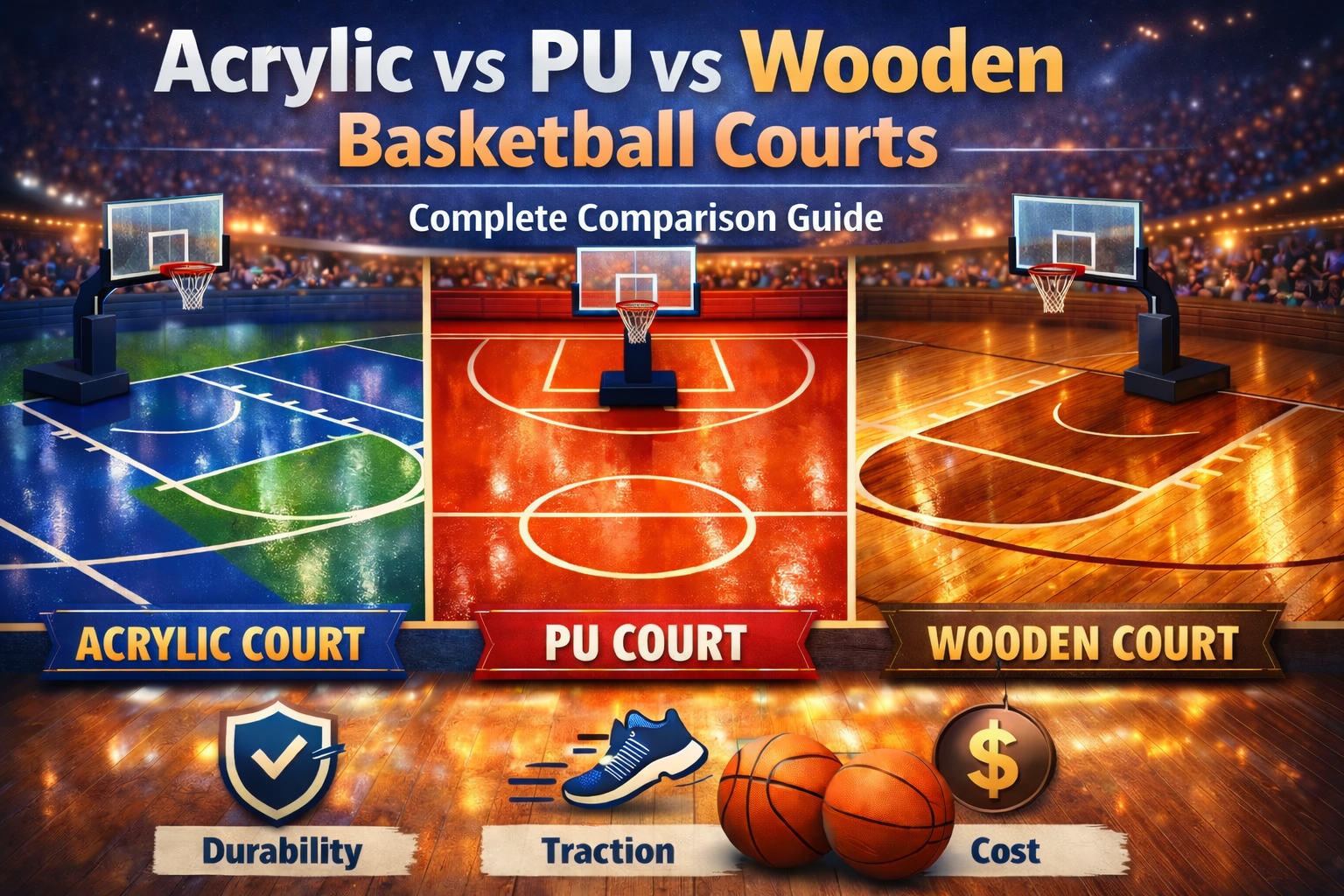
This complete comparison guide explains the differences between acrylic vs PU vs wooden basketball courts, including construction, performance, durability, maintenance, cost considerations, safety, and indoor or outdoor suitability.
Key Factors to Consider When Choosing Basketball Court Flooring
Before selecting a basketball court surface, it is important to evaluate the following factors:
1. Shock Absorption
Shock absorption helps reduce the impact transferred to players during running, jumping, landing, and rapid changes in direction. Cushioned surfaces can provide greater underfoot comfort than traditional hard surfaces.
2. Ball Response and Bounce
A consistent and uniform surface helps provide predictable basketball bounce and supports smooth gameplay.
3. Grip and Traction
Adequate traction is essential for controlled movement, quick stops, acceleration, and changes in direction while helping reduce unwanted slipping.
4. Durability
The flooring system should be selected according to expected usage, environmental exposure, traffic levels, and maintenance practices.
5. Maintenance
Different surfaces require different cleaning, inspection, recoating, polishing, or resurfacing procedures. Maintenance requirements should be considered as part of the long-term project cost.
6. Installation Cost
The initial investment varies according to the flooring material, court size, subfloor condition, installation method, cushioning system, and project specifications.
What Is an Acrylic Basketball Court?
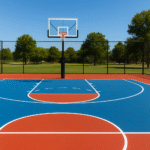
An acrylic basketball court is a synthetic sports surface generally installed over a properly prepared concrete or asphalt base. Acrylic court systems are particularly common for outdoor basketball courts because they can be designed to withstand regular outdoor exposure.
The system can include multiple coating layers that create a textured, durable playing surface with suitable traction and consistent ball response.
Acrylic flooring can be used for:
- Outdoor basketball courts
- School playgrounds
- Sports academies
- Community recreation areas
- Residential basketball courts
- Clubs and training facilities
Acrylic Basketball Court Construction and Surface Layers
A typical acrylic basketball court system may include:
- Properly prepared concrete or asphalt base
- Primer, where required
- Surface crack treatment and leveling
- Acrylic resurfacer
- Cushioning layer, where specified
- Acrylic color coating
- Textured finish
- Basketball court line marking
The exact layer configuration depends on the project requirements, base condition, selected acrylic system, and desired performance characteristics.
Advantages of Acrylic Basketball Court Flooring
Cost-Effective Solution
Acrylic systems are generally suitable for facilities looking for a practical sports surface with comparatively lower initial investment.
Suitable for Outdoor Applications
Acrylic coatings are commonly selected for outdoor basketball courts because the system can be designed to handle sunlight and changing weather conditions.
Low Maintenance
Routine cleaning and periodic inspection can help maintain the surface and playing characteristics.
Good Traction
A properly textured acrylic surface can provide suitable grip for basketball activities.
Customizable Appearance
Acrylic basketball courts can be finished in different colors and court-marking combinations to create a professional sports environment.
Limitations of Acrylic Basketball Courts
Although acrylic flooring is versatile, it is a relatively hard surface compared with cushioned PU or many wooden sports-floor systems.
Potential considerations include:
- Lower cushioning than elastic sports flooring
- Performance can be affected by poor subfloor preparation
- Cracks may appear when the underlying base moves or develops structural problems
- Outdoor surfaces require periodic inspection and resurfacing depending on usage and environmental exposure
For facilities where maximum cushioning is a priority, a cushioned acrylic system or an indoor PU/wooden sports floor may be considered.
What Is PU Basketball Court Flooring?
PU, or polyurethane, basketball court flooring is a seamless synthetic sports flooring system commonly used in indoor sports halls, academies, schools, clubs, and multi-purpose facilities.
PU systems can be designed with elastic or cushioned layers to provide greater comfort underfoot compared with conventional hard acrylic surfaces.
A PU basketball court can be suitable for facilities where the court may also be used for other indoor sports and activities.
PU Basketball Court Construction and Installation
A typical PU sports flooring system may consist of:
- Prepared concrete substrate
- Primer layer
- Elastic or cushioning layer
- PU intermediate layer
- Wear layer
- Textured or protective finish
- Basketball court line marking
Professional surface preparation is particularly important because unevenness, moisture, cracks, or substrate defects can affect the final flooring system.
Advantages of PU Basketball Court Flooring
Excellent Player Comfort
Cushioned PU systems can provide a more comfortable playing surface for activities involving frequent running and jumping.
Shock Absorption
The elastic construction can help absorb a portion of impact generated during athletic movement.
Seamless Surface
PU flooring provides a continuous surface without conventional joints between individual tiles or planks.
Multi-Sport Applications
PU flooring can be used in indoor sports halls where basketball, volleyball, badminton, and other activities may share the same facility, subject to the selected system.
Professional Appearance
PU floors can be finished in a range of colors and can incorporate clearly defined sports markings.
Limitations of PU Basketball Courts
PU flooring generally requires more specialized installation than basic acrylic court systems.
Important considerations include:
- Higher initial cost than many acrylic systems
- Requires proper substrate preparation
- Installation should be carried out by experienced professionals
- Periodic cleaning and maintenance are required
- Moisture conditions in the substrate should be properly assessed before installation
What Is a Wooden Basketball Court?
Wooden basketball courts are premium indoor sports flooring systems commonly found in professional arenas, sports complexes, universities, and high-performance training facilities.
These systems generally use hardwood or engineered sports flooring installed over a suitable subfloor system. The flooring is designed to provide a combination of ball response, traction, player comfort, and aesthetic quality.
Types of Wooden Basketball Court Flooring
Maple Hardwood Flooring
Maple is traditionally associated with high-quality basketball courts because of its uniform appearance, hardness, and playing characteristics.
Engineered Wood Sports Flooring
Engineered wood systems can provide greater dimensional stability through their layered construction and can be designed for indoor sports applications.
Floating Wooden Sports Floors
Some professional sports floors use floating or sprung subfloor systems beneath the wooden playing surface to provide additional elasticity and impact management.
The appropriate construction depends on the facility, performance requirements, budget, and installation environment.
Advantages of Wooden Basketball Courts
Premium Playing Experience
A properly designed wooden sports floor can provide excellent traction, ball response, and underfoot feel.
High-End Appearance
Natural wood provides a premium visual appearance that is widely associated with professional indoor basketball facilities.
Suitable for Professional Indoor Facilities
Wooden systems are commonly used in professional and high-level indoor basketball environments.
Long Service Potential
With appropriate installation, environmental control, cleaning, refinishing, and maintenance, quality wooden sports floors can provide a long service life.
Limitations of Wooden Basketball Courts
Wooden flooring requires a greater level of care than many synthetic alternatives.
Key considerations include:
- Higher initial installation cost
- Requires controlled indoor conditions
- Sensitive to excessive moisture and humidity
- Requires regular cleaning and maintenance
- Periodic sanding and refinishing may be required
- Professional installation is recommended
Wooden basketball flooring is therefore generally considered for premium indoor facilities where playing characteristics and appearance justify the additional investment and maintenance requirements.
Acrylic vs PU vs Wooden Basketball Courts: Complete Comparison
| Feature | Acrylic | PU | Wooden |
|---|---|---|---|
| Surface Type | Hard synthetic | Elastic/seamless synthetic | Natural/engineered wood |
| Typical Location | Outdoor | Indoor | Indoor |
| Cushioning | Low to moderate depending on system | Moderate to high | Moderate to high depending on subfloor |
| Player Comfort | Moderate | High | High |
| Weather Resistance | Suitable for outdoor applications | Primarily indoor | Indoor only |
| Maintenance | Low to moderate | Moderate | Higher |
| Installation Cost | Generally lower | Medium | Generally higher |
| Surface Appearance | Custom colors | Custom colors | Natural wood finish |
| Multi-Sport Use | Possible | Excellent for indoor halls | Possible |
| Resurfacing/Refinishing | Periodic resurfacing | Periodic maintenance/recoating as required | Sanding/refinishing as required |
| Best Suited For | Outdoor courts | Indoor training and multi-purpose facilities | Premium indoor basketball facilities |
Actual performance, service life, and maintenance requirements depend on the specific flooring system, substrate, installation quality, usage intensity, and environmental conditions.
Acrylic vs PU: Which Is More Suitable?
Acrylic and PU flooring are designed for different requirements.
Acrylic flooring is commonly selected when the facility needs a durable and economical basketball court, particularly for outdoor applications.
PU flooring is generally more suitable when player comfort, cushioning, seamless construction, and indoor multi-sport use are important considerations.
The final selection should be based on whether the court is indoor or outdoor, expected usage, available budget, required cushioning, and the condition of the base surface.
PU vs Wooden Basketball Court Flooring
PU and wooden flooring are both used for indoor sports facilities, but their construction and maintenance requirements differ.
PU flooring provides a seamless synthetic surface with cushioning options and is particularly practical for multi-purpose indoor sports halls.
Wooden flooring provides a traditional premium basketball playing environment and can be combined with sprung or elastic subfloor systems for enhanced sports performance.
The decision between the two depends on the facility’s intended use, performance requirements, maintenance capability, aesthetics, and project budget.
Acrylic vs Wooden Basketball Courts
Acrylic and wooden basketball courts are generally selected for very different environments.
Acrylic is commonly used for outdoor courts because of its suitability for outdoor exposure and comparatively economical installation.
Wooden flooring is designed primarily for controlled indoor environments where premium playing characteristics and appearance are important.
Therefore, the indoor/outdoor requirement is one of the first factors to evaluate when comparing these two options.
Performance and Player Comfort Comparison
Acrylic Basketball Courts
Acrylic provides a firm playing surface with suitable traction and consistent ball response. Standard hard acrylic systems provide less cushioning than elastic PU or sprung wooden systems.
PU Basketball Courts
PU flooring can provide enhanced cushioning and underfoot comfort, making it suitable for facilities where players spend significant time training and competing indoors.
Wooden Basketball Courts
Wooden sports floors can provide a premium combination of traction, ball response, elasticity, and playing comfort, particularly when installed over an appropriate sports subfloor system.
Durability and Maintenance Comparison
Acrylic Flooring
Acrylic basketball courts generally require routine cleaning, surface inspection, crack repair where necessary, and periodic resurfacing depending on usage and environmental exposure.
PU Flooring
PU courts require regular cleaning and inspection. Maintenance and recoating requirements depend on the specific PU system and level of usage.
Wooden Flooring
Wooden courts require more careful maintenance. Cleaning, humidity control, periodic inspection, and professional sanding or refinishing may be necessary over the life of the floor.
Basketball Court Flooring Cost Comparison
The total cost of a basketball court depends on much more than the flooring material. Project size, substrate condition, site location, drainage, surface preparation, cushioning requirements, court markings, installation complexity, and accessories can all affect the final cost.
| Flooring Type | Relative Initial Cost | Maintenance Requirement | Typical Application |
|---|---|---|---|
| Acrylic | Lower | Low to Moderate | Outdoor courts |
| PU | Medium | Moderate | Indoor sports facilities |
| Wooden | Higher | Higher | Premium indoor facilities |
Instead of comparing only the initial installation price, facility owners should consider total lifecycle cost, expected usage, maintenance requirements, and the desired playing environment.
Indoor vs Outdoor Basketball Court Flooring
Best Flooring for Outdoor Basketball Courts
Acrylic systems are commonly used for outdoor basketball courts because they can be designed for outdoor exposure and provide a practical combination of durability, performance, and cost.
Best Flooring for Indoor Basketball Courts
Indoor basketball facilities can use PU, acrylic indoor systems, or wooden sports flooring depending on performance requirements.
Best Flooring for Professional Indoor Facilities
Premium wooden sports flooring is commonly associated with high-level indoor basketball environments, while high-performance synthetic systems can also be specified according to project requirements.
Safety Considerations for Basketball Court Flooring
Player safety should be considered alongside cost and appearance when selecting basketball court flooring.
Important safety factors include:
- Adequate surface traction
- Appropriate shock absorption
- Consistent surface finish
- Smooth transitions and edges
- Proper court maintenance
- Correct subfloor preparation
- Suitable moisture control
- Regular inspection of damaged areas
No flooring material can eliminate sports injuries. However, selecting an appropriate sports flooring system and maintaining it correctly can contribute to a safer and more consistent playing environment.
Which Basketball Court Flooring Is Right for Your Facility?
The appropriate flooring depends on your facility’s environment, usage, budget, and performance requirements.
Choose Acrylic Basketball Court Flooring If:
- You are planning an outdoor basketball court
- Weather resistance is important
- You want a comparatively economical flooring solution
- Low-to-moderate maintenance is preferred
- The court will be used by schools, communities, clubs, or recreational players
Choose PU Basketball Court Flooring If:
- The court is located indoors
- Player comfort and cushioning are important
- The facility will be used for multiple indoor sports
- You want a seamless synthetic sports floor
- The court will be used regularly for training or sports activities
Choose Wooden Basketball Court Flooring If:
- You require a premium indoor basketball court
- Professional-level playing characteristics are important
- A natural wood appearance is preferred
- You can provide suitable indoor environmental control
- The facility has the budget and maintenance capability for a wooden sports floor
Why Professional Basketball Court Installation Matters
Regardless of whether you select acrylic, PU, or wooden flooring, installation quality plays a major role in the performance and durability of the finished court.
A professional basketball court installation process generally includes:
- Site inspection and measurement
- Subfloor condition assessment
- Moisture and level checks
- Surface preparation
- Flooring system selection
- Professional installation
- Court layout and line marking
- Surface inspection and quality control
- Final cleaning and handover
Proper installation helps ensure that the flooring system performs according to its intended specifications.
Conclusion
Acrylic, PU, and wooden basketball courts each have their own applications and performance characteristics.
Acrylic basketball flooring is a practical option for many outdoor courts, offering durability, weather suitability, and relatively low maintenance. PU basketball flooring provides a cushioned and seamless synthetic solution for indoor sports facilities and multi-purpose halls. Wooden basketball flooring offers a premium indoor playing environment and is widely associated with professional and high-performance basketball facilities.
The right choice should be based on court location, player requirements, expected usage, cushioning needs, maintenance capacity, substrate condition, and overall project budget rather than simply comparing the initial flooring price.
Sports Facility India can help evaluate the project requirements and recommend a suitable basketball court flooring system for schools, academies, clubs, residential facilities, sports complexes, and professional indoor or outdoor courts.
Frequently Asked Questions
1. What is the difference between acrylic, PU, and wooden basketball courts?
Acrylic is a hard synthetic surface commonly used outdoors, PU is a cushioned seamless synthetic flooring system commonly used indoors, and wooden flooring is a premium indoor sports surface traditionally used in professional basketball facilities.
2. Which basketball court flooring is suitable for outdoor use?
Acrylic flooring is commonly selected for outdoor basketball courts because the system can be designed to withstand outdoor environmental exposure.
3. Is PU flooring suitable for basketball courts?
Yes. PU flooring can be used for indoor basketball courts and is particularly suitable where cushioning, player comfort, and multi-sport functionality are required.
4. Why is wooden flooring used for professional basketball courts?
Wooden sports flooring can provide excellent traction, ball response, playing comfort, and a premium appearance, making it suitable for high-level indoor basketball facilities.
5. Which requires less maintenance: acrylic, PU, or wooden flooring?
Acrylic generally requires less intensive maintenance than wooden flooring. PU requires routine cleaning and periodic maintenance, while wooden floors typically require more careful environmental control and refinishing over time.
6. Is PU basketball flooring better than acrylic?
The two systems serve different requirements. PU is generally selected for indoor applications where cushioning and comfort are important, while acrylic is commonly selected for outdoor courts where durability and weather suitability are priorities.
7. Can a wooden basketball court be installed outdoors?
Wooden basketball flooring is generally designed for controlled indoor environments and is not normally recommended for exposed outdoor conditions.
8. How long does a basketball court flooring system last?
Service life varies according to the flooring system, installation quality, usage intensity, environmental conditions, and maintenance. Regular inspection and appropriate maintenance can help extend the useful life of the court.
9. What factors affect basketball court flooring cost?
Factors include court dimensions, flooring material, substrate condition, surface preparation, cushioning requirements, number of courts, site location, installation complexity, line marking, and additional sports-court infrastructure.
10. Can PU basketball courts be used for other sports?
Yes. PU sports flooring can be designed for multi-purpose indoor facilities where basketball and other sports are played, provided the selected flooring system meets the requirements of those activities.