

Introduction
Basketball is becoming increasingly popular across India, leading to a growing demand for modern sports facilities in schools, colleges, sports academies, residential societies, and recreational centres. Ambala, a developing city in Haryana, presents excellent opportunities for creating well-designed basketball courts that promote fitness, sports training, and recreational activities.
However, constructing a high-quality basketball court involves much more than simply preparing a flat surface and installing a basketball hoop. A successful project requires proper site planning, a strong foundation, suitable sports flooring, accurate court markings, effective drainage, and quality sports equipment. All these elements play an important role in ensuring player safety, improving playing performance, and increasing the durability of the facility.
Whether you are planning an outdoor basketball court for a school, a half-court for a residential society, or a professional indoor sports facility, understanding the construction process and available flooring options can help you make the right investment decisions.
This guide covers everything you need to know about basketball court construction in Ambala, including different court types, standard dimensions, construction procedures, estimated costs, maintenance requirements, and important factors to consider before starting your project.
Why Invest in Basketball Court Construction in Ambala?
A professionally constructed basketball court can be a valuable addition to educational institutions, residential projects, sports complexes, and private fitness facilities. With proper planning and quality installation, it provides a dedicated space for physical activities, sports training, and competitive games.
1. Increasing Demand for Sports and Fitness Facilities
Schools, colleges, sports clubs, and residential communities are increasingly focusing on fitness and outdoor activities. A dedicated basketball court encourages people to participate in regular physical exercise while providing opportunities to organise tournaments, coaching sessions, and recreational matches.
2. Improved Sports Training Opportunities
A properly designed basketball court creates a suitable environment for players to improve their shooting, dribbling, passing, coordination, and teamwork skills. Sports academies can also use these facilities to conduct professional coaching programmes and regular practice sessions.
3. Suitable for Different Weather Conditions
Outdoor basketball courts constructed with appropriate acrylic sports flooring and effective drainage systems can provide reliable playing conditions throughout the year. Indoor courts offer additional protection from rainfall, direct sunlight, and other external weather conditions.
When planning a basketball court in Ambala, it is important to consider hot summer temperatures, seasonal rainfall, and exposure to sunlight while selecting the flooring material.
4. Better Utilisation of Available Space
Basketball courts can make school playgrounds, institutional campuses, residential open spaces, and sports grounds more useful. Depending on the available area and project requirements, you can construct a full-size court, a half-court, or a customised recreational playing area.
5. Long-Term Benefits for Institutions and Communities
A well-maintained basketball court can encourage sports participation, attract players, and improve the overall value of a property. Choosing suitable construction materials and following regular maintenance practices can also help minimise future repair and replacement expenses.
Types of Basketball Courts Available in Ambala
Choosing the right basketball court flooring is one of the most important decisions during construction. The ideal flooring option depends on the available budget, installation location, expected usage, maintenance requirements, and desired playing performance.
1. Concrete Basketball Courts
Concrete is widely used as a foundation material for outdoor basketball courts. It provides a strong and stable base when designed and installed correctly. However, using plain concrete as the final playing surface may not provide the same comfort and playing characteristics as specialised sports flooring.
Advantages:
- Provides a strong foundation when properly constructed.
- Suitable for different outdoor sports facilities.
- Can be finished with compatible acrylic sports coatings.
- Requires relatively simple cleaning and maintenance.
Limitations:
- The hard surface may increase impact stress on players’ joints.
- Poor-quality construction can result in cracks and uneven areas.
- Improper drainage may lead to water accumulation.
For improved playing conditions, concrete surfaces are generally finished with suitable sports flooring rather than being left untreated.
2. Acrylic Basketball Court Flooring
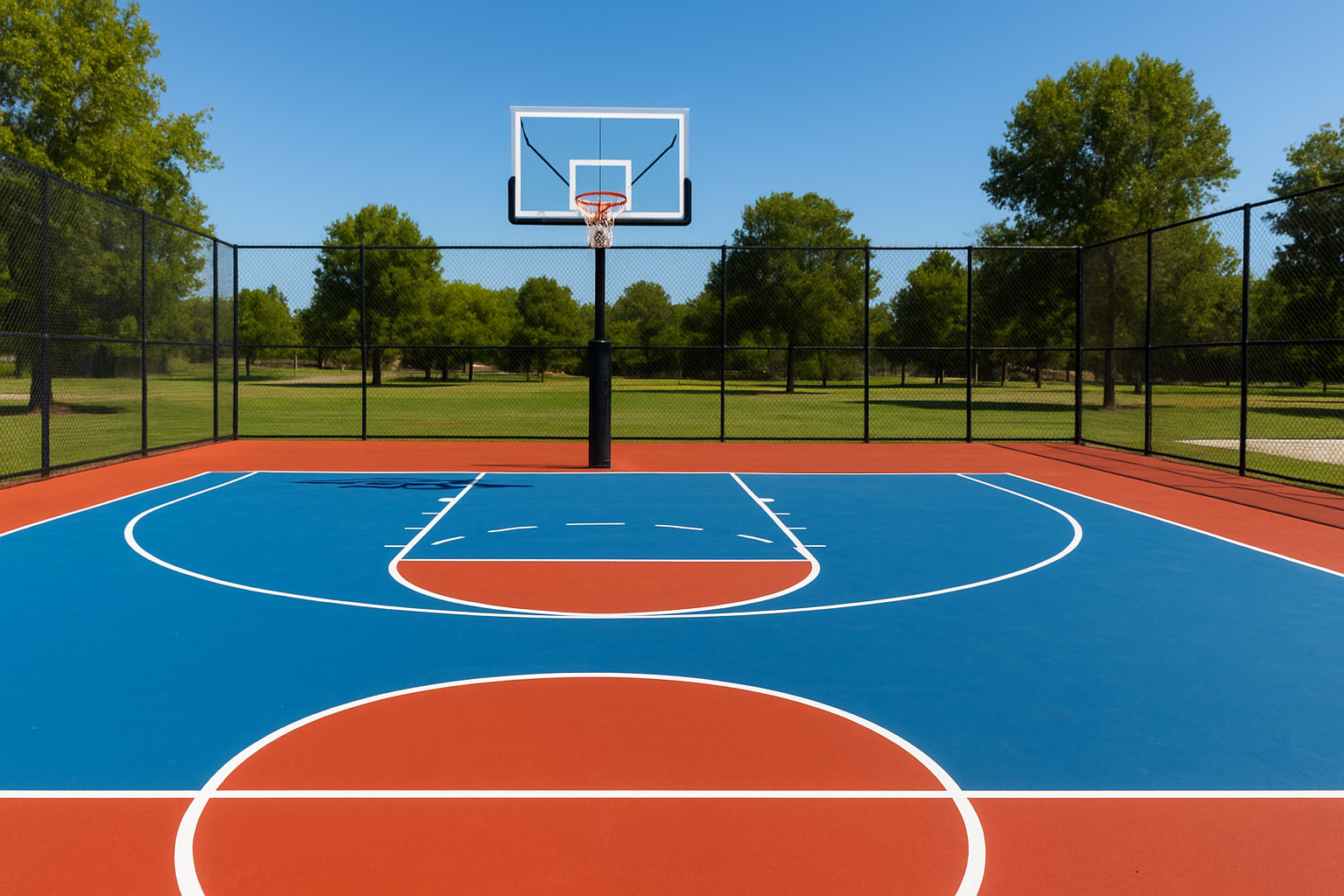
Acrylic sports flooring is one of the most preferred options for outdoor basketball courts. It provides a durable, attractive, and properly textured playing surface when installed over a suitable concrete or asphalt base.
The flooring system generally includes surface preparation, primer application where required, multiple acrylic coating layers, and professional court line marking. Cushioning layers can also be included depending on the selected flooring specification.
Key benefits:
- Available in different colours and surface finishes.
- Provides suitable traction for basketball activities.
- Designed for outdoor sports applications.
- Allows clear and durable court markings.
- Offers convenient cleaning and maintenance.
Acrylic flooring is an excellent option for schools, colleges, sports academies, and residential societies looking for a practical combination of durability, appearance, and affordability.
3. Polyurethane Sports Flooring
Polyurethane, commonly known as PU flooring, is another flooring solution used in modern sports facilities. These systems can be customised according to the performance and cushioning requirements of the playing area.
Advantages:
- Provides a smooth and consistent playing surface.
- Selected systems offer improved shock absorption.
- Available in different performance specifications.
- Offers a professional finish for indoor and suitable outdoor applications.
PU flooring systems are available in different grades and constructions. Therefore, it is important to select a product specifically designed for basketball and suitable for the installation environment.
4. Rubber and PVC Sports Flooring
Rubber and PVC flooring are commonly considered for indoor basketball courts, sports halls, and multipurpose facilities. Their performance depends on the material quality, thickness, installation process, and overall flooring design.
Advantages:
- Certain products provide good cushioning and impact absorption.
- Available in different colours and designs.
- Suitable options are available for indoor sports facilities.
- Can be installed over properly prepared surfaces.
Before selecting rubber or PVC flooring, check its suitability for basketball activities, including traction, ball response, wear resistance, and long-term durability.
5. Wooden Basketball Court Flooring
Wooden sports flooring is commonly used in professional indoor basketball arenas and sports stadiums. A properly installed wooden flooring system provides consistent playing characteristics and an attractive professional appearance.
Advantages:
- Suitable for indoor basketball facilities.
- Offers reliable ball response and playing characteristics.
- Provides a premium sports flooring appearance.
- Ideal for professional training and organised competitions.
Considerations:
- Requires a properly designed indoor sports hall.
- Installation expenses are comparatively high.
- Temperature and humidity conditions need to be controlled.
- Regular cleaning, inspection, and refinishing may be required.
For basketball court projects in Ambala, wooden flooring is a suitable choice for indoor facilities where environmental conditions and long-term maintenance can be properly managed.
Standard Basketball Court Dimensions
Correct court dimensions are essential for ensuring a suitable playing environment. Before starting construction, the complete court layout should be prepared according to the intended usage and applicable basketball standards.
According to FIBA regulations, a standard full-size basketball court measures 28 metres in length and 15 metres in width, measured from the inside edges of the boundary lines.
| Court feature | Standard measurement |
|---|---|
| Full basketball court | 28 m × 15 m |
| Half-court playing area | Approximately 14 m × 15 m |
| Free-throw line distance | 5.80 m from the endline |
| Three-point arc radius | 6.75 m |
| Basketball hoop height | 3.05 m above the playing surface |
These measurements represent the playing area and do not include the additional space required around the court. Proper safety clearances should be provided for player movement, fencing, spectator areas, and equipment installation.
A half-court is a practical option for smaller residential properties, schools, and recreational facilities. However, if the court is intended for official tournaments or professional competitions, the layout should be finalised according to the latest applicable basketball regulations.
Step-by-Step Process for Basketball Court Construction in Ambala
Constructing a durable basketball court requires proper planning and a systematic installation process. Every construction stage contributes to the quality, safety, and long-term performance of the facility.
Step 1: Site Inspection and Planning
The first step involves inspecting the proposed construction location and evaluating the available space. The contractor should assess soil conditions, ground levels, drainage patterns, surrounding structures, and accessibility for construction equipment.
For outdoor basketball courts in Ambala, planning should also consider sunlight exposure, seasonal rainfall, and the natural direction of water flow.
The initial planning process should include:
- Finalising the court dimensions and orientation.
- Deciding between an indoor and outdoor facility.
- Selecting the appropriate sports flooring system.
- Identifying safety clearances and entry points.
- Planning lighting, fencing, and basketball equipment.
Proper site planning helps minimise construction delays and unexpected expenses.
Step 2: Ground Preparation and Levelling
After completing the site inspection, the construction area is cleared of vegetation, loose soil, stones, debris, and other unwanted materials.
The ground is then excavated and levelled according to the approved construction layout. Depending on the site conditions, the subgrade is compacted to create a stable foundation for the basketball court.
Proper ground preparation is essential because inadequate compaction can lead to uneven settlement, surface cracks, and premature flooring damage.
The foundation requirements should be determined according to the soil condition and technical specifications of the project.
Step 3: Foundation and Base Construction
The foundation is one of the most important components of basketball court construction. It supports the complete flooring system and directly affects the durability of the finished court.
Depending on the project requirements, the foundation may include a compacted granular sub-base, concrete, asphalt, or a combination of suitable construction materials.
Important considerations include:
- Proper subgrade preparation and compaction.
- Suitable base thickness and reinforcement.
- Accurate surface levels and finishing.
- Appropriate drainage arrangements.
- Provision for control and movement joints.
- Compatibility with the selected sports flooring.
The foundation should be designed according to local ground conditions and the expected level of court usage. Installing expensive sports flooring over a poorly prepared base can result in unnecessary maintenance and repair expenses.
Step 4: Drainage and Water Management
Effective drainage is particularly important for outdoor basketball courts. Poor water management can cause water accumulation, surface deterioration, algae growth, and interruptions during gameplay.
The court should be constructed with a suitable surface gradient and an appropriate drainage arrangement based on the site conditions.
Drainage channels and outlets should be positioned to direct rainwater away from the playing surface. The finished court should also be checked for depressions and uneven areas where water may collect.
Step 5: Sports Flooring Installation
Once the foundation is completed and has achieved the required condition, the next step is installing the selected sports flooring system.
For acrylic basketball courts, the process generally includes cleaning the base, repairing surface defects, applying compatible primers where required, and installing the recommended acrylic coating layers.
For indoor facilities, PU, rubber, PVC, or wooden flooring systems require their own substrate preparation and installation methods.
The installation team should follow the manufacturer’s guidelines regarding application thickness, moisture conditions, temperature, and curing time. Proper curing is necessary to ensure that the flooring develops its intended performance before regular use.
Step 6: Court Line Marking
Court markings are essential for defining the playing area and ensuring accurate gameplay. They should be applied after the sports flooring has reached the appropriate stage of curing.
The marking process generally includes:
- Boundary lines.
- Centre line and centre circle.
- Free-throw lines and restricted areas.
- Three-point arc.
- Other markings required for the selected court layout.
All markings should be measured carefully and applied using compatible line-marking materials. For competition-level facilities, the dimensions should be verified according to the applicable basketball regulations.
Step 7: Basketball Equipment Installation
After completing the flooring and court markings, the required basketball equipment and additional facilities are installed.
Common equipment includes:
- Basketball poles and backboards.
- Basketball rings and nets.
- Secure anchoring and foundation systems.
- Protective padding.
- Perimeter fencing.
- Floodlights for evening games.
- Player seating and spectator arrangements, where required.
All equipment should be installed securely, with appropriate safety clearances. Lighting should also be designed to provide sufficient visibility without creating excessive glare.
Step 8: Final Inspection and Project Handover
The final stage involves checking the completed basketball court before handing it over for use.
The inspection should cover the playing surface, court markings, basketball equipment, drainage arrangements, and surrounding safety provisions.
The contractor should identify and correct any uneven surfaces, visible cracks, loose fittings, incomplete markings, or drainage issues.
At the time of handover, the client should receive relevant product details, maintenance guidelines, warranty information, and other project documentation.
Basketball Court Construction Cost in Ambala
The overall cost of basketball court construction depends on several factors, including court size, foundation requirements, flooring material, site conditions, sports equipment, and additional facilities.
The following flooring rates are indicative budgeting references and should not be considered confirmed current market quotations. Actual prices may vary depending on the selected materials, supplier, project specifications, and installation requirements.
| Flooring option | Indicative flooring rate |
|---|---|
| Acrylic sports flooring | ₹70–₹90 per sq. ft. |
| Rubber or PVC flooring | ₹90–₹120 per sq. ft. |
| Wooden indoor sports flooring | ₹250–₹350 per sq. ft. |
These rates may apply only to the flooring component and may exclude foundation work, excavation, drainage, equipment, and other construction expenses.
What Is the Cost of a Full Outdoor Basketball Court?
A standard full-size basketball playing area measuring 28 m × 15 m covers approximately 4,521 square feet. Additional space will be required for safety clearances, fencing, and surrounding facilities.
For certain basic outdoor synthetic basketball court projects in Ambala, a preliminary construction budget of ₹8 lakh to ₹15 lakh can be considered. However, this is an approximate planning figure rather than a fixed or guaranteed project quotation.
The final construction cost may change depending on:
- Site excavation and ground preparation.
- Foundation and base construction.
- Drainage arrangements.
- Selected sports flooring system.
- Court markings and finishing.
- Basketball poles, backboards, rings, and nets.
- Perimeter fencing and lighting.
- Labour, transportation, taxes, and warranty coverage.
Before selecting a contractor, request a detailed and itemised quotation. Comparing similar specifications will help you understand the actual value offered by different service providers.
Essential Factors to Consider Before Construction
1. Choose Flooring According to Court Requirements
Different basketball facilities require different flooring solutions. An outdoor school court may need acrylic flooring, while an indoor professional sports hall may require PU or wooden flooring.
Consider the playing environment, expected usage, maintenance requirements, and available budget before finalising the flooring material.
2. Focus on Foundation Quality
A properly engineered foundation is necessary for maintaining a stable and durable basketball court. Poor construction can result in cracks, uneven settlement, and premature surface damage.
Always ensure that the base is prepared according to the site’s soil conditions and project specifications.
3. Consider Local Weather Conditions
Ambala experiences hot summers and seasonal rainfall, which can affect outdoor sports surfaces. Select flooring materials suitable for outdoor exposure and ensure that proper drainage arrangements are included in the construction plan.
4. Select an Experienced Construction Contractor
Choose a contractor who has relevant experience in basketball court construction and sports flooring installation.
Check completed projects, material specifications, installation procedures, customer feedback, and warranty conditions before finalising the service provider.
5. Include Lighting and Safety Arrangements
If the basketball court will be used during evening hours, suitable lighting should be included in the project design.
Also consider protective padding, fencing, safe access routes, equipment positioning, and adequate clearance around the playing area.
6. Plan for Long-Term Maintenance
The investment does not end after construction. Regular cleaning, surface inspection, minor repairs, equipment maintenance, and periodic resurfacing should be included in the long-term budget.
Basketball Court Maintenance and Care
Regular maintenance is important for protecting the flooring system, maintaining playing performance, and increasing the service life of a basketball court.
Daily and Weekly Cleaning
Remove dust, leaves, litter, and other debris from the court regularly. Use suitable cleaning equipment and methods recommended by the flooring manufacturer.
Avoid using harsh chemicals or cleaning products that may damage the sports coating.
Regular Surface Inspection
Inspect the playing surface for cracks, peeling, worn areas, uneven patches, and standing water. Identifying minor defects at an early stage can help prevent more expensive repairs.
Drainage System Maintenance
Keep drainage channels, outlets, and surrounding areas free from leaves, mud, and other obstructions. Check the drainage performance after heavy rainfall to ensure that water flows away from the playing surface.
Basketball Equipment Inspection
Regularly inspect basketball poles, backboards, rings, nets, protective padding, and anchoring systems. Repair or replace damaged components before they create potential safety hazards.
Periodic Resurfacing
Acrylic basketball courts may require resurfacing after several years, depending on playing frequency, weather exposure, material quality, and maintenance practices.
A period of five to seven years can be used as a general planning reference, although the actual resurfacing requirement should be determined through regular surface inspections.
Wooden indoor courts also require appropriate cleaning, humidity management, periodic inspection, and refinishing according to the manufacturer’s recommendations.
Common Challenges in Basketball Court Construction in Ambala
Weather-Related Surface Problems
High temperatures, rainfall, moisture, and direct sunlight can affect outdoor sports flooring. Selecting weather-appropriate materials and following the correct installation procedures can help reduce premature surface deterioration.
Poor Foundation Construction
An uneven or unstable foundation may cause cracks, settlement, and inconsistent playing conditions. Proper soil assessment, ground compaction, and construction quality checks are necessary to avoid these issues.
Selecting Flooring Only on the Basis of Price
Choosing the cheapest flooring option may result in poor durability or unsuitable playing characteristics. Compare material quality, technical specifications, installation methods, and warranty coverage before making a decision.
Incomplete Project Planning
Ignoring drainage, lighting, safety clearances, equipment foundations, or fencing during the planning stage can increase project expenses later. A complete construction plan should include all essential requirements before work begins.
Lack of Regular Maintenance
Even professionally constructed basketball courts need routine maintenance. Without proper cleaning and timely repairs, the flooring and equipment may deteriorate faster than expected.
Why Choose a Professional Basketball Court Construction Company?
Working with an experienced sports construction company can make the entire basketball court development process more organised and efficient.
A professional contractor should provide assistance with site inspection, court layout planning, flooring selection, foundation preparation, drainage arrangements, sports surface installation, line marking, and equipment fitting.
When selecting a basketball court construction company in Ambala, consider the following factors:
- Experience in sports court construction.
- Knowledge of different sports flooring systems.
- Quality of construction materials.
- Transparent and itemised pricing.
- Professional installation procedures.
- Clear project timelines.
- Reliable after-installation support and warranty conditions.
For specialised sports flooring and construction requirements, you can explore the basketball court construction solutions offered by Sports-Facility.in to learn more about available flooring systems and court development options.
Always request a site-specific assessment and detailed quotation before starting the project.
Conclusion
Basketball court construction in Ambala requires proper planning, quality construction materials, a stable foundation, and professional installation. Whether you are developing a sports facility for a school, college, residential society, sports academy, or indoor stadium, every construction decision should be based on the intended usage and long-term performance requirements.
Acrylic sports flooring is a suitable option for many outdoor basketball courts, while PU, rubber, PVC, and wooden flooring systems can be considered for different indoor and specialised applications. The right flooring choice depends on the available budget, site conditions, playing requirements, and maintenance expectations.
By focusing on foundation quality, effective drainage, accurate court markings, suitable basketball equipment, and regular maintenance, you can develop a durable and functional sports facility.
If you are planning a new basketball court project in Ambala, start with a professional site assessment, compare detailed construction quotations, and consult an experienced sports flooring specialist to identify the most suitable solution for your requirements.