

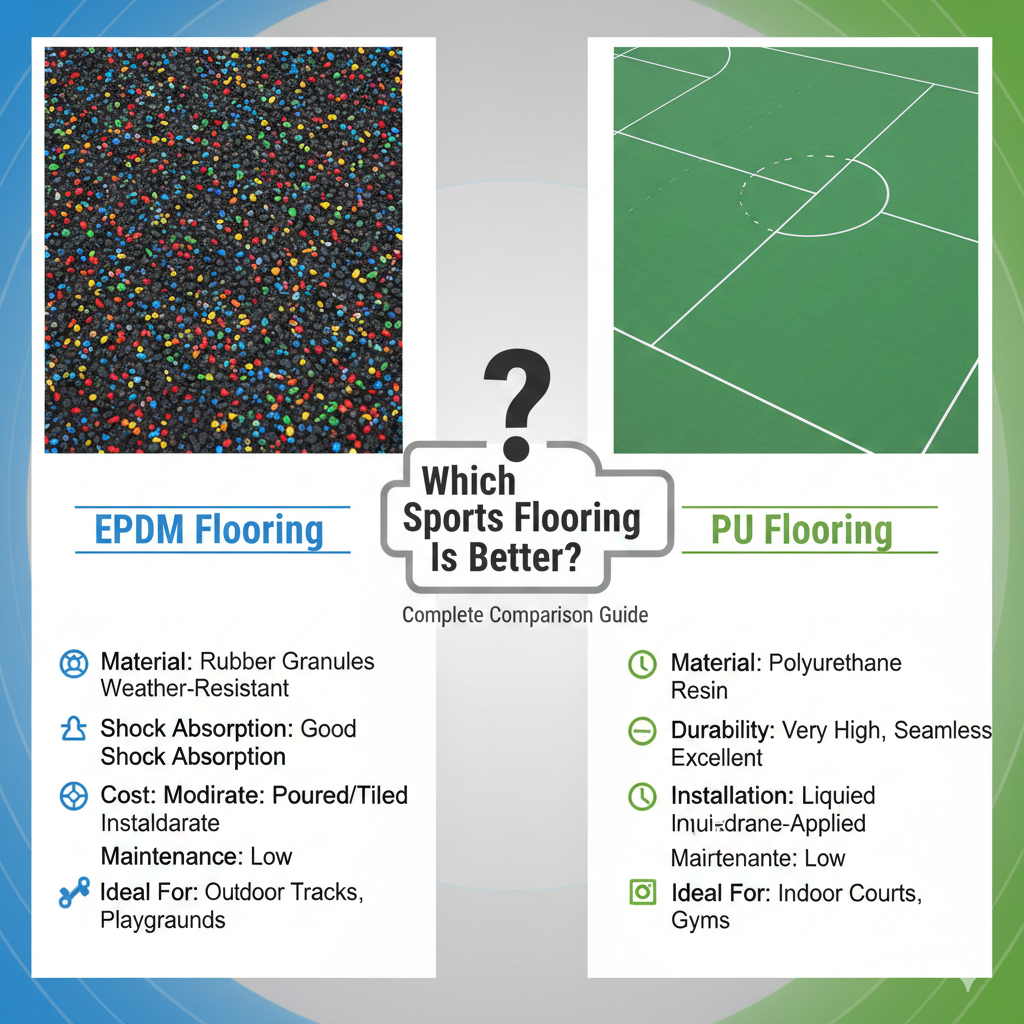
Choosing the right sports flooring is a crucial decision for any school, stadium, academy, gym, or recreational facility. Among the most trusted synthetic sports flooring options in India and globally, EPDM flooring and PU flooring stand out for their durability, performance, and athlete safety. However, both systems are designed with different compositions, installation methods, and usage benefits—making each one suitable for specific sports and environments.
This guide provides a complete comparison of EPDM vs PU flooring, covering construction, performance characteristics, durability, maintenance, ideal applications, advantages, and which flooring is ultimately better for your facility.
What Is EPDM Flooring?
EPDM (Ethylene Propylene Diene Monomer) flooring is a rubber-based sports surface made from colored EPDM granules. It is typically installed in combination with SBR (Styrene-Butadiene Rubber) base layers. EPDM rubber flooring is known for its cushion feel, high impact absorption, and long-term resistance to UV, heat, and harsh weather.
Where EPDM is commonly used:
-
Running tracks
-
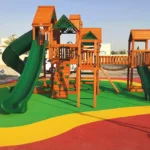
Children’s play areas
-
Jogging tracks & parks
-
Skating zones
-
Multi-purpose outdoor courts
-
Walkways & recreational spaces
-
Kindergarten and school play flooring
Key properties:
-
Excellent elasticity
-
Anti-slip even when wet
-
Long-lasting colour retention
-
High shock absorption
What Is PU Flooring?
PU (Polyurethane) flooring is a seamless, high-performance sports floor designed primarily for indoor sports. It is applied as a liquid PU coating that forms a smooth, non-porous, elastic surface after curing. PU sports flooring is known for consistent ball bounce, uniform grip, and excellent performance for fast-paced sports.
Where PU flooring is commonly used:
-
Indoor badminton courts
-
Indoor basketball & volleyball courts
-
Gymnasiums
-
Fitness centres
-
Multipurpose indoor sports halls
-
Roller sports & indoor futsal
Key properties:
-
Extremely smooth yet high-traction surface
-
Seamless installation without joints
-
Great ball rebound characteristics
-
Easy to maintain
EPDM vs PU Flooring (Side-by-Side Comparison)
Below is the complete comparison to help you choose the right flooring:
**1. Material Composition
EPDM Flooring
-
Made of rubber granules (EPDM) mixed with binder
-
Often installed in multiple layers (SBR base + EPDM top)
-
Granular texture
PU Flooring
-
Made of liquid polyurethane poured on-site
-
Forms a flat, smooth, elastic layer
-
Seamless and non-granular
Winner:
-
EPDM for outdoor longevity
-
PU for indoor performance
**2. Sports Performance
EPDM Flooring
-
Excellent for shock absorption
-
Supports safe fall protection (ideal for children)
-
Not suitable for high-speed ball sports
-
Not designed for high-level indoor sports
PU Flooring
-
Offers excellent ball bounce
-
Designed for badminton, basketball, and volleyball
-
Smooth texture ideal for fast footwork
-
Provides uniform performance for competitive sports
Winner: PU flooring for professional indoor sports.
**3. Durability & Lifespan
EPDM Flooring
-
8–15 years (depending on thickness and exposure)
-
UV-resistant and weatherproof
-
Perfect for outdoor use
PU Flooring
-
6–10 years
-
Sensitive to moisture during installation
-
Best suited for indoor environments to extend lifespan
Winner:
-
EPDM for outdoor durability
-
PU for indoor sports durability
**4. Maintenance Needs
EPDM Flooring
-
Very low maintenance
-
Does not fade easily
-
Can withstand heavy foot traffic
-
No waxing or polishing required
PU Flooring
-
Requires more care indoors
-
Needs proper cleaning to avoid scratches
-
Sensitive to heavy equipment dragging
Winner: EPDM flooring (minimum maintenance).
**5. Safety & Comfort
EPDM Flooring
-
High shock absorption
-
Child-safe, soft, and comfortable
-
Slip-resistant even in rain
-
Minimises injury risk
PU Flooring
-
Offers controlled shock absorption
-
Ideal for athletic performance
-
Non-slip when dry but needs care when wet
Winner:
-
EPDM for children’s play and outdoor safety
-
PU for indoor athlete comfort
**6. Installation Process
EPDM Flooring
-
Multi-layer installation
-
Time-consuming
-
Requires skilled technicians
PU Flooring
-
Seamless application
-
Faster installation
-
Requires moisture-free environment
Winner:
-
PU is quicker but more sensitive
-
EPDM is stronger but needs expertise
**7. Aesthetic Appeal
EPDM Flooring
-
Available in unlimited colour combinations
-
Can create patterns, shapes, numbers, and graphics
-
Popular for schools and play areas
PU Flooring
-
Professional indoor sports appearance
-
Available in selected solid colours
-
Smooth and premium look
Winner:
-
EPDM for creative outdoor designs
-
PU for premium indoor sports look
**8. Cost Comparison
EPDM Flooring Cost (India)
-
Approx. ₹250–₹550 per sq ft
-
Depends on thickness (10mm–25mm)
-
Slightly higher installation cost
PU Flooring Cost (India)
-
Approx. ₹180–₹400 per sq ft
-
Depends on cushion base thickness
-
More economical for indoor courts
Winner:
-
PU is generally more budget-friendly for sports courts
-
EPDM gives better long-term value outdoors
Which Flooring Should You Choose—EPDM or PU?
Choose EPDM flooring if you need:
✔ Outdoor sports flooring
✔ Jogging tracks / running tracks
✔ Children’s play flooring
✔ Weather-resistant, all-season surface
✔ High safety and cushioning
✔ Colourful designs and graphics
EPDM is the best choice for outdoor and recreational areas.
Choose PU flooring if you need:
✔ Indoor sports courts
✔ Badminton, volleyball, basketball, futsal
✔ Seamless and professional playing surface
✔ Excellent ball bounce and foot grip
✔ Smooth & elastic flooring for athletes
PU is the best choice for professional indoor sports facilities.
Final Verdict
There is no single “better” option—EPDM and PU flooring are designed for different purposes.
-
EPDM is superior for outdoor, impact-safe, weatherproof, and decorative applications.
-
PU is superior for indoor, high-performance sports that require precision, bounce, and grip.
Your choice depends entirely on your sport type, location, budget, and performance expectations.