


Introduction to Pickleball and Tennis Courts
Pickleball and tennis are two of the most popular racket sports in the world, each offering unique gameplay experiences, court designs, and spatial requirements. While tennis has long been associated with tradition, competitive play, and global tournaments, pickleball has rapidly emerged as a modern favorite due to its accessibility, compact court size, and fast-paced yet beginner-friendly nature.
Understanding the differences between pickleball and tennis courts is essential for players, facility planners, schools, sports clubs, and developers. Whether you are building a new court, converting an existing one, or simply trying to understand gameplay dynamics, knowing how these courts differ in dimensions, layout, and surface can help you make informed decisions.
The Rising Popularity of Pickleball
Pickleball has seen explosive growth worldwide, particularly in urban and community settings where space is limited. The sport combines elements of tennis, badminton, and table tennis, making it easy to learn and suitable for all age groups.
Its smaller court size, lower physical intensity, and social nature make it ideal for schools, residential societies, clubs, and recreational centers. Additionally, the ability to convert existing tennis courts into multiple pickleball courts has significantly contributed to its adoption.
Tennis: A Timeless Classic
Tennis, on the other hand, remains a globally recognized sport with a rich history and professional structure. It requires greater physical endurance, larger playing areas, and more complex techniques. Tennis courts are standard across international competitions, making them essential for serious training and professional-level play.
Despite requiring more space and maintenance, tennis courts continue to be a cornerstone of sports infrastructure in academies, clubs, and stadiums.
Standard Pickleball Court Dimensions
Court Size and Layout
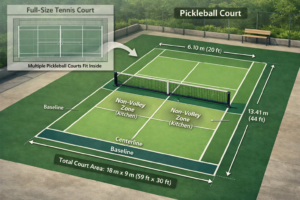
A standard pickleball court measures:
- Length: 13.41 meters (44 feet)
- Width: 6.10 meters (20 feet)
- Total recommended area (including run-off space): Approximately 18m × 9m
The court is divided into two equal halves by a net and includes specific zones that define gameplay.
Non-Volley Zone (Kitchen) Explained
One of the most unique features of a pickleball court is the Non-Volley Zone, commonly known as the “kitchen.”
- Extends 2.13 meters (7 feet) from the net on both sides
- Players are not allowed to volley (hit the ball in the air) while standing in this zone
- Designed to prevent aggressive net play and promote strategic rallies
This zone plays a critical role in shaping the tactical nature of pickleball, encouraging placement and control over power.
Standard Tennis Court Dimensions
Singles vs Doubles Court Size
A standard tennis court has different widths for singles and doubles play:
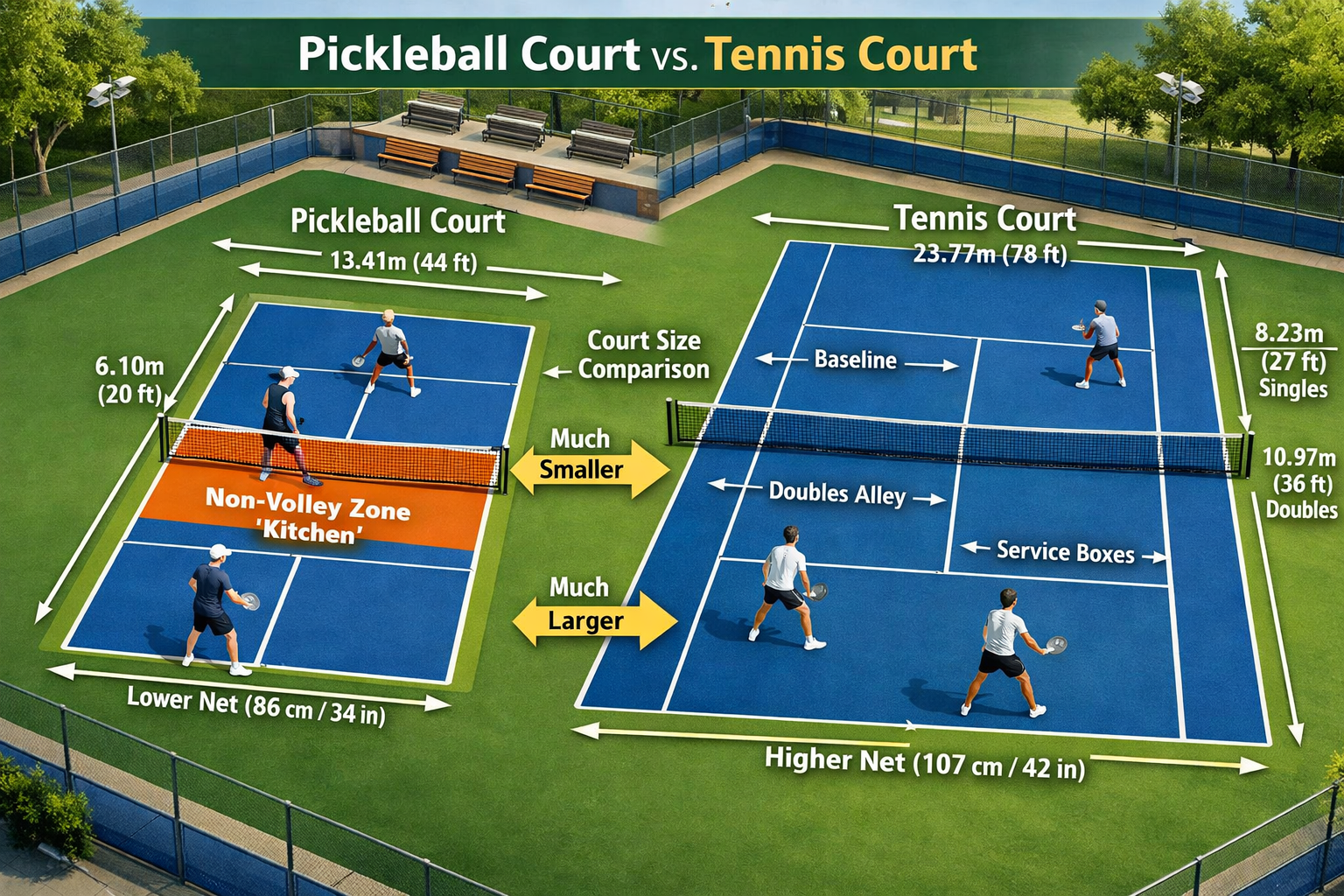
- Length (both): 23.77 meters (78 feet)
- Singles width: 8.23 meters (27 feet)
- Doubles width: 10.97 meters (36 feet)
- Recommended total area: Up to 36m × 18m including run-offs
The larger size demands greater movement, stamina, and court coverage.
Baseline, Service Boxes, and Net Details
Baseline:
- Located at the back of the court
- Players serve from behind this line
Service Boxes:
- Divided into left and right sections
- Serve must land diagonally in the opponent’s service box
Net Height:
- Center: 0.91 meters (3 feet)
- Posts: 1.07 meters (3.5 feet)
These elements create a structured and dynamic gameplay system focused on precision and power.
Key Differences Between Pickleball and Tennis Courts
Size Comparison
- Pickleball courts are much smaller, roughly one-third the size of a tennis court
- Tennis courts require significantly more space for safe play and movement
- Multiple pickleball courts can fit within a single tennis court area
Net Height Differences
- Pickleball net height:
- Center: 0.86 meters (34 inches)
- Posts: 0.91 meters (36 inches)
- Tennis net height:
- Center: 0.91 meters
- Posts: 1.07 meters
Pickleball nets are slightly lower, making rallies faster and more controlled.
Court Markings and Layout Variations
- Pickleball courts have fewer and simpler markings
- Tennis courts feature more complex lines for singles, doubles, and service areas
- The “kitchen” zone in pickleball has no equivalent in tennis
Pickleball Court Lines Explained
A pickleball court includes:
- Baseline: Back boundary line
- Sidelines: Define court width
- Centerline: Divides service areas
- Non-volley zone line: Marks the kitchen boundary
- Service areas: Left and right sections behind the kitchen
These lines are straightforward and easy to understand, making pickleball beginner-friendly.
Tennis Court Lines Explained
Tennis courts have a more detailed layout:
- Baseline and sidelines for overall boundaries
- Singles sidelines inside the doubles lines
- Service line dividing the court horizontally
- Center service line splitting service boxes
- Center mark indicating serving position
This complexity supports varied gameplay styles and competitive formats.
Surface Types and Materials
Pickleball Court Surfaces
Common pickleball surfaces include:
- Acrylic-coated concrete
- Asphalt with textured coatings
- Modular tiles (for temporary setups)
Key characteristics:
- Smooth yet slightly textured for grip
- Moderate cushioning
- Low maintenance
Tennis Court Surfaces
Tennis courts come in several types:
- Hard courts: Acrylic over concrete/asphalt
- Clay courts: Crushed brick or shale
- Grass courts: Natural turf
- Synthetic courts: Cushioned or hybrid surfaces
Each surface affects ball speed, bounce, and playing style.
Space Requirements and Court Conversion
Can You Fit a Pickleball Court on a Tennis Court?
Yes, and this is one of the biggest advantages of pickleball.
- Up to 4 pickleball courts can fit within a standard tennis court
- Shared spaces can be efficiently redesigned using temporary or permanent markings
- Nets can be portable or adjustable
This flexibility makes pickleball an excellent option for maximizing land use.
Multi-Use Court Benefits
Creating multi-use courts offers several advantages:
- Optimizes space utilization
- Serves multiple user groups
- Reduces infrastructure costs
- Encourages community engagement
- Increases facility revenue potential
Schools, clubs, and residential complexes often prefer dual-purpose courts for this reason.
Conclusion
Pickleball and tennis courts differ significantly in size, layout, and gameplay dynamics. While tennis courts are larger, more complex, and suited for high-intensity competition, pickleball courts are compact, accessible, and ideal for recreational play.
The growing popularity of pickleball is largely driven by its adaptability—especially the ability to convert existing tennis courts into multi-use facilities. For developers and planners, this creates an opportunity to serve a broader audience without requiring additional land.
Ultimately, the choice between building a pickleball or tennis court depends on your available space, target users, and long-term goals. In many cases, combining both through smart design is the most effective solution.
FAQ
1. What is the main difference between pickleball and tennis court size?
Pickleball courts are significantly smaller—about one-third the size of a tennis court.
2. Can I convert my tennis court into a pickleball court?
Yes, you can fit up to four pickleball courts on a single tennis court using proper markings and portable nets.
3. What is the “kitchen” in pickleball?
It is the non-volley zone near the net where players cannot hit the ball in the air.
4. Which court is easier to maintain?
Pickleball courts are generally easier and more cost-effective to maintain due to their smaller size.
5. Are the surfaces the same for both sports?
They can be similar (hard surfaces), but tennis also includes clay and grass courts, which are not used in pickleball.
6. Which sport is better for beginners?
Pickleball is typically easier to learn due to its smaller court and simpler rules.
7. Do pickleball and tennis use the same net?
No, pickleball nets are slightly lower than tennis nets.