




Introduction
Volleyball is a globally popular sport played across schools, clubs, beaches, and professional arenas. Whether you’re a beginner learning the basics or a professional planning a competition-level facility, understanding accurate volleyball court measurements is essential. Proper dimensions ensure fair gameplay, player safety, and compliance with international standards.
A well-measured volleyball court not only improves performance but also prevents disputes during matches. From court size to net height and markings, every element plays a crucial role in the game’s structure.
Official Court Size According to FIVB
The official governing body for volleyball, the Fédération Internationale de Volleyball (FIVB), defines standard court dimensions used worldwide.
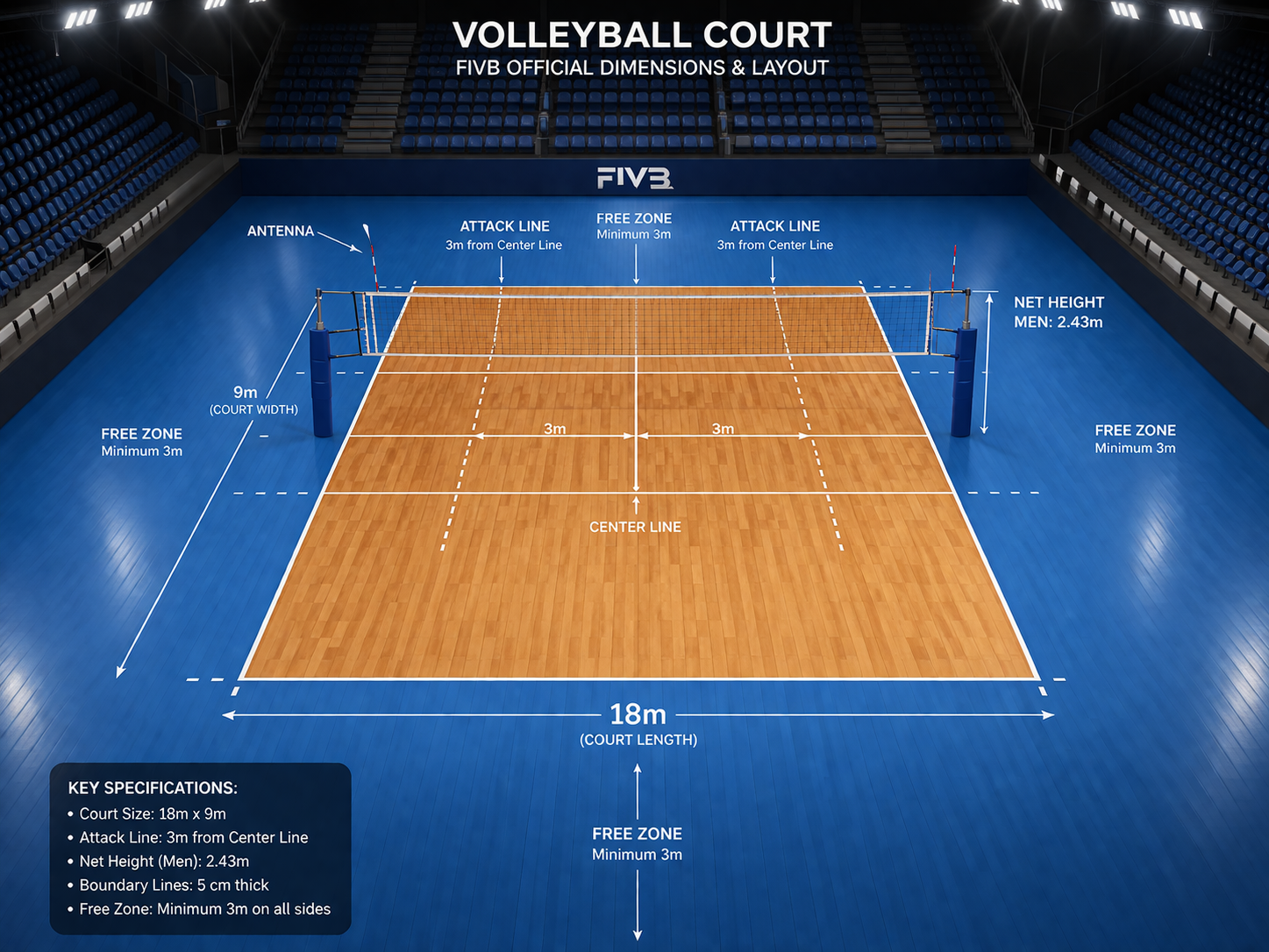
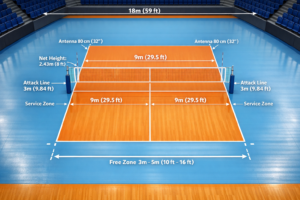
- Court Length: 18 meters
- Court Width: 9 meters
The court is rectangular and divided into two equal halves by a net. Each side measures 9 meters × 9 meters. These dimensions apply to both recreational and professional indoor volleyball.
Total Playing Area Including Free Zone
Beyond the marked court, there is an additional space called the free zone, which is essential for safe movement.
- Minimum 3 meters of free space on all sides
- For international matches, this can extend up to 5–8 meters
- Vertical clearance should be at least 7 meters, ideally more for professional play
This extended area allows players to chase the ball without obstruction, especially during high-speed rallies.
Layout and Markings of a Volleyball Court
A volleyball court includes several clearly defined lines and zones that guide gameplay. All lines are typically 5 cm wide and should be of a contrasting color to the playing surface.
Key markings include:
- Boundary lines
- Center line
- Attack line
- Service zones
The layout must be symmetrical and precisely measured to maintain fairness.
Boundary Lines and Their Importance
Boundary lines define the limits of the playing area and include:
- Baselines (end lines): Mark the back edges of the court
- Sidelines: Mark the sides of the court
These lines are considered part of the court. If the ball touches any boundary line, it is considered in play. Accurate marking ensures correct judgment during matches.
Center Line and Attack Line Explained
Center Line
- Runs directly under the net
- Divides the court into two equal halves
- Players must not completely cross this line during play
Attack Line (3-Meter Line)
- Located 3 meters from the center line on each side
- Separates the front zone from the back zone
- Back-row players must jump from behind this line when attacking
These lines are critical for enforcing rules and maintaining structured gameplay.
Volleyball Net Specifications
The net is one of the most important components of a volleyball court.
- Width: 1 meter
- Length: 9.5 to 10 meters
- Made of mesh material with a white band on top
The net is placed vertically above the center line and must be tightly secured to avoid sagging.
Net Height for Men, Women, and Youth
Different categories have specific net height requirements:
- Men: 2.43 meters (7.97 feet)
- Women: 2.24 meters (7.35 feet)
- Youth: Varies based on age group
Proper net height ensures fair competition and appropriate difficulty levels for players.
Antennas and Their Role in Gameplay
Antennas are vertical rods attached to the net above the sidelines.
- Extend 80 cm above the net
- Mark the crossing space for the ball
- Help referees determine whether the ball is in or out
If the ball passes outside the antennas, it is considered out of bounds.
Zones and Areas on the Volleyball Court
A volleyball court is divided into multiple zones:
- Front zone: Area near the net
- Back zone: Area behind the attack line
- Service zone: Area behind the baseline
- Substitution zone: Area near the sidelines
Each zone has specific rules governing player movement and actions.
Front Zone vs Back Zone
Front Zone
- Extends from the net to the attack line
- Typically occupied by attackers and blockers
- Allows front-row players to spike and block
Back Zone
- Extends from the attack line to the baseline
- Used by defensive players
- Back-row players have restrictions on attacking
Understanding these zones is crucial for team strategy and positioning.
Indoor vs Beach Volleyball Court Measurements
Indoor Volleyball
- Standard size: 18m × 9m
- Hard or synthetic flooring
- Six players per team
Beach Volleyball
- Smaller court: 16m × 8m
- Played on sand
- Two players per team
Key Differences in Dimensions
- Beach courts are smaller
- Surface type differs significantly
- Player count is reduced in beach volleyball
- Movement is slower on sand compared to indoor courts
These differences impact gameplay style and physical demands.
Court Measurement in Feet, Meters, and Other Units
Understanding measurements in multiple units is useful for planning and construction.
- 1 meter = 3.28084 feet
- Measurements may also be converted into yards depending on regional preferences
Using standardized units ensures accuracy and global compatibility.
Conversion Table for Easy Reference
| Measurement | Meters | Feet |
|---|---|---|
| Court Length | 18 m | 59 ft |
| Court Width | 9 m | 29.5 ft |
| Net Height (Men) | 2.43 m | 7.97 ft |
| Net Height (Women) | 2.24 m | 7.35 ft |
This table helps in quick conversions during planning and setup.
Common Mistakes in Court Measurement
Many errors can occur during court setup, including:
- Incorrect line spacing
- Uneven surface leveling
- Wrong net height
- Ignoring free zone requirements
- Misaligned center or attack lines
These mistakes can affect gameplay quality and safety.
Tips for Setting Up a Volleyball Court
- Always measure twice before marking
- Use high-quality marking materials
- Ensure proper surface leveling
- Maintain correct net tension
- Follow official standards strictly
Attention to detail ensures a professional-quality court.
Step-by-Step Court Setup Guide
- Select Location: Choose a flat, open area
- Measure Dimensions: Mark 18m × 9m rectangle
- Mark Boundary Lines: Use chalk, paint, or tape
- Add Center and Attack Lines: Ensure precise spacing
- Install Net Posts: Place them securely on both sides
- Fix the Net: Adjust to correct height
- Check Alignment: Verify all measurements
- Prepare Free Zone: Clear surrounding space
Following these steps ensures a proper and safe setup.
Tools Required for Accurate Measurement
- Measuring tape (30m or longer)
- Chalk or marking paint
- String lines for alignment
- Leveling tools
- Net and poles
- Line markers or rollers
Using the right tools improves accuracy and efficiency.
Conclusion
Accurate volleyball court measurement is the foundation of a great playing experience. Whether you are setting up a court for casual play or professional competition, following official dimensions and guidelines ensures fairness, safety, and performance.
From court size and markings to net specifications and zoning, every detail contributes to the overall quality of the game. With proper planning and execution, you can create a volleyball court that meets international standards and delivers an उत्कृष्ट playing experience.
FAQ
1. What is the standard size of a volleyball court?
The standard size is 18 meters long and 9 meters wide.
2. What is the height of a volleyball net?
It is 2.43 meters for men and 2.24 meters for women.
3. How much free space is required around the court?
At least 3 meters on all sides is recommended.
4. What is the attack line in volleyball?
It is a line 3 meters from the net that separates front and back zones.
5. Can I build a volleyball court in a small area?
Yes, but you must maintain minimum dimensions and safety space.
6. What surface is best for volleyball courts?
Indoor courts typically use synthetic or wooden flooring, while outdoor courts may use concrete or sand.
7. Why are antennas used in volleyball?
They help determine whether the ball crosses the net within the legal playing area.