

Basketball is witnessing unprecedented growth across India, making it one of the fastest-growing sports in schools, colleges, residential societies, sports academies, and municipal complexes. Its simplicity, cost-effectiveness, and inclusivity make it an ideal sport for youth development, community engagement, and professional training. A well-constructed basketball court is not just a playing surface—it becomes the heart of a community, hosting local tournaments, weekend leagues, practice sessions, and professional coaching programs.
To ensure a safe, durable, and professional-standard facility, investing in expert basketball court construction services in India is essential. From soil testing and drainage to flooring, lighting, and equipment installation, every stage matters to create courts that last decades.
Why Build a Basketball Court in India?
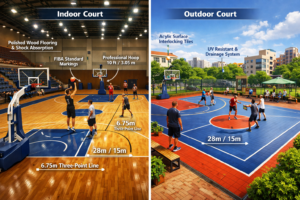
A professionally constructed basketball court offers far more than an area for shooting hoops. It ensures:
-
Player Safety: Shock-absorbing floors and anti-slip surfaces reduce injuries.
-
Consistent Performance: Proper flooring ensures reliable bounce, grip, and traction.
-
Community Engagement: Courts act as hubs for schools, colleges, residential communities, and local clubs.
-
Long-Term Durability: High-quality materials and precise construction extend the lifespan of the court.
Whether you represent a school, housing society, sports academy, or municipal authority, professional basketball court construction guarantees a safe, enjoyable, and long-lasting facility.
Standards & Dimensions for Professional Play
To meet international standards, courts in India should follow FIBA guidelines:
-
Playing Area: 28 m × 15 m (International standard).
-
Safety Zone: Minimum 2 m buffer around the court (total 32 m × 19 m).
-
Key Markings: Center circle radius – 1.8 m; Three-point arc – 6.75 m; Line width – 50 mm; Rim height – 3.05 m.
-
Indoor Ceiling Height: Minimum 7 m; for professional events or broadcasts, 14 m+ recommended.
Adhering to these specifications ensures safety, professional-standard play, and compliance for tournaments.
Indoor vs Outdoor Basketball Courts
Indoor Courts
Advantages:
-
Consistent bounce with premium wooden flooring.
-
All-weather play unaffected by rain or sun.
-
Controlled lighting, ventilation, and aesthetic appeal.
Challenges:
-
Higher construction and maintenance costs.
-
May require HVAC systems and professional lighting.
Ideal Use: Professional academies, tournament venues, and schools or college programs.
Outdoor Courts
Advantages:
-
Cost-effective and quick to build.
-
Durable surfaces using acrylic coatings or interlocking tiles.
-
Suitable for community spaces, playgrounds, and housing societies.
Challenges:
-
Exposure to weather can reduce surface life.
-
Requires proper drainage to avoid water accumulation.
Popular Outdoor Materials in India: UV-resistant acrylic coatings, modular interlocking polypropylene tiles, and synthetic polyurethane (PU) surfaces.
Basketball Court Flooring & Surface Options
Choosing the right surface is key to player safety, performance, and maintenance.
-
Wooden Sprung Floors (Indoor)
-
Maple or engineered timber on a shock-absorbing sub-frame.
-
Excellent bounce, professional feel, and high durability.
-
Requires periodic sanding and refinishing.
-
-
Polyurethane (PU) Floors
-
Seamless synthetic poured over a base.
-
Good shock absorption, rebound consistency, and weather resistance.
-
Suitable for both indoor and outdoor use.
-
-
Acrylic Coatings (Outdoor)
-
Applied over concrete or asphalt.
-
Offers grip and UV resistance; recoating every 3–5 years is recommended.
-
-
Interlocking Polypropylene Tiles
-
Modular, water-draining, UV-stable, and shock-absorbing.
-
Quick installation and ideal for multi-sport or community courts.
-
Foundation, Drainage & Construction Essentials
-
Concrete Slab & Reinforcement: Thickness 100–150 mm, reinforced with mesh and dowels.
-
Sub-Base & Compaction: Crushed rock or engineered fill under the slab prevents uneven settlement.
-
Drainage Slope: Minimum 1% slope ensures water runoff on outdoor courts.
-
Lighting & Ancillary Infrastructure: LED lighting, seating, fencing, and safety measures improve usability and professionalism.
Hoops, Backboards & Accessories
-
Rim Height: Standard 3.05 m (10 ft).
-
Backboards: FIBA-approved dimensions for professional use.
-
Systems: Portable systems are cost-effective; in-ground systems are sturdier for high usage.
-
Spectator Safety: Maintain at least a 2 m buffer around the court.
Project Costs & Budgeting (India)
-
Indoor Courts: ₹290–₹1,580 per sq ft depending on wood or PU surfaces.
-
Outdoor Acrylic/Synthetic Courts: ₹120–₹350 per sq ft.
Cost Includes:
-
Site preparation & sub-base compaction
-
Concrete or asphalt base
-
Flooring installation
-
Line markings, hoops, backboards
-
Lighting, fencing, and seating
Step-by-Step Construction Process
-
Site Survey & Design: Orientation, soil tests, elevation planning.
-
Earthworks & Sub-Base: Excavation, compaction, base installation.
-
Concrete/Asphalt Base: Pouring, reinforcement, control joints, curing.
-
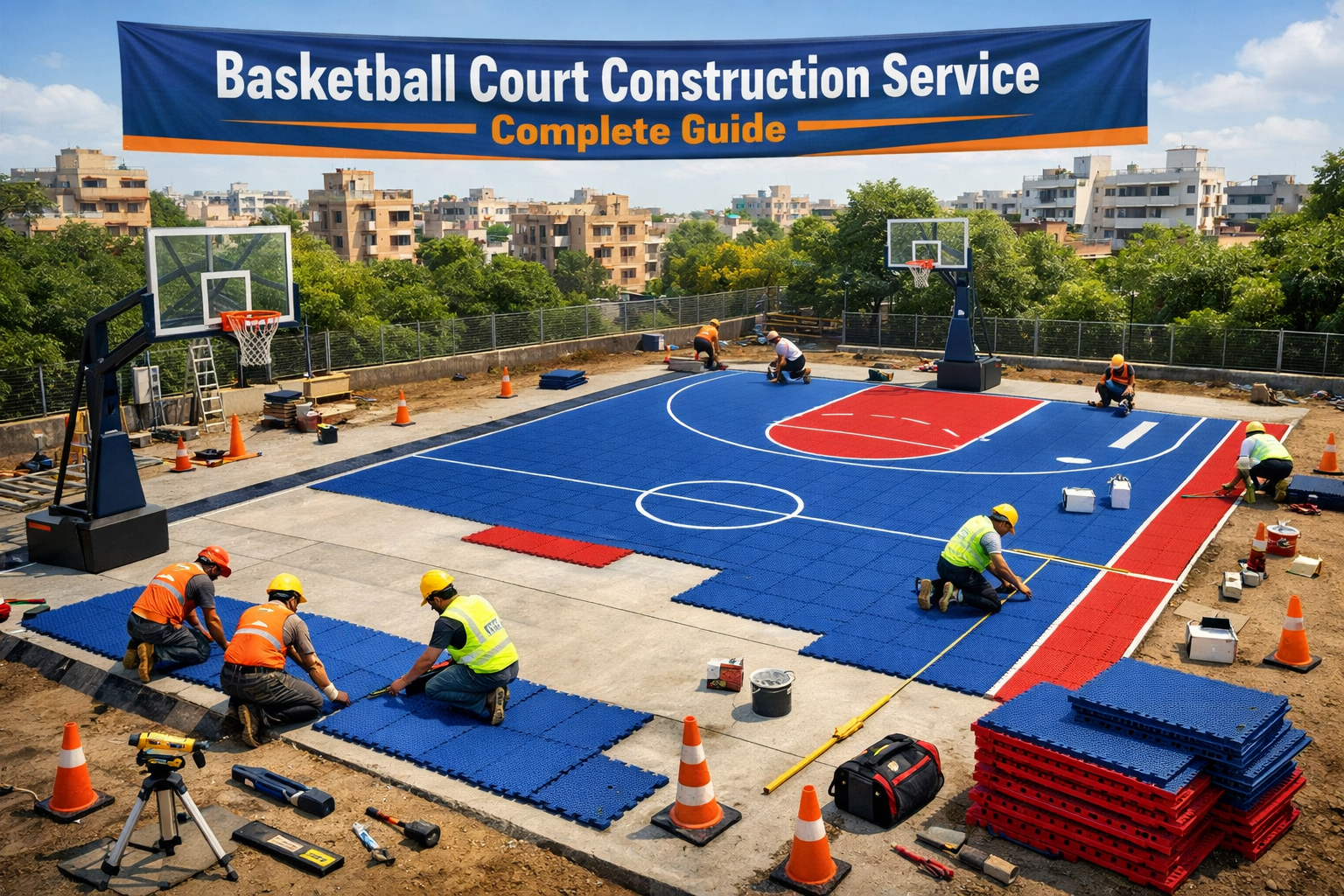
Surface Installation: Wood, PU, acrylic, or interlocking tiles.
-
Line Markings & Equipment Setup: Hoops, nets, scoreboards, padding.
-
Lighting & Fencing: LED poles, boundary fencing, benches.
-
Testing & Commissioning: Bounce tests, lighting checks, final inspection.
Timeline: Outdoor small courts – 4–6 weeks; Indoor stadium-grade – 3–6 months.
Maintenance & Longevity
-
Acrylic Outdoor Courts: Recoat every 3–7 years.
-
PU Floors: Topcoat refresh every 7–12 years.
-
Wooden Floors: Sand and refinish every 7–10 years.
Routine Checks: Inspect drainage, hoops, surfaces, and expansion joints annually.
Avoid Common Construction Mistakes
-
Skipping soil testing → uneven surfaces and cracks.
-
Ignoring drainage → waterlogging and surface damage.
-
Cheap base with premium flooring → uneven bounce.
-
Insufficient lighting or clearance → unsafe play.
-
No maintenance plan → premature deterioration.
Fixes: Hire experienced contractors, use quality materials, and enforce warranties.
Conclusion
Professional basketball court construction in India is an investment in safety, performance, and community engagement. Whether for a local school, residential society, municipal sports complex, or professional academy, following FIBA standards, using high-quality materials, and working with reputable contractors ensures a facility that stands the test of time.
Treat your basketball court as you would a home—it’s the foundation, flooring, and fittings that define the experience. From consistent bounce to clean lines, optimal lighting, and safety measures, expert construction transforms your vision into a high-performance reality.
Frequently Asked Questions (FAQ) – Basketball Court Construction in India
1. Why should I hire professional basketball court construction services in India?
Professional contractors ensure proper site survey, soil testing, drainage, and flooring installation. This guarantees safe play, long-lasting surfaces, and adherence to FIBA/SAI standards, avoiding costly repairs or uneven courts.
2. What are the standard dimensions of a basketball court in India?
FIBA standard courts have a playing area of 28 m × 15 m with a 2 m safety buffer around the court. Center circle radius – 1.8 m, three-point arc – 6.75 m, and rim height – 3.05 m. Indoor courts require a minimum ceiling height of 7 m, 14 m+ for tournaments.
3. Which is better for Indian conditions – indoor or outdoor courts?
-
Indoor courts: Ideal for professional academies and all-weather play; uses wooden or PU flooring.
-
Outdoor courts: Cost-effective, quick to install, and durable with acrylic or interlocking tiles. Proper drainage is essential to handle monsoons.
4. What flooring options are available for basketball courts in India?
-
Wooden Sprung Floors (Indoor): High-quality, professional bounce, requires maintenance.
-
Polyurethane (PU) Floors: Shock-absorbing, seamless, suitable for indoor/outdoor use.
-
Acrylic Coatings (Outdoor): UV-resistant, cost-effective, recoating every 3–5 years.
-
Interlocking Polypropylene Tiles: Quick installation, water-draining, ideal for community courts.
5. How much does it cost to build a basketball court in India?
-
Indoor courts: ₹290–₹1,580 per sq ft depending on materials and complexity.
-
Outdoor courts: ₹120–₹350 per sq ft for acrylic/synthetic or interlocking tiles.
Costs include site preparation, base, flooring, markings, hoops, lighting, fencing, and seating.
6. How long does it take to construct a basketball court?
-
Outdoor community courts: 4–6 weeks
-
Indoor professional or stadium-grade courts: 3–6 months
Timeline depends on site conditions, materials, and approvals.
7. Do outdoor courts require maintenance?
Yes. Maintenance is essential for longevity:
-
Acrylic surfaces: Recoat every 3–7 years
-
PU floors: Topcoat every 7–12 years
-
Wooden floors: Sand and refinish every 7–10 years
Annual inspections of drainage, hoops, and expansion joints are recommended.
8. What common mistakes should I avoid during construction?
-
Skipping soil tests → uneven settlement
-
Poor drainage → waterlogging & surface damage
-
Using cheap sub-base with premium flooring → cracks & uneven bounce
-
Ignoring lighting or clearance → unsafe play
-
No maintenance plan → premature deterioration
9. Can you build basketball courts in all major Indian cities?
Yes, professional construction services are available in Mumbai, Delhi, Bangalore, Hyderabad, Lucknow, Chennai, Kolkata, Pune, Ahmedabad, Jaipur, Indore, Coimbatore, Bhubaneswar, Kochi, and Patna, customized for local weather, soil, and city regulations.
10. Are the basketball courts compliant with FIBA and BFI standards?
Absolutely. All professional projects follow FIBA-approved dimensions, flooring, hoop systems, and safety standards. Many outdoor courts also comply with SAI and GEM specifications for UV-stable surfaces, weather resistance, and rebound consistency.
11. Can I get both portable and in-ground basketball hoop systems?
Yes. Portable systems are flexible, cost-effective, and ideal for residential or community courts. In-ground systems are sturdy, suitable for schools, academies, or tournament-ready facilities.