

|
Getting your Trinity Audio player ready...
|
Introduction
Basketball has evolved from a recreational pastime into one of the world’s most popular competitive sports. Across India, the demand for professionally designed basketball courts is growing rapidly as schools, universities, sports academies, residential societies, clubs, corporate campuses, and government organizations increasingly invest in quality sports infrastructure. A professionally constructed basketball court not only enhances athletic performance but also improves player safety, reduces maintenance costs, and delivers long-term value.
Whether you are planning to build an indoor training facility, an outdoor community court, or a tournament-standard basketball arena, successful construction requires careful planning, expert engineering, premium-quality materials, and strict adherence to international standards. Every stage—from site evaluation and base preparation to flooring installation, line marking, lighting, drainage, and equipment installation—plays a vital role in ensuring a durable and high-performance sports facility.
Professional basketball court construction services encompass much more than laying a playing surface. They involve architectural planning, civil engineering, sports flooring technology, environmental considerations, and compliance with international guidelines. A well-designed court provides consistent ball bounce, superior traction, shock absorption, weather resistance (for outdoor courts), and long-lasting performance under intensive use.
This comprehensive guide explains everything you need to know about basketball court construction, including court types, planning considerations, official dimensions, site preparation, foundation work, and construction best practices. Whether you’re a school administrator, sports academy owner, architect, builder, or investor, this guide will help you make informed decisions before starting your project.
Why Invest in Professional Court Construction?
A basketball court is a long-term investment in sports infrastructure. When designed and built correctly, it offers decades of reliable performance while minimizing repair and maintenance costs.
Professional construction ensures:
- Enhanced player safety
- Superior playing performance
- International-standard dimensions
- Longer flooring lifespan
- Better drainage for outdoor courts
- Lower maintenance expenses
- Increased property value
- Higher participation in sports activities
- Compliance with sports federation standards
- Excellent return on investment
Unlike ordinary concrete surfaces, professionally constructed basketball courts are engineered to withstand continuous athletic movements, repeated impacts, changing weather conditions, and heavy foot traffic.
Benefits of a Professionally Constructed Basketball Court
1. Enhanced Player Safety
Safety is the foundation of every sports facility. Professional basketball courts incorporate advanced surface technologies that reduce the risk of slips, falls, ankle injuries, knee strain, and muscle fatigue. Shock-absorbing flooring systems help minimize the impact on players’ joints during jumping, sprinting, and sudden directional changes.
2. Better Playing Experience
A professionally engineered court delivers:
- Consistent ball rebound
- Uniform surface texture
- Excellent traction
- Controlled player movement
- Smooth transitions
- Faster gameplay
- Improved shooting accuracy
These characteristics significantly improve both recreational and competitive play.
3. Long-Term Durability
Premium basketball courts are designed to endure years of intensive use without compromising performance. High-quality construction materials resist:
- UV exposure
- Moisture penetration
- Surface cracking
- Abrasion
- Heavy foot traffic
- Weather fluctuations
- Color fading
This durability reduces repair frequency and extends the court’s service life.
4. Lower Maintenance Costs
Investing in quality construction minimizes future maintenance expenses. Proper drainage, durable coatings, and robust base construction reduce issues such as water accumulation, surface deterioration, and structural damage, resulting in lower lifecycle costs.
5. Multi-Purpose Use
Modern basketball courts can be designed as multi-sport facilities, accommodating activities such as volleyball, badminton, futsal, pickleball, and recreational events. This flexibility maximizes facility utilization and return on investment.
Where Are Construction Services Required?
<p data-start=”4740″ data-end=”4837″>Professional basketball court construction is suitable for a wide range of facilities, including:
- Schools
- Colleges and universities
- Sports academies
- Indoor sports complexes
- Community parks
- Residential townships
- Clubhouses
- Corporate campuses
- Government sports facilities
- Military training centers
- Recreation centers
- Commercial sports complexes
- Stadiums
- Hotels and resorts
- Fitness and wellness centers
Each project requires a customized approach based on user demographics, available space, budget, and intended level of play.
Types of Basketball Courts
Selecting the right type of basketball court depends on the intended use, available budget, maintenance requirements, and environmental conditions.
Outdoor Basketball Courts
Outdoor courts are widely used in schools, parks, residential societies, and community sports facilities. These courts are designed to withstand varying weather conditions while providing a reliable playing experience.
Typical features include:
- Weather-resistant surfaces
- UV-stable coatings
- Anti-slip finishes
- Efficient drainage systems
- Durable court markings
- Low maintenance requirements
Outdoor courts are ideal for recreational use, training sessions, and community tournaments.
Indoor Basketball Courts
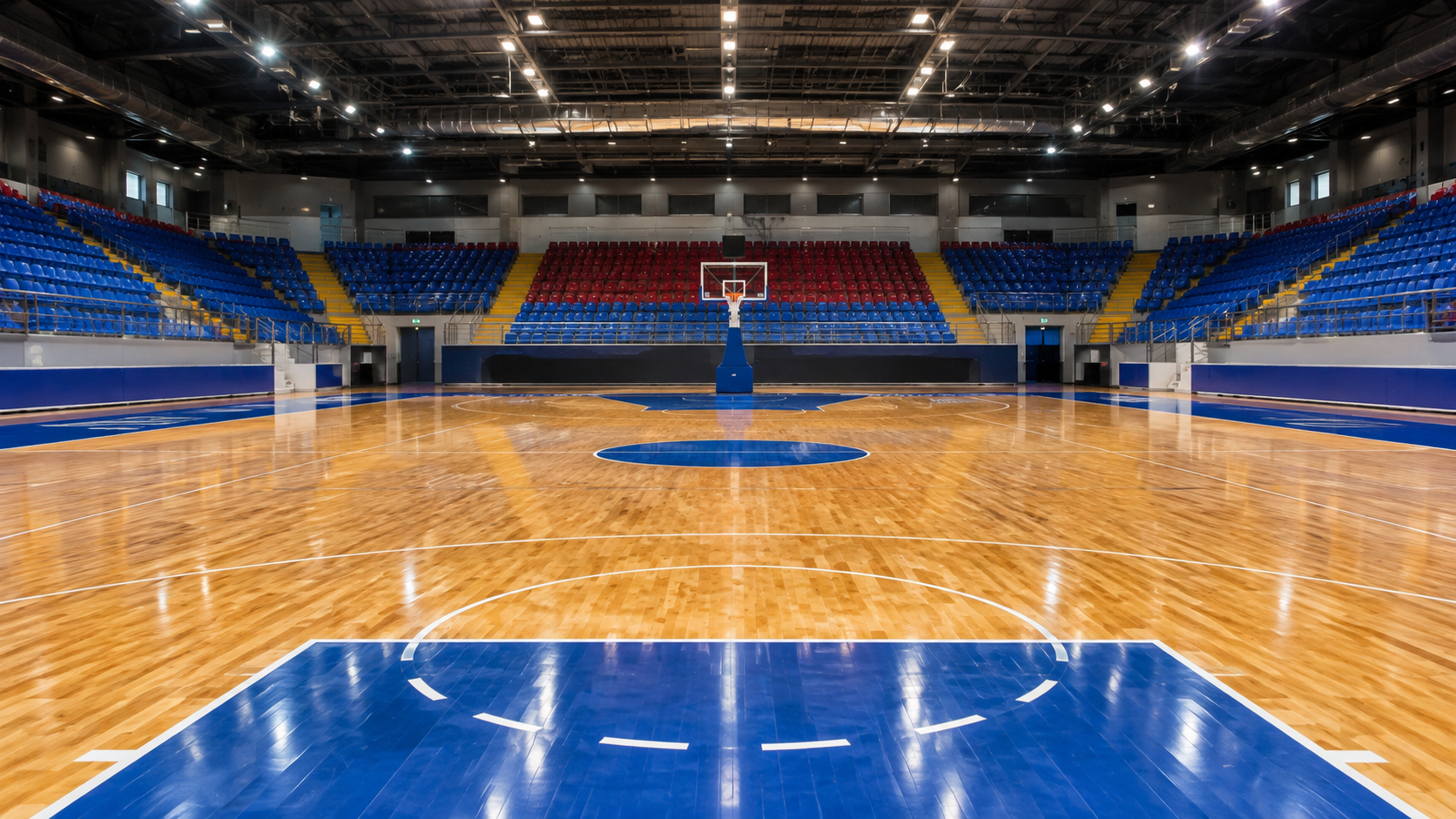
Indoor basketball courts are preferred for professional competitions, sports academies, universities, and high-performance training centers. These courts offer a controlled environment that protects the playing surface from weather-related wear and ensures consistent playing conditions.
Key benefits include:
- Superior playing comfort
- Controlled indoor climate
- Enhanced shock absorption
- Reduced maintenance
- Year-round usability
- Premium aesthetics
Indoor courts are often equipped with advanced lighting systems, climate control, and spectator seating.
Training Courts
Training courts focus on player development and skill enhancement. They may incorporate additional features such as adjustable hoops, shooting stations, and specialized training equipment to support coaching programs.
Recreational Courts
Recreational courts are designed for casual play in parks, residential communities, schools, and clubhouses. These courts prioritize durability, ease of maintenance, and cost-effectiveness while maintaining safe playing conditions.
Planning Before Construction
Successful basketball court construction begins long before the first layer of concrete or sports flooring is installed. Comprehensive planning ensures that the facility meets current needs while remaining adaptable for future expansion.
Important planning considerations include:
- Intended level of competition
- Available land area
- Indoor or outdoor installation
- Flooring system selection
- Budget allocation
- Site drainage
- Lighting requirements
- Spectator seating
- Accessibility
- Parking availability
- Maintenance strategy
- Local building regulations
- Environmental factors
Proper planning helps prevent costly redesigns and construction delays.
Official Basketball Court Dimensions
Using internationally recognized dimensions is essential for delivering a court suitable for training and competition.
Full Basketball Court Dimensions
| Component | Standard Measurement |
|---|---|
| Court Length | 28 meters |
| Court Width | 15 meters |
| Center Circle Diameter | 3.6 meters |
| Free Throw Line Distance | 4.6 meters |
| Three-Point Line Radius | 6.75 meters |
| Basketball Ring Height | 3.05 meters |
| Restricted Area Radius | 1.25 meters |
| Backboard Width | 1.80 meters |
| Backboard Height | 1.05 meters |
Additional clear run-off space should be provided around the playing area to ensure player safety during high-speed movement.
Choosing the Ideal Location
The location of a basketball court significantly influences its durability, usability, and maintenance requirements.
A suitable site should provide:
- Stable soil conditions
- Adequate drainage
- Easy accessibility
- Space for future expansion
- Good natural ventilation (for outdoor facilities)
- Proper sunlight orientation
- Safe surrounding environment
- Convenient utility access
For indoor projects, structural design, ventilation, and ceiling height should also be carefully evaluated.
Site Survey and Soil Investigation
Every successful project begins with a detailed site survey. This process identifies existing conditions and potential challenges before construction begins.
The survey typically includes:
- Topographic mapping
- Soil bearing capacity testing
- Groundwater level assessment
- Moisture analysis
- Drainage evaluation
- Existing utility identification
- Land slope measurement
- Environmental impact considerations
Understanding these factors enables engineers to design a stable and long-lasting foundation.
Importance of Proper Ground Preparation
Ground preparation is one of the most critical stages of basketball court construction. Even the highest-quality sports flooring cannot perform effectively if installed on an unstable base.
Proper ground preparation involves:
- Clearing vegetation and debris
- Excavation to the required depth
- Removal of unsuitable soil
- Soil stabilization (if necessary)
- Layered compaction
- Grade correction
- Moisture control
- Drainage integration
A well-prepared subgrade minimizes settlement, cracking, and surface deformation over time.
Base Construction: The Foundation of a Durable Court
The structural base supports the entire basketball court system and directly impacts its longevity and performance.
A typical base construction process includes:
Excavation
The site is excavated to the specified depth based on soil conditions and engineering requirements.
Subgrade Compaction
The exposed soil is compacted using heavy rollers to achieve the required density and load-bearing capacity.
Granular Sub-Base Installation
Layers of crushed stone or granular material are placed and compacted to improve drainage and distribute structural loads evenly.
Base Layer Construction
Depending on the project, a reinforced concrete slab or asphalt base is constructed. The base must be level, stable, and free from surface irregularities.
Surface Leveling
Laser-guided leveling equipment is used to achieve precise tolerances, ensuring a uniform playing surface and proper water runoff for outdoor courts.
Curing
Concrete bases are allowed to cure adequately before sports flooring installation. Proper curing enhances strength, durability, and crack resistance.
Why Precision Engineering Matters
Professional basketball court construction relies on precision engineering at every stage. Even minor deviations in level, slope, or surface flatness can affect ball bounce, player movement, and overall performance.
Key engineering practices include:
- Laser leveling
- Moisture testing
- Expansion joint planning
- Crack prevention measures
- Drainage design
- Material quality testing
- Structural load analysis
- Dimensional verification
Attention to these details ensures the court performs consistently for years while minimizing maintenance needs.
Basketball Court Flooring Systems,
The flooring system is the heart of every basketball court. Regardless of how strong the foundation is, the playing experience ultimately depends on the quality, resilience, traction, shock absorption, and durability of the surface. Professional basketball court flooring is engineered to provide optimal ball bounce, player comfort, and long-term performance while withstanding thousands of hours of gameplay.
Selecting the right flooring involves evaluating factors such as indoor or outdoor use, budget, maintenance requirements, climate, expected footfall, and the level of competition. A well-chosen flooring system reduces injury risks, improves athlete confidence, and minimizes lifecycle maintenance costs.
Why Basketball Court Flooring Matters
Basketball is a high-impact sport involving continuous running, sprinting, jumping, pivoting, and sudden directional changes. Inferior flooring can lead to inconsistent ball rebound, slippery conditions, surface cracks, and increased stress on players’ knees, ankles, and lower back.
A professionally installed sports flooring system provides:
- Consistent ball rebound
- Excellent grip and traction
- Shock absorption
- Slip resistance
- Joint protection
- Noise reduction
- Long service life
- Easy maintenance
- Weather resistance (for outdoor courts)
- Professional appearance
Proper flooring not only enhances performance but also creates a safer and more enjoyable playing environment.
Factors to Consider Before Choosing Basketball Court Flooring
Every project has unique requirements. Before selecting a flooring system, consider:
Indoor or Outdoor Installation
Outdoor courts require UV-resistant and weatherproof surfaces, while indoor courts prioritize shock absorption, aesthetics, and professional playing characteristics.
Level of Competition
A recreational community court has different performance requirements than a professional training academy or tournament venue.
Budget
Flooring options vary in initial investment and long-term maintenance. A lower upfront cost may result in higher repair expenses over time, making lifecycle cost an important consideration.
Maintenance Expectations
Some surfaces require periodic recoating or refinishing, while others need only routine cleaning. Choosing a flooring system that matches your maintenance capabilities helps preserve performance and appearance.
Climate Conditions
Temperature fluctuations, rainfall, humidity, and sunlight exposure influence flooring performance. Materials should be selected based on local environmental conditions.
Acrylic Basketball Court Flooring
Acrylic sports flooring is one of the most widely used outdoor basketball court surfaces due to its durability, affordability, and excellent all-weather performance.
The system typically consists of multiple layers applied over a concrete or asphalt base, creating a seamless, textured playing surface.
Advantages of Acrylic Basketball Flooring
- UV-resistant surface
- Excellent weather resistance
- Slip-resistant finish
- Uniform ball bounce
- Attractive color options
- Low maintenance
- Long service life
- Fast installation
- Suitable for multi-sport courts
Acrylic courts maintain their appearance even under prolonged sunlight and are ideal for schools, colleges, parks, and residential communities.
Best Applications
- Schools
- Universities
- Outdoor stadiums
- Residential townships
- Sports academies
- Public parks
- Community centers
Polyurethane (PU) Basketball Court Flooring
Polyurethane flooring is a premium synthetic sports flooring solution designed for high-performance indoor facilities. It provides exceptional resilience, flexibility, and player comfort.
Unlike rigid surfaces, PU flooring absorbs impact energy, reducing stress on athletes’ joints during repeated jumping and landing.
Benefits of PU Flooring
- Outstanding shock absorption
- Superior player comfort
- Excellent traction
- Seamless finish
- High durability
- Easy cleaning
- Chemical resistance
- Premium appearance
- Long operational life
PU flooring is commonly installed in professional training centers, indoor arenas, and elite sports academies.
Recommended For
- Professional basketball arenas
- Indoor sports complexes
- International training centers
- Universities
- Premium sports clubs
Wooden Basketball Court Flooring
Hardwood flooring remains the preferred choice for many professional indoor basketball courts due to its natural playing characteristics and premium appearance.
High-quality hardwood systems are typically installed over resilient subfloor structures that improve shock absorption and player comfort.
Advantages
- Excellent ball response
- Premium aesthetics
- Comfortable playing surface
- Superior shock absorption
- Long lifespan
- Professional competition standards
- Refinishable surface
Common hardwood species include maple because of its density, durability, and consistent playing characteristics.
Ideal Projects
- Professional leagues
- Indoor stadiums
- Tournament venues
- Universities
- National sports academies
Modular Sports Tile Flooring
Modular sports tiles are increasingly popular for outdoor basketball courts because of their quick installation, portability, and ease of maintenance.
The interlocking tile system creates a durable playing surface with built-in drainage channels.
Benefits
- Fast installation
- Replaceable individual tiles
- Weather resistant
- Excellent drainage
- UV stability
- Low maintenance
- Comfortable underfoot
- Attractive appearance
These courts are commonly used for schools, residential societies, rooftop sports facilities, and recreational centers.
Concrete Basketball Courts
Concrete remains one of the most economical basketball court surfaces. Although it is durable, it lacks the shock absorption and comfort provided by specialized sports flooring systems.
Advantages include:
- High structural strength
- Low initial cost
- Long lifespan
- Minimal structural maintenance
Limitations include:
- Hard playing surface
- Higher injury risk
- Poor shock absorption
- Surface cracking if improperly constructed
- Less comfortable during extended play
Concrete is often used as the structural base beneath acrylic or modular flooring rather than as the final playing surface.
Asphalt Basketball Courts
Asphalt is another common base material, particularly for outdoor courts. When properly constructed and coated with acrylic sports surfacing, asphalt provides a smooth, durable playing surface.
Advantages include:
- Cost-effective construction
- Good drainage performance
- Quick installation
- Smooth finish
- Suitable for acrylic coatings
Routine inspections and timely crack repairs help maintain long-term performance.
Cushion Systems in Basketball Flooring
Modern basketball courts often incorporate cushion layers beneath the playing surface to improve athlete safety and playing comfort.
These systems reduce impact forces generated during jumping and running while maintaining consistent ball response.
Benefits include:
- Reduced joint stress
- Improved comfort
- Better energy return
- Lower fatigue
- Enhanced player confidence
- Reduced injury risk
The thickness and composition of the cushion layer depend on the selected flooring system and intended level of play.
Surface Texture and Slip Resistance
Surface texture significantly influences player safety and performance.
An ideal basketball court provides enough traction for quick acceleration, stopping, and turning without creating excessive friction that could increase the risk of injury.
Professional sports flooring achieves this balance through carefully engineered textured coatings and finishing systems.
Ball Bounce Performance
Consistent ball rebound is essential for competitive basketball.
Factors influencing ball bounce include:
- Surface hardness
- Base flatness
- Flooring elasticity
- Material density
- Installation quality
Professional construction ensures that every section of the court delivers uniform playing characteristics.
UV Resistance for Outdoor Courts
Outdoor basketball courts are continuously exposed to sunlight. UV-resistant coatings prevent:
- Color fading
- Surface degradation
- Premature cracking
- Material brittleness
High-quality acrylic systems are specifically formulated to maintain their performance and appearance despite prolonged UV exposure.
Water Resistance and Drainage
Proper drainage is one of the most critical elements of outdoor basketball court construction.
Standing water can damage flooring, encourage algae growth, and create hazardous playing conditions.
A well-designed drainage system includes:
- Engineered surface slope
- Side drains
- Perimeter drainage channels
- Proper sub-base permeability
- Moisture management layers
These features help keep the court dry and playable after rainfall.
Court Slope and Surface Flatness
Outdoor basketball courts require a gentle slope to facilitate water runoff without affecting gameplay.
Precision laser leveling ensures:
- Uniform surface elevations
- Proper drainage
- Consistent ball movement
- Reduced water accumulation
Maintaining strict flatness tolerances is equally important for indoor courts, where even slight unevenness can influence player movement and ball behavior.
Court Colors and Visual Design
Color selection enhances both aesthetics and functionality.
Popular combinations include:
- Blue with red key area
- Green with blue borders
- Light blue with dark blue perimeter
- Gray with orange accents
- Red with dark gray borders
- Custom school or club colors
High-contrast line markings improve visibility for players, referees, and spectators.
Multi-Sport Basketball Court Flooring
Many institutions maximize space by designing courts that support multiple sports.
A multi-purpose court can accommodate:
- Basketball
- Volleyball
- Badminton
- Pickleball
- Futsal
- Handball
Proper planning ensures that markings, dimensions, and flooring performance meet the requirements of each activity without compromising usability.
Quality Testing Before Handover
Before a basketball court is handed over, comprehensive quality inspections should be completed.
Typical checks include:
- Surface level verification
- Line marking accuracy
- Ball rebound consistency
- Slip resistance
- Surface hardness
- Moisture content
- Drainage performance (outdoor courts)
- Coating thickness
- Color consistency
- Equipment alignment
These inspections help confirm that the facility meets design specifications and delivers reliable performance.
Maintenance Tips for Long-Lasting Flooring
Routine maintenance extends the lifespan of any basketball court.
Best practices include:
- Sweep or vacuum regularly to remove dust and debris.
- Clean spills promptly using manufacturer-recommended products.
- Inspect the surface periodically for cracks, peeling, or wear.
- Keep drainage systems clear on outdoor courts.
- Avoid dragging heavy equipment across the playing surface.
- Recoat acrylic surfaces when wear becomes noticeable.
- Maintain stable indoor temperature and humidity for wooden floors.
- Schedule professional inspections at regular intervals.
Consistent maintenance preserves performance, appearance, and safety while reducing long-term repair costs.
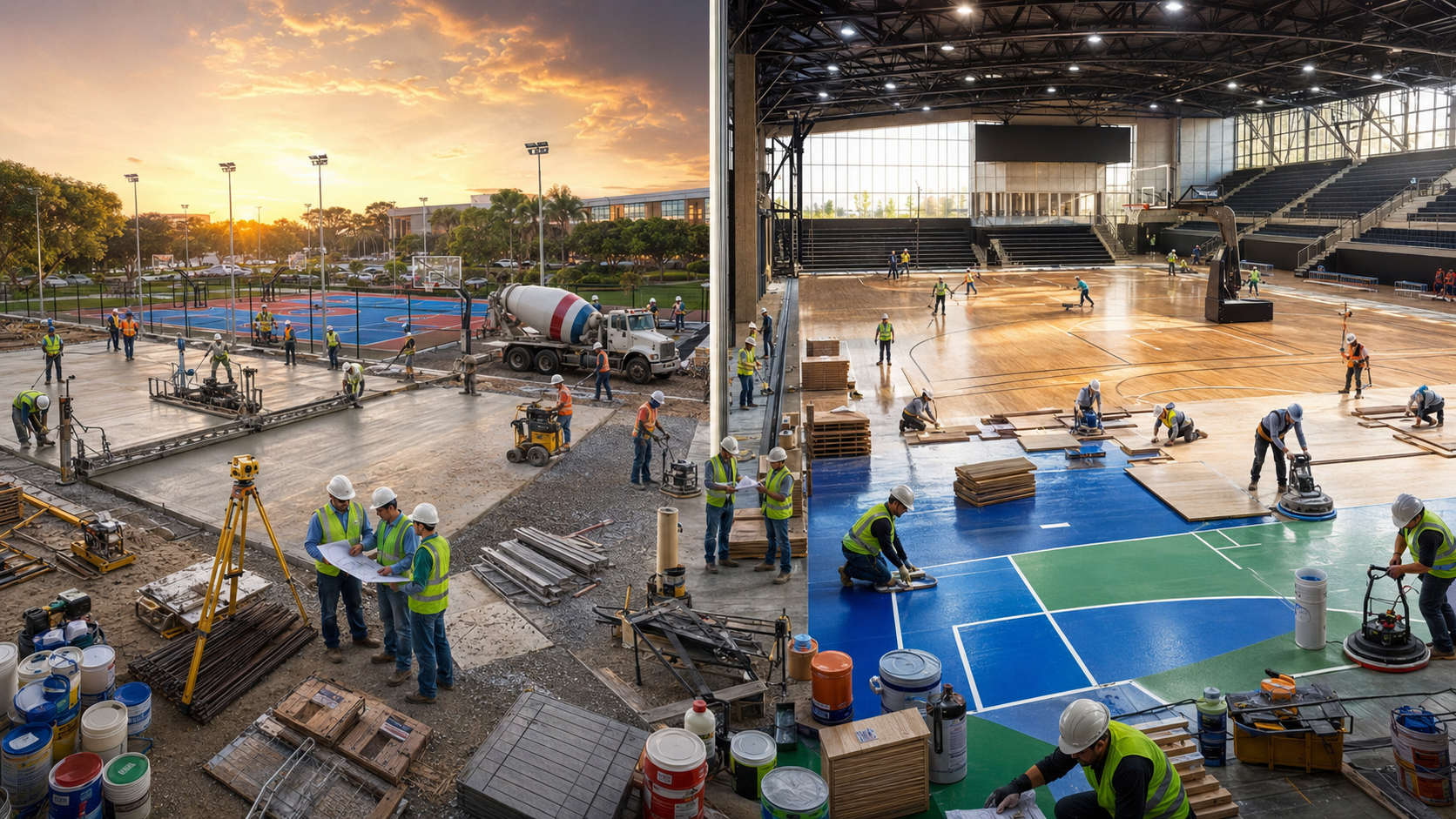
Step-by-Step Court Construction Process,
A high-performance basketball court is the result of careful planning, precision engineering, quality materials, and professional execution. Every stage of construction contributes to the court’s durability, safety, appearance, and playing performance. Even the most advanced flooring system cannot compensate for poor foundation work or improper installation practices.
This section explains the complete basketball court construction process, from site preparation to final handover, while highlighting the essential components that transform a vacant space into a world-class sports facility.
Step-by-Step
Professional basketball court construction follows a systematic sequence to ensure structural stability and long-term performance.
Site Assessment and Project Planning
The first phase involves evaluating the project site and understanding client requirements.
This stage includes:
- Site inspection
- Soil testing
- Topographical survey
- Drainage analysis
- Utility identification
- Budget assessment
- Design planning
- Material selection
- Construction scheduling
A detailed feasibility study helps identify potential challenges before construction begins.
Site Clearing and Preparation
The construction area must be cleared before foundation work begins.
Activities include:
- Removing vegetation
- Eliminating debris
- Demolishing existing structures if necessary
- Clearing rocks and obstacles
- Establishing construction boundaries
Proper site preparation creates a clean working environment and ensures accurate layout execution.
Excavation and Earthwork
Excavation is carried out according to engineering specifications and soil conditions.
The depth of excavation depends on:
- Soil bearing capacity
- Groundwater conditions
- Court type
- Structural design requirements
The objective is to create a stable foundation capable of supporting the court system for many years.
Subgrade Preparation
The subgrade forms the lowest structural layer beneath the basketball court.
Proper subgrade preparation involves:
- Soil stabilization
- Moisture conditioning
- Mechanical compaction
- Surface grading
- Density testing
A poorly compacted subgrade can lead to settlement, cracks, and uneven playing surfaces.
Granular Sub-Base Installation
A granular sub-base layer improves drainage and distributes loads evenly.
Common materials include:
- Crushed stone
- Aggregates
- Granular fill materials
Benefits include:
- Enhanced stability
- Improved drainage
- Reduced settlement risk
- Better load distribution
Each layer is compacted thoroughly to achieve the required density.
Drainage System Installation
Drainage is one of the most important components of outdoor basketball court construction.
An effective drainage system prevents:
- Water accumulation
- Surface deterioration
- Structural damage
- Mold and algae growth
Drainage solutions may include:
- Perimeter drains
- Channel drains
- Surface slope systems
- Underground drainage networks
Professional drainage design significantly extends court lifespan.
Concrete or Asphalt Base Construction
The structural base provides the platform for the sports flooring system.
Reinforced Concrete Base
Concrete is widely used because of its:
- Strength
- Durability
- Stability
- Long lifespan
Concrete slabs are reinforced to reduce cracking and improve structural integrity.
Advantages
- Exceptional durability
- Smooth finish
- High load-bearing capacity
- Suitable for various flooring systems
Asphalt Base
Asphalt bases are commonly used for outdoor courts.
Benefits include:
- Faster installation
- Cost efficiency
- Good drainage characteristics
- Smooth surface quality
The choice between concrete and asphalt depends on budget, location, climate, and project objectives.
Precision Leveling
Surface flatness is critical for basketball performance.
Professional contractors use:
- Laser leveling systems
- Digital measuring equipment
- Surveying instruments
Precision leveling ensures:
- Uniform ball bounce
- Proper water runoff
- Consistent playing conditions
- Accurate line marking
Even minor deviations can negatively impact gameplay.
Concrete Curing
Concrete requires adequate curing time before flooring installation begins.
Proper curing:
- Increases strength
- Reduces shrinkage cracks
- Improves durability
- Enhances long-term stability
Insufficient curing often leads to future surface failures and flooring problems.
Surface Grinding and Preparation
Before installing sports flooring, the base surface must be prepared carefully.
Preparation activities include:
- Grinding high spots
- Filling voids
- Crack repair
- Surface cleaning
- Moisture testing
A clean and level substrate ensures proper adhesion and long-lasting flooring performance.
Sports Flooring Installation
Once the base is ready, the selected sports flooring system is installed.
Depending on project specifications, this may include:
- Acrylic sports flooring
- Polyurethane flooring
- Wooden sports flooring
- Modular sports tiles
- Cushioned sports systems
Each system requires specialized installation techniques and quality control procedures.
Acrylic Court Installation Process
Typical acrylic flooring installation includes:
- Surface cleaning
- Primer application
- Acrylic resurfacer layers
- Cushion layers (if specified)
- Color coating application
- Texture coating installation
- Line marking
- Final inspection
The result is a durable and weather-resistant playing surface.
Polyurethane Flooring Installation
PU flooring systems generally involve:
- Primer application
- Elastic layer installation
- Cushion layer placement
- PU coating application
- Surface finishing
- Court marking
The seamless finish provides excellent comfort and professional performance.
Wooden Basketball Court Installation
Wooden flooring installation includes:
- Moisture barrier placement
- Subfloor construction
- Shock absorption system installation
- Hardwood panel installation
- Sanding
- Finishing
- Court marking
Precision installation is essential to maintain dimensional stability and performance.
Basketball Court Marking
Accurate line marking is crucial for both training and competitive play.
Court markings typically include:
- Boundary lines
- Center line
- Center circle
- Free throw lanes
- Three-point arc
- Restricted area
- Team bench zones
Professional marking systems use durable, high-visibility sports coatings.
Basketball Pole and Hoop Installation
Basketball equipment must be installed according to international standards.
Components include:
- Goal posts
- Backboards
- Hoops
- Nets
- Padding systems
The basketball rim height is typically maintained at 3.05 meters (10 feet).
Proper anchoring ensures safety and long-term stability.
Types of Basketball Goal Systems
Fixed Basketball Systems
Suitable for:
- Schools
- Parks
- Community courts
- Sports academies
Benefits:
- High durability
- Low maintenance
- Strong structural stability
Adjustable Basketball Systems
Ideal for:
- Training facilities
- Multi-age sports programs
- Educational institutions
Benefits:
- Adjustable rim height
- Versatile use
- Skill development support
Portable Basketball Systems
Often used in:
- Temporary venues
- Event spaces
- Multipurpose facilities
Benefits:
- Mobility
- Flexibility
- Easy relocation
Basketball Backboards
Backboards are available in several materials.
Tempered Glass
Preferred for professional facilities because of:
- Superior rebound performance
- Professional appearance
- Excellent durability
Acrylic
Offers:
- Cost-effectiveness
- Impact resistance
- Good visibility
Polycarbonate
Provides:
- High strength
- Vandal resistance
- Recreational suitability
Basketball Court Fencing Installation
Fencing enhances safety and protects surrounding areas.
Functions include:
- Ball containment
- Player safety
- Property protection
- Controlled access
Common fencing options include:
- Chain-link fencing
- Welded mesh fencing
- Powder-coated steel fencing
Fence heights vary according to facility requirements.
Lighting Installation for Basketball Courts
Proper lighting is essential for player safety, visibility, and performance.
Modern basketball facilities use energy-efficient LED lighting systems.
Benefits include:
- Uniform illumination
- Reduced glare
- Lower energy consumption
- Longer lifespan
- Improved visibility
Key Lighting Design Considerations
Professional lighting design focuses on:
- Lux levels
- Pole placement
- Light uniformity
- Glare control
- Energy efficiency
- Maintenance accessibility
Adequate lighting ensures safe and enjoyable gameplay during evening hours.
Spectator and Seating Areas
Competitive basketball facilities often include spectator zones.
Design considerations include:
- Clear viewing angles
- Safety barriers
- Comfortable seating
- Accessibility compliance
- Emergency exits
A well-designed spectator area enhances the overall sports experience.
Additional Court Accessories
Professional basketball courts may include:
- Scoreboards
- Shot clocks
- Team benches
- Referee stands
- Protective wall padding
- Storage systems
- Drinking water stations
- Public announcement systems
These features improve functionality and tournament readiness.
Quality Control and Inspection
Before project completion, comprehensive inspections are conducted.
Quality checks include:
- Surface flatness
- Drainage performance
- Equipment alignment
- Flooring adhesion
- Court dimensions
- Lighting levels
- Marking accuracy
- Safety compliance
Detailed inspections ensure that every component meets project specifications.
Common Construction Mistakes to Avoid
Many basketball court failures result from avoidable mistakes.
Common issues include:
- Poor soil preparation
- Inadequate drainage
- Improper compaction
- Low-quality materials
- Incorrect slope design
- Inaccurate court dimensions
- Weak equipment anchoring
- Insufficient curing time
Hiring experienced basketball court contractors helps eliminate these risks.
Basketball Court Construction Timeline
Project duration depends on:
- Court size
- Flooring type
- Weather conditions
- Site complexity
- Material availability
Typical timelines include:
| Activity | Estimated Duration |
|---|---|
| Site Survey & Design | 3–7 Days |
| Excavation & Earthwork | 5–10 Days |
| Sub-Base Construction | 5–8 Days |
| Concrete/Asphalt Base | 7–14 Days |
| Curing Period | 14–28 Days |
| Flooring Installation | 5–12 Days |
| Equipment Installation | 2–5 Days |
| Final Inspection | 1–2 Days |
Total project duration generally ranges from 6 to 10 weeks depending on project scope.
Basketball Court Maintenance Best Practices
Routine maintenance protects your investment and ensures long-term performance.
Daily Maintenance
- Remove dust and debris
- Check for standing water
- Inspect equipment
Weekly Maintenance
- Surface cleaning
- Drainage inspection
- Fence inspection
Monthly Maintenance
- Equipment tightening
- Surface damage inspection
- Line marking assessment
Annual Maintenance
- Professional inspection
- Surface repair
- Recoating if necessary
- Structural evaluation
Regular maintenance significantly increases court lifespan while maintaining safety and performance standards.
Benefits of Hiring Professional Basketball Court Contractors
Experienced basketball court builders provide:
- Expert project management
- International-standard construction
- Advanced installation technology
- Quality material sourcing
- Faster project completion
- Warranty support
- Long-term maintenance guidance
Professional execution minimizes risks and ensures a durable, high-performance sports facility.