


Introduction
Basketball is gaining popularity across India, and Ranchi is steadily developing its sports infrastructure to support this growing interest. Schools, colleges, sports academies, residential societies, private clubs, and government institutions are increasingly investing in well-designed basketball courts to encourage physical fitness, recreational activities, and professional sports training.
However, successful basketball court construction in Ranchi involves much more than preparing a flat surface and installing basketball hoops. A durable, safe, and high-performing court requires proper site assessment, foundation preparation, suitable flooring materials, accurate court markings, effective drainage, and professional installation. Each of these elements contributes to the court’s playing quality, safety, and long-term performance.
Whether you are planning an outdoor basketball court for a school or a professional indoor facility for a sports academy, understanding the construction process, flooring options, dimensions, estimated costs, and maintenance requirements will help you make informed decisions.
In this guide, we explain the essential aspects of building a basketball court in Ranchi, from selecting the right surface to understanding the overall construction process and investment.
Why Invest in Basketball Court Construction in Ranchi?
The demand for organized sports facilities is creating opportunities for basketball court development throughout Ranchi. A professionally constructed court can serve different age groups, skill levels, and sporting requirements.
- Growing demand for sports infrastructure: Schools, colleges, sports academies, and community facilities can use basketball courts to encourage participation and develop athletic skills.
- Year-round sporting activities: Appropriate outdoor synthetic flooring and effective drainage help courts withstand changing weather conditions, including Ranchi’s monsoon season.
- Health and fitness benefits: Basketball improves cardiovascular endurance, coordination, agility, balance, and teamwork, making it an excellent activity for students and fitness enthusiasts.
- Professional training opportunities: Sports academies and clubs benefit from properly marked courts and quality playing surfaces that support regular practice and competitive matches.
- Better use of available space: Depending on the site and budget, owners can develop a full-size court, a half-court, or a multipurpose recreational facility.
Types of Basketball Courts in Ranchi
Selecting the right basketball court surface is one of the most important decisions during construction. The ideal option depends on whether the court will be installed indoors or outdoors, how frequently it will be used, and the available budget.
1. Concrete Basketball Courts
Concrete is commonly used as a structural base for outdoor basketball courts. It provides a firm foundation for synthetic sports flooring when properly designed and constructed.
Advantages:
- Strong and suitable for outdoor installations.
- Relatively straightforward to maintain as a base material.
- Can support acrylic sports coatings when the surface is properly prepared.
Considerations: Bare concrete is extremely hard underfoot and may develop cracks because of ground movement, inadequate curing, or poor construction. For better playing comfort and surface consistency, a suitable sports coating can be installed over a properly prepared concrete base.
2. Acrylic Basketball Court Flooring
Acrylic sports flooring is a practical choice for many outdoor basketball courts in Ranchi. It is generally installed over a suitable concrete or asphalt base using a system of compatible primers, resurfacing materials, and textured coatings.
Key benefits include:
- Good traction when the system is correctly specified.
- Resistance to outdoor exposure when suitable products are used.
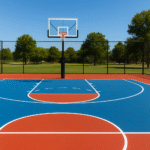
- Customizable playing colours and professional court markings.
- Relatively simple routine cleaning and maintenance.
Acrylic flooring is particularly suitable for schools, residential communities, colleges, and outdoor sports facilities. However, its performance depends on base quality, installation conditions, drainage, and the specific coating system selected.
3. Polyurethane and Rubberized Sports Flooring
Polyurethane and rubberized systems may be suitable where additional surface comfort, impact absorption, or specialized performance characteristics are required.
Their suitability depends on the product specification, installation method, intended use, and exposure to weather. Not every polyurethane or rubber flooring system is designed for outdoor basketball courts, so the material should be selected according to the project’s requirements.
4. Wooden Basketball Court Flooring
Wooden flooring is commonly associated with indoor basketball courts, sports halls, and competitive training facilities. Properly designed sports timber flooring can provide consistent ball response and a more comfortable playing experience than a hard, unprotected surface.
Advantages:
- Suitable for indoor training and competitive basketball.
- Can provide consistent ball bounce and playing characteristics.
- Offers a professional appearance for sports arenas and academies.
Considerations: Wooden sports floors require a controlled indoor environment, appropriate subfloor construction, and regular maintenance. They are generally not recommended for direct exposure to rain and outdoor weather.
Standard Basketball Court Dimensions
Court dimensions should be finalized before construction begins. For a regulation full-size basketball court, the International Basketball Federation (FIBA) specifies a playing area measuring 28 metres long and 15 metres wide, measured from the inside edges of the boundary lines.
Important planning measurements include:
- Full-size playing area: 28 m × 15 m.
- Three-point line: The FIBA three-point arc has a radius of 6.75 m from the specified point on the floor, with straight side segments positioned according to the official rules.
- Free-throw line: Positioned 5.80 m from the endline, measured to its outside edge, under FIBA specifications.
- Basket height: 3.05 m above the playing floor.
- Run-off and safety space: Additional clearance is required around the playing area for safe movement, access, and equipment placement.
A half-court can be designed for recreational play, training, and space-constrained sites. Its final dimensions and markings should reflect the intended format rather than assuming that every half-court is simply a reduced regulation court.
For schools and recreational facilities, the design may be adapted to the available site. However, projects intended for official competition should follow the applicable federation requirements and confirm the latest specifications before construction.
Step-by-Step Basketball Court Construction in Ranchi
A systematic construction process helps reduce installation errors, prevent premature surface deterioration, and improve the overall playing experience.
Step 1: Site Inspection and Planning
The first step is to assess the proposed location, ground conditions, available space, access routes, and intended usage.
For outdoor courts in Ranchi, particular attention should be given to rainwater management and the surrounding ground levels. The site should provide sufficient space for the playing area, safety clearances, fencing, lighting, and maintenance access.
At this stage, the contractor should also establish the project budget, court dimensions, flooring requirements, and equipment specifications.
Step 2: Ground Preparation and Foundation Work
A stable foundation is essential for long-term court performance. Depending on the site conditions, construction may involve excavation, soil compaction, sub-base preparation, and the installation of a suitable concrete or asphalt base.
The foundation should be designed according to soil conditions, anticipated loads, and the selected flooring system. Proper curing and surface preparation are equally important before the sports flooring is installed.
Poorly prepared foundations can lead to cracks, uneven surfaces, and premature coating failure.
Step 3: Drainage and Surface-Level Planning
Ranchi experiences seasonal rainfall, making drainage a critical consideration for outdoor basketball court construction.
The design should prevent water from collecting on the playing surface or around the foundation. Appropriate gradients, drainage channels, and site grading should be incorporated according to the engineering design and manufacturer’s requirements.
Drainage should be planned before the final surface is installed rather than treated as an additional feature after construction.
Step 4: Sports Flooring Installation
Once the base is ready and meets the required conditions, the selected flooring system can be installed.
For acrylic courts, the process may include cleaning, crack repairs, compatible priming, resurfacing, and the application of textured sports coatings. The exact sequence depends on the specified product system.
Indoor wooden courts require a different construction approach involving the appropriate subfloor, sports flooring assembly, timber surface, and protective finish.
All installation work should follow the manufacturer’s instructions, including requirements for temperature, moisture, curing, and application conditions.
Step 5: Court Markings and Colour Finishing
Accurate line markings are essential for organized basketball games. The markings should be measured carefully and applied using compatible, durable paint.
The court can be finished in contrasting colours to distinguish the playing area and surrounding zones. Schools, academies, and clubs may also incorporate branding or logos where appropriate, provided these do not interfere with official playing markings.
Step 6: Basketball Equipment Installation
The final stage involves installing basketball hoops, backboards, support structures, and other accessories.
Depending on the facility’s needs, additional features may include perimeter fencing, floodlights, seating, player benches, and scoreboards.
Basketball posts and foundations must be properly designed and installed to provide stability and reduce the risk of injury. Outdoor lighting should be positioned to minimize glare and provide suitable visibility across the playing surface.
Before the court is handed over, the contractor should inspect the surface, drainage, markings, equipment stability, and overall site safety.
Cost of Basketball Court Construction in Ranchi
The total investment for a basketball court in Ranchi depends on its size, site conditions, foundation requirements, flooring system, equipment, and finishing specifications.
Indicative planning estimates for flooring materials and complete construction should be treated separately because they cover different items.
| Construction component | Indicative cost |
|---|---|
| Acrylic sports flooring | ₹70–₹90 per sq. ft. |
| Rubber or PVC sports flooring | ₹90–₹120 per sq. ft. |
| Indoor wooden sports flooring | ₹250–₹350 per sq. ft. |
| Complete outdoor basketball court | ₹8–₹15 lakh or more |
These figures are preliminary budgeting references, not verified current quotations for Ranchi. Actual prices may differ depending on the material specification, thickness, subfloor condition, civil work, equipment quality, transportation, taxes, and contractor scope. Flooring-only rates should not be assumed to include the foundation, drainage, hoops, fencing, or lighting.
A full outdoor court measuring 28 m × 15 m has a playing-area footprint of approximately 4,521 square feet. Additional space may be needed for safety clearances and access, so the total constructed area can be larger.
Before approving a budget, request an itemized quotation covering site preparation, foundation, drainage, flooring, line markings, equipment, installation, and applicable taxes. Comparing quotations on the same scope of work makes it easier to assess overall value and avoid unexpected expenses.
Maintenance Tips for Long-Lasting Performance
Regular maintenance helps protect the investment and preserve the court’s playing characteristics.
- Clean the surface regularly: Remove dust, leaves, and debris to maintain traction and prevent surface contamination.
- Inspect for cracks and damage: Check the base and flooring periodically, particularly after the monsoon season.
- Keep drainage systems clear: Remove debris from drainage channels and ensure rainwater can flow away from the court.
- Repair surface damage promptly: Address peeling coatings, cracks, and uneven areas before the damage spreads.
- Inspect basketball equipment: Check the stability of support structures, backboards, rims, and fixings.
- Schedule professional resurfacing: Acrylic surfaces may require periodic recoating depending on usage, weather exposure, and product quality.
- Maintain indoor wooden flooring correctly: Use appropriate cleaning products and follow the flooring manufacturer’s recommendations for refinishing and protective treatments.
The resurfacing interval should be determined by the actual condition of the court rather than relying on a fixed number of years.
Common Challenges in Basketball Court Construction in Ranchi
Weather and Monsoon Conditions
Heavy seasonal rainfall can expose weaknesses in drainage and foundation design. Selecting an appropriate outdoor flooring system and providing effective water management are essential for reliable performance.
Foundation Quality
Uneven ground, insufficient compaction, and poorly designed concrete bases can cause cracking and surface deterioration. A site-specific foundation design helps reduce these risks.
Choosing the Wrong Flooring
A material suitable for an indoor stadium may not be appropriate for an exposed outdoor court. Flooring should be selected according to the installation environment, expected usage, maintenance capacity, and playing requirements.
Budget Planning
Focusing only on the initial flooring price can lead to unexpected expenses during construction. A realistic budget should include civil work, drainage, equipment, finishing, and future maintenance.
Contractor Experience
Sports flooring requires more than general construction expertise. Choose a contractor with relevant project experience, clearly defined material specifications, suitable installation procedures, and a documented scope of work.
How to Choose the Right Basketball Court Construction Company in Ranchi
Selecting a reliable contractor is important for achieving the desired quality and durability.
Before finalizing a company, consider the following factors:
- Relevant experience: Review completed basketball court projects and ask for references where possible.
- Material specifications: Confirm the proposed flooring system, product details, and suitability for indoor or outdoor installation.
- Construction methodology: Ask how the foundation, drainage, surface preparation, and finishing will be handled.
- Transparent pricing: Request a detailed quotation that identifies included and excluded items.
- Quality assurance: Clarify the inspection process, workmanship warranty, and material warranty.
- After-installation support: Confirm whether maintenance guidance, repairs, and resurfacing services are available.
A contractor who explains the technical requirements clearly can help you make better decisions throughout the project.
Conclusion
Basketball court construction in Ranchi offers schools, colleges, sports academies, residential communities, and private clubs an opportunity to develop better sporting facilities. However, a successful project depends on careful planning, a strong foundation, effective drainage, suitable sports flooring, accurate markings, and reliable equipment.
Acrylic flooring is often a practical option for outdoor courts, while professionally designed wooden flooring can be appropriate for indoor sports facilities. The right choice depends on the intended use, site conditions, budget, and long-term maintenance requirements.
If you are planning basketball court construction in Ranchi, consult an experienced sports infrastructure provider such as Sports-Facility.in to discuss your site requirements, flooring options, construction scope, and budget. A well-planned court can deliver a safe, functional, and enjoyable playing environment for years to come.